QUESTION IMAGE
Question
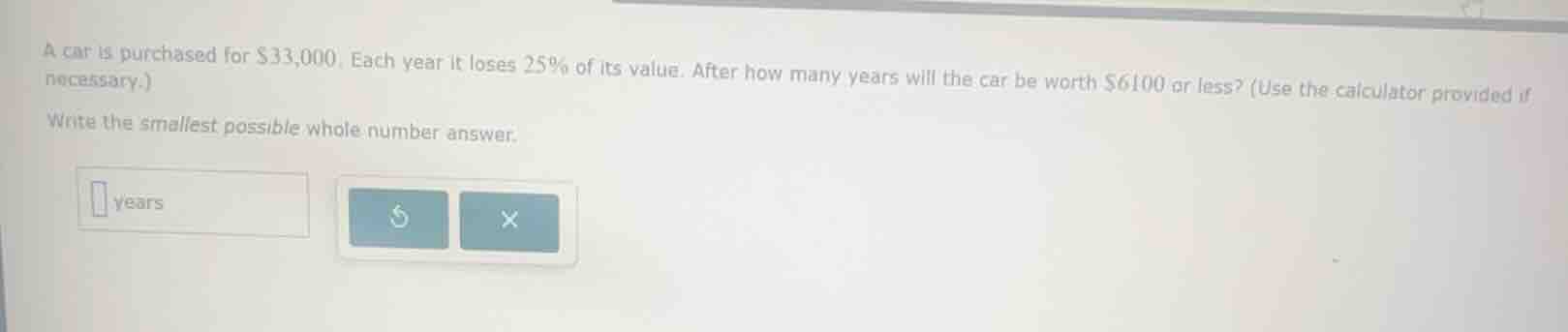
a car is purchased for $33,000. each year it loses 25% of its value. after how many years will the car be worth $6100 or less? (use the calculator provided if necessary.)
write the smallest possible whole number answer.
years
Step1: Define the depreciation formula
The value of the car after \( n \) years follows an exponential decay model. The formula for the value \( V \) of the car after \( n \) years is \( V = P(1 - r)^n \), where \( P \) is the initial price, \( r \) is the annual depreciation rate, and \( n \) is the number of years. Here, \( P = 33000 \), \( r = 0.25 \) (since 25% = 0.25), so the formula becomes \( V = 33000(0.75)^n \).
Step2: Set up the inequality
We want to find \( n \) such that \( 33000(0.75)^n \leq 6100 \). First, divide both sides by 33000:
\[
(0.75)^n \leq \frac{6100}{33000}
\]
Simplify the right - hand side: \( \frac{6100}{33000}\approx0.1848 \)
Step3: Solve for \( n \) using logarithms
Take the natural logarithm of both sides: \( \ln((0.75)^n)\leq\ln(0.1848) \)
Using the logarithm power rule \( \ln(a^b)=b\ln(a) \), we get \( n\ln(0.75)\leq\ln(0.1848) \)
Since \( \ln(0.75)<0 \) (because \( 0.75 < 1 \)), when we divide both sides by \( \ln(0.75) \), the inequality sign will flip. So:
\[
n\geq\frac{\ln(0.1848)}{\ln(0.75)}
\]
Calculate \( \frac{\ln(0.1848)}{\ln(0.75)}\approx\frac{- 1.687}{-0.2877}\approx5.86 \)
Since \( n \) must be a whole number, and we need the smallest whole number such that the inequality holds, we round up to the next whole number.

Snap & solve any problem in the app
Get step-by-step solutions on Sovi AI
Photo-based solutions with guided steps
Explore more problems and detailed explanations
6