QUESTION IMAGE
Question
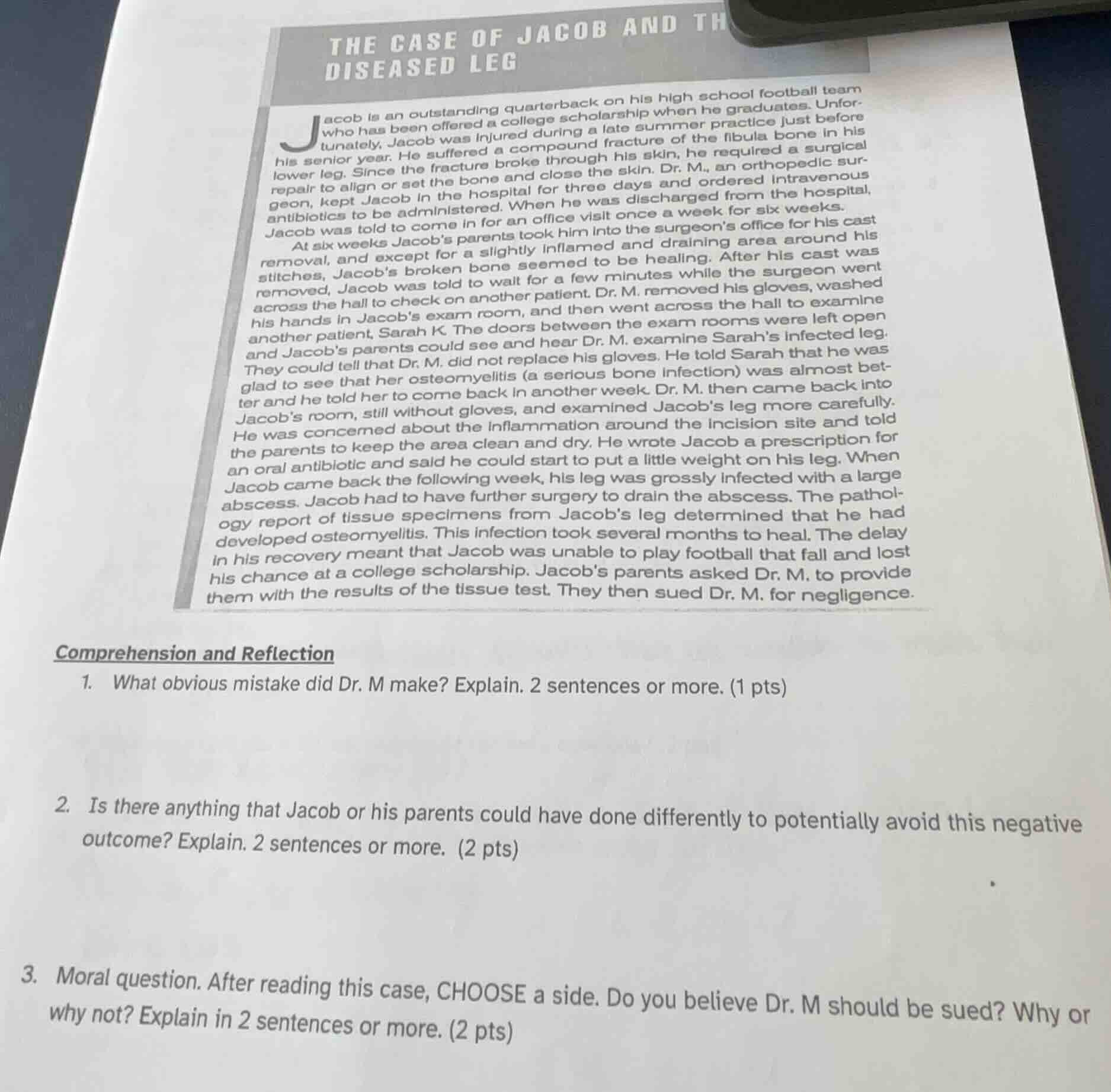
the case of jacob and th diseased leg jacob is an outstanding quarterback on his high school football team who has been offered a college scholarship when he graduates. unfor- tunately, jacob was injured during a late summer practice just before his senior year. he suffered a compound fracture of the fibula bone in his lower leg. since the fracture broke through his skin, he required a surgical repair to align or set the bone and close the skin. dr. m., an orthopedic sur- geon, kept jacob in the hospital for three days and ordered intravenous antibiotics to be administered. when he was discharged from the hospital, jacob was told to come in for an office visit once a week for six weeks. at six weeks jacobs parents took him into the surgeons office for his cast removal, and except for a slightly inflamed and draining area around his stitches, jacobs broken bone seemed to be healing. after his cast was removed, jacob was told to wait for a few minutes while the surgeon went across the hall to check on another patient. dr. m. removed his gloves, washed his hands in jacobs exam room, and then went across the hall to examine another patient, sarah k. the doors between the exam rooms were left open and jacobs parents could see and hear dr. m. examine sarahs infected leg. they could tell that dr. m. did not replace his gloves. he told sarah that he was glad to see that her osteomyelitis (a serious bone infection) was almost bet- ter and he told her to come back in another week. dr. m. then came back into jacobs room, still without gloves, and examined jacobs leg more carefully. he was concerned about the inflammation around the incision site and told the parents to keep the area clean and dry. he wrote jacob a prescription for an oral antibiotic and said he could start to put a little weight on his leg. when jacob came back the following week, his leg was grossly infected with a large abscess. jacob had to have further surgery to drain the abscess. the pathol- ogy report of tissue specimens from jacobs leg determined that he had developed osteomyelitis. this infection took several months to heal. the delay in his recovery meant that jacob was unable to play football that fall and lost his chance at a college scholarship. jacobs parents asked dr. m. to provide them with the results of the tissue test. they then sued dr. m. for negligence. comprehension and reflection 1. what obvious mistake did dr. m make? explain. 2 sentences or more. (1 pts) 2. is there anything that jacob or his parents could have done differently to potentially avoid this negative outcome? explain. 2 sentences or more. (2 pts) 3. moral question. after reading this case, choose a side. do you believe dr. m should be sued? why or why not? explain in 2 sentences or more. (2 pts)
Question 1
Dr. M made the mistake of not replacing his gloves after examining another patient (Sarah) with an infected leg before examining Jacob. This violated infection control protocols, as he could have transferred Sarah's infectious bacteria to Jacob's surgical site, leading to Jacob's subsequent osteomyelitis.
Jacob or his parents could have advocated for proper infection control by reminding Dr. M to change gloves or wash hands before re - examining Jacob. Additionally, they could have closely monitored the surgical site for signs of infection and sought a second opinion if they were concerned about the initial care, which might have led to earlier intervention.
Dr. M should be sued. His negligence in not following basic infection control procedures (not changing gloves) directly led to Jacob's severe infection, prolonged recovery, and loss of a college scholarship. Medical professionals have a duty of care, and his breach of this duty caused significant harm to Jacob.

Snap & solve any problem in the app
Get step-by-step solutions on Sovi AI
Photo-based solutions with guided steps
Explore more problems and detailed explanations
Dr. M's obvious mistake was failing to replace his gloves after examining Sarah (a patient with an infected leg) before examining Jacob. This breach of infection control likely transferred infectious agents to Jacob's leg, causing his osteomyelitis.