QUESTION IMAGE
Question
cellular reproduction
cellular reproduction
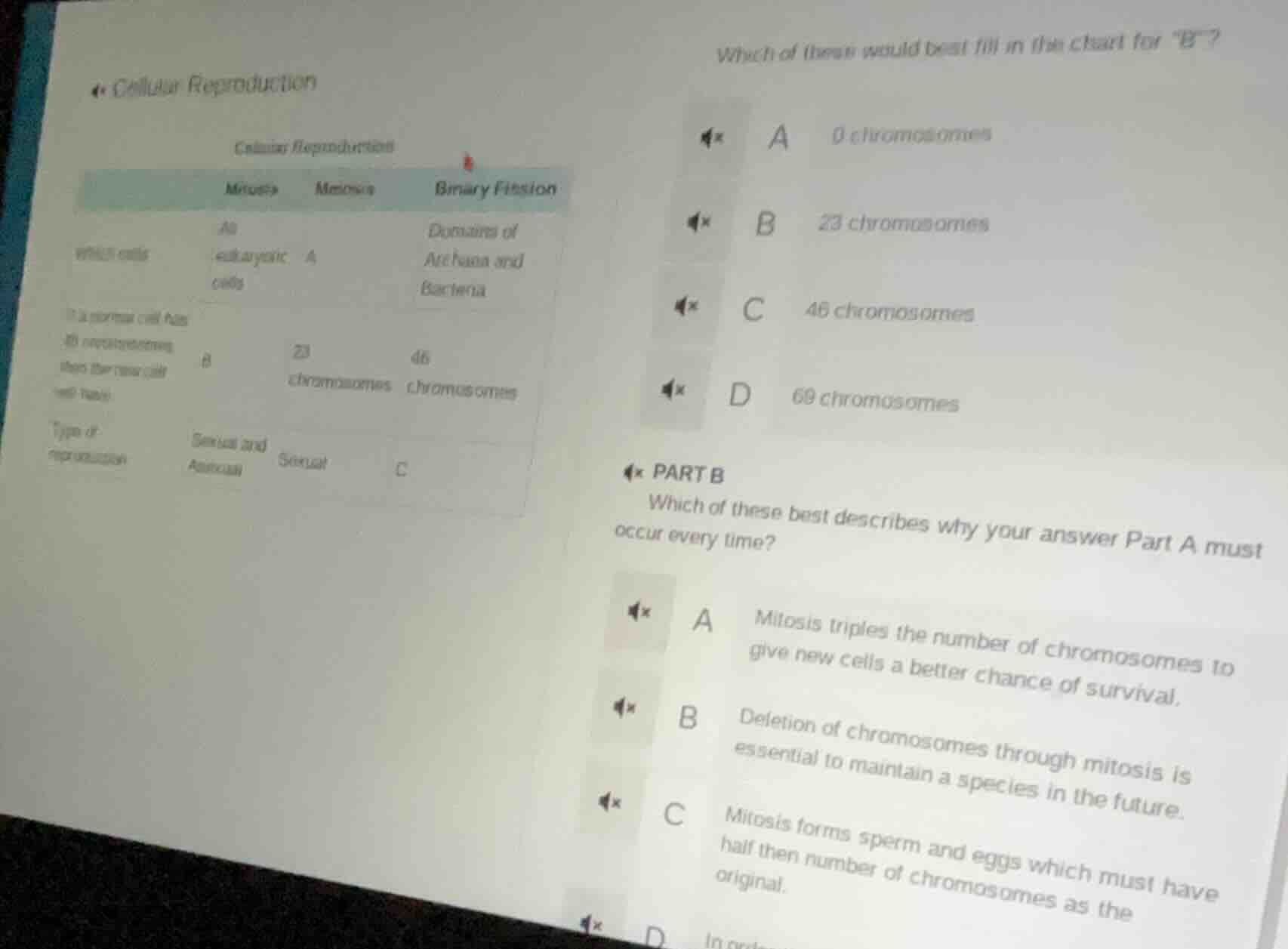
mitosis\tmeiosis\tbinary fission
which cells\tall eukaryotic cells\ta\tdomains of archaea and bacteria
if a normal cell has 46 chromosomes, then the new cell will have\tb\t23 chromosomes\t46 chromosomes
type of reproduction\tasexual and asexual\tsexual\tc
which of these would best fill in the chart for \b\?
a\t46 chromosomes
b\t23 chromosomes
c\t46 chromosomes
d\t69 chromosomes
part b
which of these best describes why your answer part a must occur every time?
a\tmitosis triples the number of chromosomes to give new cells a better chance of survival.
b\tdeletion of chromosomes through mitosis is essential to maintain a species in the future.
c\tmitosis forms sperm and eggs which must have half then number of chromosomes as the original.
d\ttext cut off
Part A
In mitosis (somatic cell division), the daughter cells have the same number of chromosomes as the parent cell. Human somatic cells have 46 chromosomes, so mitosis (for eukaryotic cells) results in daughter cells with 46 chromosomes. Option C is 46 chromosomes, which fits the "B" (mitosis chromosome number) in the chart. Option A is unclear, B is 23 (meiosis result), D is incorrect.
Mitosis is for growth, repair, etc., and produces daughter cells identical to the parent (same chromosome number). Option D (likely stating "In order to maintain the correct number of chromosomes in daughter cells, mitosis replicates and divides chromosomes equally") would be correct. Other options: A is wrong (mitosis doesn't triple), B is wrong (deletion not essential), C is meiosis (sperm/eggs), not mitosis.

Snap & solve any problem in the app
Get step-by-step solutions on Sovi AI
Photo-based solutions with guided steps
Explore more problems and detailed explanations
C. 46 chromosomes