QUESTION IMAGE
Question
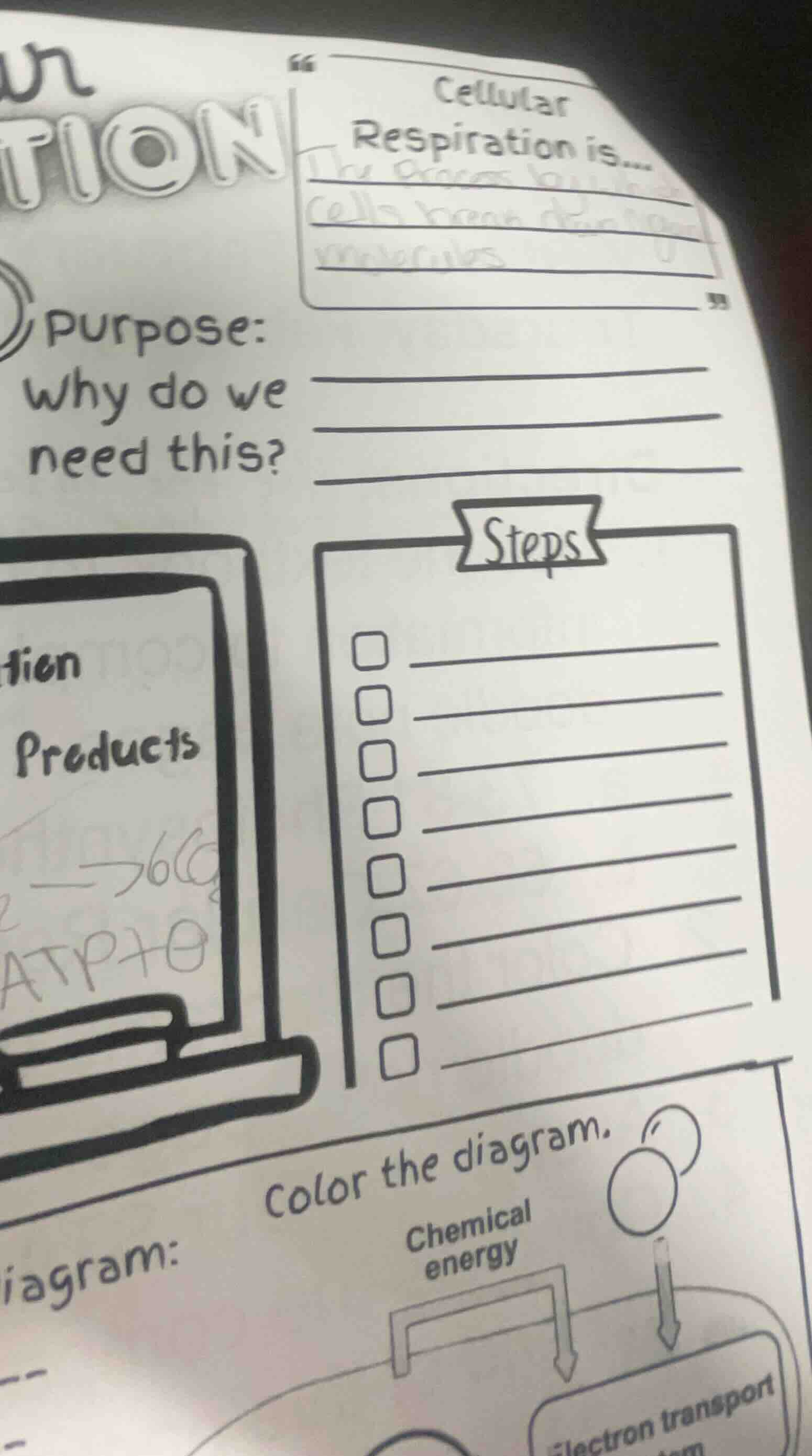
cellular respiration is... purpose: why do we need this? steps products color the diagram. chemical energy iagram: electron transport
To answer questions about cellular respiration (from the worksheet):
1. Definition of Cellular Respiration:
Cellular respiration is the process by which cells break down glucose (and other organic molecules) to release energy (in the form of ATP), carbon dioxide, and water. It occurs in the mitochondria (and cytoplasm for glycolysis) of cells, and can be aerobic (with oxygen) or anaerobic (without oxygen).
2. Purpose of Cellular Respiration:
We need cellular respiration to produce ATP (adenosine triphosphate), the cell’s main energy currency. ATP powers essential cellular activities like growth, movement, protein synthesis, and active transport. Without ATP, cells (and organisms) could not survive or function.
3. Steps of Cellular Respiration (Aerobic, most common in eukaryotes):
- Glycolysis: Occurs in the cytoplasm. Breaks down 1 glucose (6-carbon) into 2 pyruvate (3-carbon) molecules. Produces a small amount of ATP (2 net) and NADH (electron carrier).
- Pyruvate Oxidation: Pyruvate enters the mitochondria. Converted to acetyl-CoA, releasing CO₂ and producing NADH.
- Citric Acid Cycle (Krebs Cycle): In the mitochondrial matrix. Acetyl-CoA is broken down, producing CO₂, ATP (or GTP), NADH, and FADH₂ (another electron carrier).
- Electron Transport Chain (ETC) + Oxidative Phosphorylation: In the inner mitochondrial membrane. Electrons from NADH/FADH₂ are passed through proteins, creating a proton gradient. ATP synthase uses this gradient to make large amounts of ATP (≈26–34 per glucose). Oxygen acts as the final electron acceptor, combining with protons to form water.
4. Products of Cellular Respiration (Aerobic):
From 1 glucose molecule, the products are:
- ATP: ~30–38 total (varies by cell type).
- Carbon Dioxide (CO₂): Released during pyruvate oxidation and the citric acid cycle.
- Water (H₂O): Formed when oxygen accepts electrons and combines with protons at the end of the ETC.
If the worksheet asks for “Products” (seen in the image), list: ATP, CO₂, and H₂O. For “Steps,” list the four stages above (glycolysis, pyruvate oxidation, citric acid cycle, ETC/oxidative phosphorylation).
For the “Color the diagram” section (showing “Chemical energy” and “Electron transport”):
- The “Chemical energy” arrow likely represents glucose (or other fuel) entering the process.
- The “Electron transport” step is part of the ETC, where energy from electrons is used to make ATP. Color coding might involve:
- Mitochondria (double membrane) in a distinct color.
- Glycolysis (cytoplasm) in another.
- Arrows for electron flow (e.g., red for high-energy electrons) or ATP (green for energy).
Let me know if you need help with a specific part (e.g., filling in the worksheet blanks, explaining a step, or diagram coloring)!

Snap & solve any problem in the app
Get step-by-step solutions on Sovi AI
Photo-based solutions with guided steps
Explore more problems and detailed explanations
To answer questions about cellular respiration (from the worksheet):
1. Definition of Cellular Respiration:
Cellular respiration is the process by which cells break down glucose (and other organic molecules) to release energy (in the form of ATP), carbon dioxide, and water. It occurs in the mitochondria (and cytoplasm for glycolysis) of cells, and can be aerobic (with oxygen) or anaerobic (without oxygen).
2. Purpose of Cellular Respiration:
We need cellular respiration to produce ATP (adenosine triphosphate), the cell’s main energy currency. ATP powers essential cellular activities like growth, movement, protein synthesis, and active transport. Without ATP, cells (and organisms) could not survive or function.
3. Steps of Cellular Respiration (Aerobic, most common in eukaryotes):
- Glycolysis: Occurs in the cytoplasm. Breaks down 1 glucose (6-carbon) into 2 pyruvate (3-carbon) molecules. Produces a small amount of ATP (2 net) and NADH (electron carrier).
- Pyruvate Oxidation: Pyruvate enters the mitochondria. Converted to acetyl-CoA, releasing CO₂ and producing NADH.
- Citric Acid Cycle (Krebs Cycle): In the mitochondrial matrix. Acetyl-CoA is broken down, producing CO₂, ATP (or GTP), NADH, and FADH₂ (another electron carrier).
- Electron Transport Chain (ETC) + Oxidative Phosphorylation: In the inner mitochondrial membrane. Electrons from NADH/FADH₂ are passed through proteins, creating a proton gradient. ATP synthase uses this gradient to make large amounts of ATP (≈26–34 per glucose). Oxygen acts as the final electron acceptor, combining with protons to form water.
4. Products of Cellular Respiration (Aerobic):
From 1 glucose molecule, the products are:
- ATP: ~30–38 total (varies by cell type).
- Carbon Dioxide (CO₂): Released during pyruvate oxidation and the citric acid cycle.
- Water (H₂O): Formed when oxygen accepts electrons and combines with protons at the end of the ETC.
If the worksheet asks for “Products” (seen in the image), list: ATP, CO₂, and H₂O. For “Steps,” list the four stages above (glycolysis, pyruvate oxidation, citric acid cycle, ETC/oxidative phosphorylation).
For the “Color the diagram” section (showing “Chemical energy” and “Electron transport”):
- The “Chemical energy” arrow likely represents glucose (or other fuel) entering the process.
- The “Electron transport” step is part of the ETC, where energy from electrons is used to make ATP. Color coding might involve:
- Mitochondria (double membrane) in a distinct color.
- Glycolysis (cytoplasm) in another.
- Arrows for electron flow (e.g., red for high-energy electrons) or ATP (green for energy).
Let me know if you need help with a specific part (e.g., filling in the worksheet blanks, explaining a step, or diagram coloring)!