QUESTION IMAGE
Question
cftr mutations
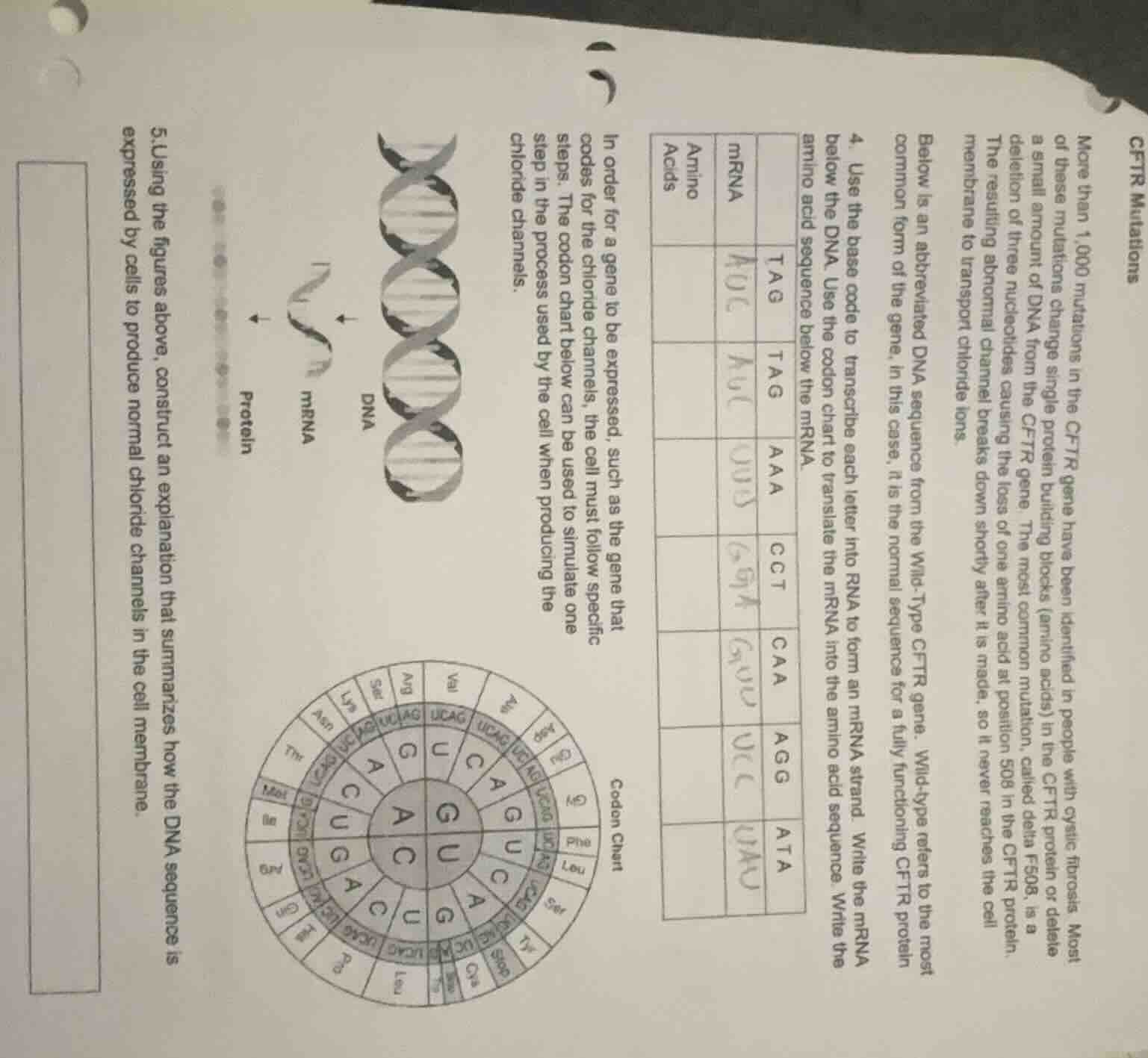
more than 1,000 mutations in the cftr gene have been identified in people with cystic fibrosis. most of these mutations change single protein building blocks (amino acids) in the cftr protein or delete a small amount of dna from the cftr gene. the most common mutation, called delta f508, is a deletion of three nucleotides causing the loss of one amino acid at position 508 in the cftr protein. the resulting abnormal channel breaks down shortly after it is made, so it never reaches the cell membrane to transport chloride ions.
below is an abbreviated dna sequence from the wild-type cftr gene. wild-type refers to the most common form of the gene, in this case, it is the normal sequence for a fully functioning cftr protein
- use the base code to transcribe each letter into rna to form an mrna strand. write the mrna amino acid sequence below the dna. use the codon chart to translate the mrna into the amino acid sequence. write the mrna amino acid sequence below the mrna.
| dna | tag | tag | aaa | cct | caa | agg | ata |
|---|---|---|---|---|---|---|---|
| amino acids |
in order for a gene to be expressed, such as the gene that codes for the chloride channels, the cell must follow specific steps. the codon chart below can be used to simulate one step in the process used by the cell when producing the chloride channels.
5.using the figures above, construct an explanation that summarizes how the dna sequence is expressed by cells to produce normal chloride channels in the cell membrane.
Step1: Transcribe DNA to mRNA
RNA uses uracil (U) instead of thymine (T). Complementary base pairing: A→U, T→A, C→G, G→C.
- DNA TAG → mRNA AUC
- DNA TAG → mRNA AUC
- DNA AAA → mRNA UUU
- DNA CCT → mRNA GGA
- DNA CAA → mRNA GUU
- DNA AGG → mRNA UCC
- DNA ATA → mRNA UAU
Step2: Translate mRNA to amino acids
Use the circular codon chart to match each mRNA codon to its amino acid:
- AUC → Isoleucine (Ile)
- AUC → Isoleucine (Ile)
- UUU → Phenylalanine (Phe)
- GGA → Glycine (Gly)
- GUU → Valine (Val)
- UCC → Serine (Ser)
- UAU → Tyrosine (Tyr)
Completed Table:
| DNA | mRNA | Amino Acids |
|---|---|---|
| TAG | AUC | Isoleucine (Ile) |
| AAA | UUU | Phenylalanine (Phe) |
| CCT | GGA | Glycine (Gly) |
| CAA | GUU | Valine (Val) |
| AGG | UCC | Serine (Ser) |
| ATA | UAU | Tyrosine (Tyr) |
---
To produce normal chloride channels:
- Transcription: The wild-type CFTR DNA sequence in the nucleus is transcribed into complementary mRNA (A→U, T→A, C→G, G→C).
- Translation: The mRNA moves to a ribosome, where the codons are matched to amino acids using the cell's codon chart, assembling the functional CFTR protein.
- Protein Localization: The properly folded CFTR protein is transported to the cell membrane, where it functions as a chloride channel to move chloride ions across the membrane.

Snap & solve any problem in the app
Get step-by-step solutions on Sovi AI
Photo-based solutions with guided steps
Explore more problems and detailed explanations
- The completed transcription/translation table is shown above.
- Normal chloride channel production: DNA transcription → mRNA translation into functional CFTR protein → protein transport to cell membrane to act as chloride channels.