QUESTION IMAGE
Question
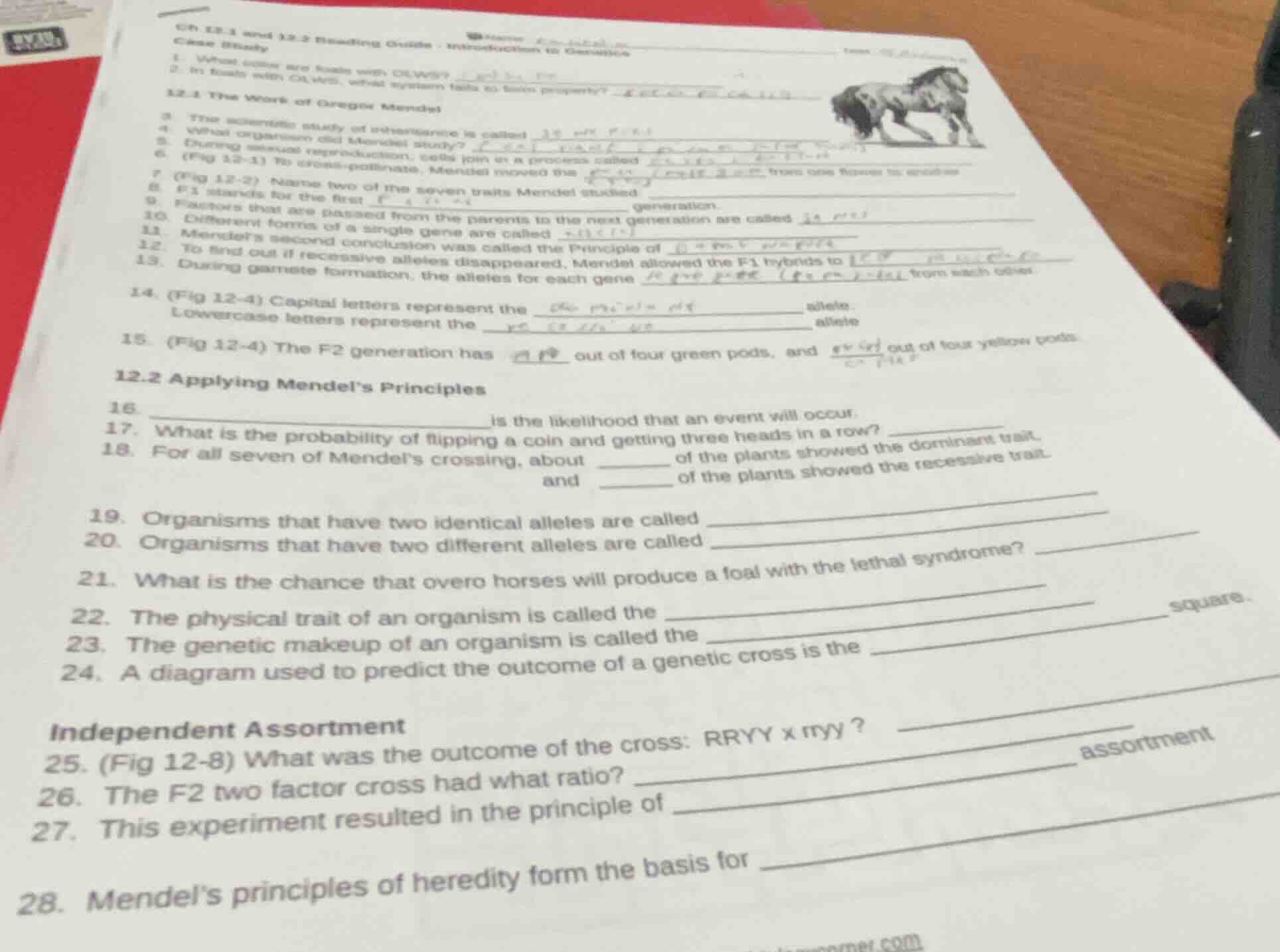
ch 12-1 and 12-2 reading guide : introduction to genetics
case study
- what color are foals with olws?
- in foals with olws, what system fails to form properly?
12.1 the work of gregor mendel
- the scientific study of inheritance is called
- what organism did mendel study?
- during sexual reproduction, cells join in a process called
- (fig 12-1) to cross-pollinate, mendel removed the from one flower to another
- (fig 12-2) name two of the seven traits mendel studied
- f1 stands for the first generation
- factors that are passed from the parents to the next generation are called
- different forms of a single gene are called
- mendel’s second conclusion was called the principle of
- to find out if recessive alleles disappeared, mendel allowed the f1 hybrids to
- during gamete formation, the alleles for each gene from each other
- (fig 12-4) capital letters represent the allele
lowercase letters represent the allele
- (fig 12-4) the f2 generation has out of four green pods, and out of four yellow pods
12.2 applying mendel’s principles
- is the likelihood that an event will occur
- what is the probability of flipping a coin and getting three heads in a row?
- for all seven of mendel’s crossing, about of the plants showed the dominant trait,
and of the plants showed the recessive trait
- organisms that have two identical alleles are called
- organisms that have two different alleles are called
- what is the chance that overo horses will produce a foal with the lethal syndrome?
- the physical trait of an organism is called the
- the genetic makeup of an organism is called the
- a diagram used to predict the outcome of a genetic cross is the square
independent assortment
- (fig 12-8) what was the outcome of the cross: rryy × rryy?
- the f2 two factor cross had what ratio?
- this experiment resulted in the principle of assortment
- mendel’s principles of heredity form the basis for
To solve question 17: "What is the probability of flipping a coin and getting three heads in a row?" we can use the following steps:
Step 1: Determine the probability of getting heads in a single coin flip
A fair coin has 2 possible outcomes: heads (H) or tails (T). The probability of getting heads in one flip is \( \frac{1}{2} \).
Step 2: Use the multiplication rule for independent events
Since each coin flip is an independent event (the outcome of one flip does not affect the outcome of another), we multiply the probabilities of each individual event. For three consecutive heads, we calculate:
\[
P(\text{three heads}) = P(\text{head}) \times P(\text{head}) \times P(\text{head})
\]
Substituting the probability of getting heads in one flip (\( \frac{1}{2} \)) into the formula:
\[
P(\text{three heads}) = \frac{1}{2} \times \frac{1}{2} \times \frac{1}{2}
\]
Step 3: Calculate the result
\[
\frac{1}{2} \times \frac{1}{2} \times \frac{1}{2} = \frac{1}{8}
\]
So the probability of flipping a coin and getting three heads in a row is \( \frac{1}{8} \).
For question 18: "For all seven of Mendel’s crossings, about ____ of the plants showed the dominant trait, and ____ of the plants showed the recessive trait."
From Mendel's experiments with pea plants, when he crossed purebred (homozygous) parents with contrasting traits (e.g., tall vs. short) and then allowed the F1 generation to self - pollinate (or cross - pollinate in a controlled way) to produce the F2 generation, he observed a consistent pattern. In the F2 generation, the ratio of dominant to recessive traits was approximately 3:1. This means that about \( \frac{3}{4} \) (or 75%) of the plants showed the dominant trait, and about \( \frac{1}{4} \) (or 25%) of the plants showed the recessive trait.
Final Answers
- \( \frac{1}{8} \)
- \( \frac{3}{4} \) (or 75%), \( \frac{1}{4} \) (or 25%)

Snap & solve any problem in the app
Get step-by-step solutions on Sovi AI
Photo-based solutions with guided steps
Explore more problems and detailed explanations
To solve question 17: "What is the probability of flipping a coin and getting three heads in a row?" we can use the following steps:
Step 1: Determine the probability of getting heads in a single coin flip
A fair coin has 2 possible outcomes: heads (H) or tails (T). The probability of getting heads in one flip is \( \frac{1}{2} \).
Step 2: Use the multiplication rule for independent events
Since each coin flip is an independent event (the outcome of one flip does not affect the outcome of another), we multiply the probabilities of each individual event. For three consecutive heads, we calculate:
\[
P(\text{three heads}) = P(\text{head}) \times P(\text{head}) \times P(\text{head})
\]
Substituting the probability of getting heads in one flip (\( \frac{1}{2} \)) into the formula:
\[
P(\text{three heads}) = \frac{1}{2} \times \frac{1}{2} \times \frac{1}{2}
\]
Step 3: Calculate the result
\[
\frac{1}{2} \times \frac{1}{2} \times \frac{1}{2} = \frac{1}{8}
\]
So the probability of flipping a coin and getting three heads in a row is \( \frac{1}{8} \).
For question 18: "For all seven of Mendel’s crossings, about ____ of the plants showed the dominant trait, and ____ of the plants showed the recessive trait."
From Mendel's experiments with pea plants, when he crossed purebred (homozygous) parents with contrasting traits (e.g., tall vs. short) and then allowed the F1 generation to self - pollinate (or cross - pollinate in a controlled way) to produce the F2 generation, he observed a consistent pattern. In the F2 generation, the ratio of dominant to recessive traits was approximately 3:1. This means that about \( \frac{3}{4} \) (or 75%) of the plants showed the dominant trait, and about \( \frac{1}{4} \) (or 25%) of the plants showed the recessive trait.
Final Answers
- \( \frac{1}{8} \)
- \( \frac{3}{4} \) (or 75%), \( \frac{1}{4} \) (or 25%)