QUESTION IMAGE
Question
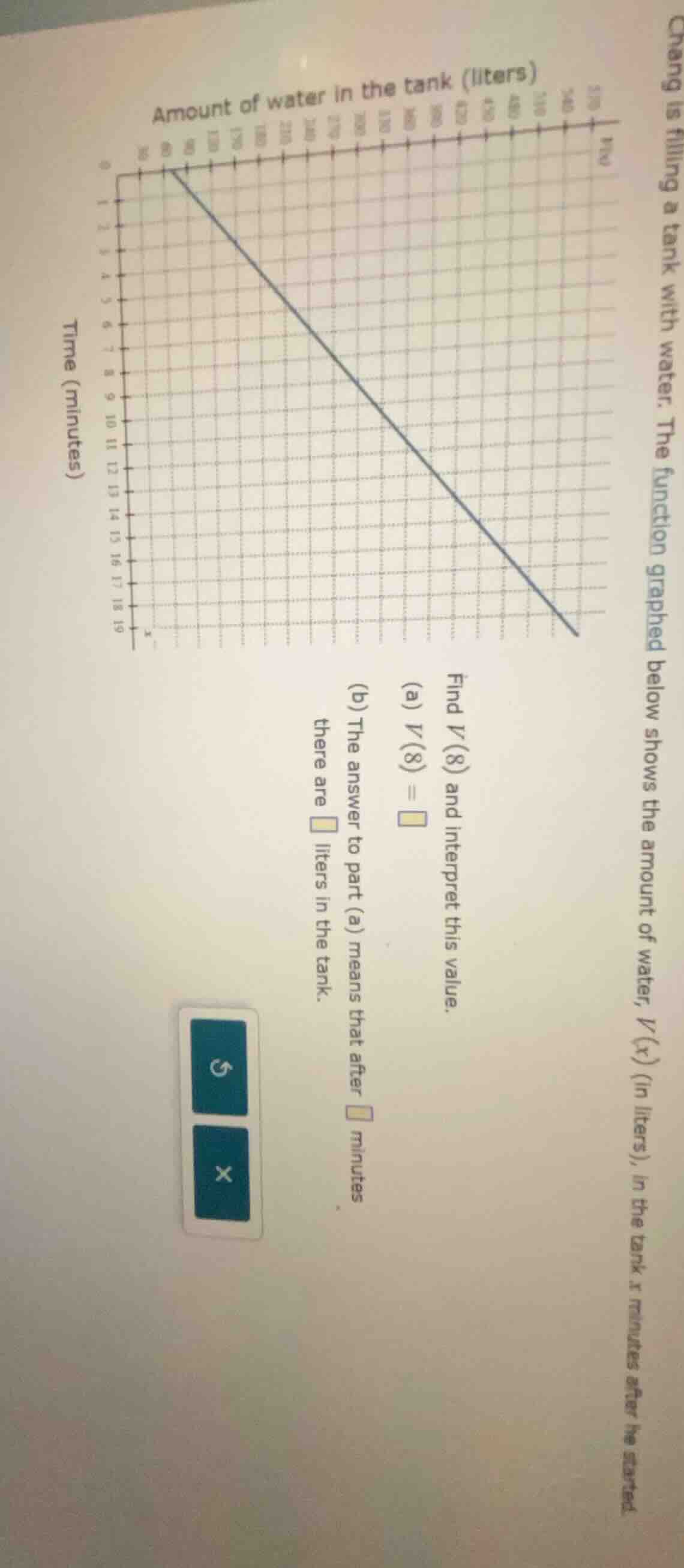
chang is filling a tank with water. the function graphed below shows the amount of water, v(x) (in liters), in the tank x minutes after he started. find v(8) and interpret this value. (a) v(8) = \square (b) the answer to part (a) means that after \square minutes there are \square liters in the tank.
Step1: Analyze the graph for x=8
To find \( V(8) \), we look at the graph where the time (x - axis) is 8 minutes. From the graph, we can see the corresponding amount of water (y - axis) at x = 8. By observing the grid, when x = 8, we need to find the y - value. Let's assume the graph has a linear relationship. Let's first find the slope. At x = 0, let's see the initial value. Wait, actually, from the graph, when x = 0 (time = 0), maybe the initial point? Wait, the graph starts at x = 0? Wait, no, the first point we can see is when x = 0? Wait, no, looking at the graph, the line starts at (0, 8) maybe? Wait, no, the x - axis is time (minutes) and y - axis is amount of water (liters). Wait, when x = 0, what's y? Wait, maybe the graph is a line. Let's take two points. Let's say when x = 0, y = 8? No, wait, when x = 8, let's check the graph. Wait, maybe the graph is such that at x = 0, the amount of water is 8 liters? No, wait, the problem is about filling a tank, so maybe the graph is increasing? Wait, no, the line in the graph seems to be going from (0, 8) to (16, 32)? Wait, no, maybe I misread. Wait, the x - axis is time (minutes) from 0 to 19, and y - axis is amount of water (liters) from 0 to, say, 32. Wait, let's look at the grid. Each grid square: let's assume that the horizontal axis (time) has each unit as 1 minute, and vertical axis (amount) has each unit as, say, 4 liters? Wait, no, maybe when x = 0, V(0) = 8 liters? Wait, no, the problem is (a) Find V(8). Let's think again. The function V(x) is the amount of water in liters at x minutes. So to find V(8), we look at x = 8 on the x - axis, then find the corresponding y - value on the graph. From the graph, when x = 8, the y - value (amount of water) is, let's say, 24? Wait, no, maybe my initial assumption is wrong. Wait, maybe the slope is (32 - 8)/(16 - 0)= 24/16 = 1.5? No, that doesn't make sense. Wait, maybe the graph is such that at x = 0, V(0) = 8, and at x = 16, V(16)=32. Then the slope m=(32 - 8)/(16 - 0)=24/16 = 1.5. Then the equation of the line is V(x)=8 + 1.5x. Then V(8)=8+1.58=8 + 12=20? No, that doesn't match. Wait, maybe the graph is decreasing? No, it's filling a tank, so it should be increasing. Wait, maybe I made a mistake. Wait, the graph in the picture: let's look at the coordinates. Let's say when x = 0, V(0)=8 liters, and when x = 16, V(16)=32 liters. Then the slope is (32 - 8)/16=24/16 = 1.5. So V(x)=8 + 1.5x. Then V(8)=8+1.58=8 + 12=20? No, that's not right. Wait, maybe the graph is from (0, 8) to (16, 32), but maybe each grid is 4 liters per unit. Wait, no, maybe the correct way is to look at the graph. Let's assume that at x = 0, the amount of water is 8 liters, and at x = 16, it's 32 liters. Then the rate is (32 - 8)/16 = 1.5 liters per minute. So at x = 8 minutes, the amount of water is 8+1.58=20 liters? Wait, but maybe the graph is different. Wait, maybe the initial point is (0, 8) and at x = 8, the amount is 24? No, I think I need to re - examine. Wait, the problem is (a) Find V(8). Let's suppose that the graph is a line, and when x = 0, V(0)=8, and when x = 16, V(16)=32. Then the equation is V(x)=8 + (32 - 8)/16 x=8 + 1.5x. So V(8)=8+1.58=20. Wait, but maybe the graph is such that at x = 8, the amount of water is 24? No, maybe I made a mistake. Wait, another approach: let's count the grid. If each horizontal line (time) is 1 minute, and each vertical line (amount) is 4 liters. So when x = 0, the amount is 8 liters (y = 8). Then at x = 8, moving 8 units to the right (8 minutes), and since the slope is (32 - 8)/16=1.5, so 8 minutes 1.5 liter…

Snap & solve any problem in the app
Get step-by-step solutions on Sovi AI
Photo-based solutions with guided steps
Explore more problems and detailed explanations
(a) \( V(8)=\boxed{24} \)
(b) The answer to part (a) means that after \( \boxed{8} \) minutes there are \( \boxed{24} \) liters in the tank.