QUESTION IMAGE
Question
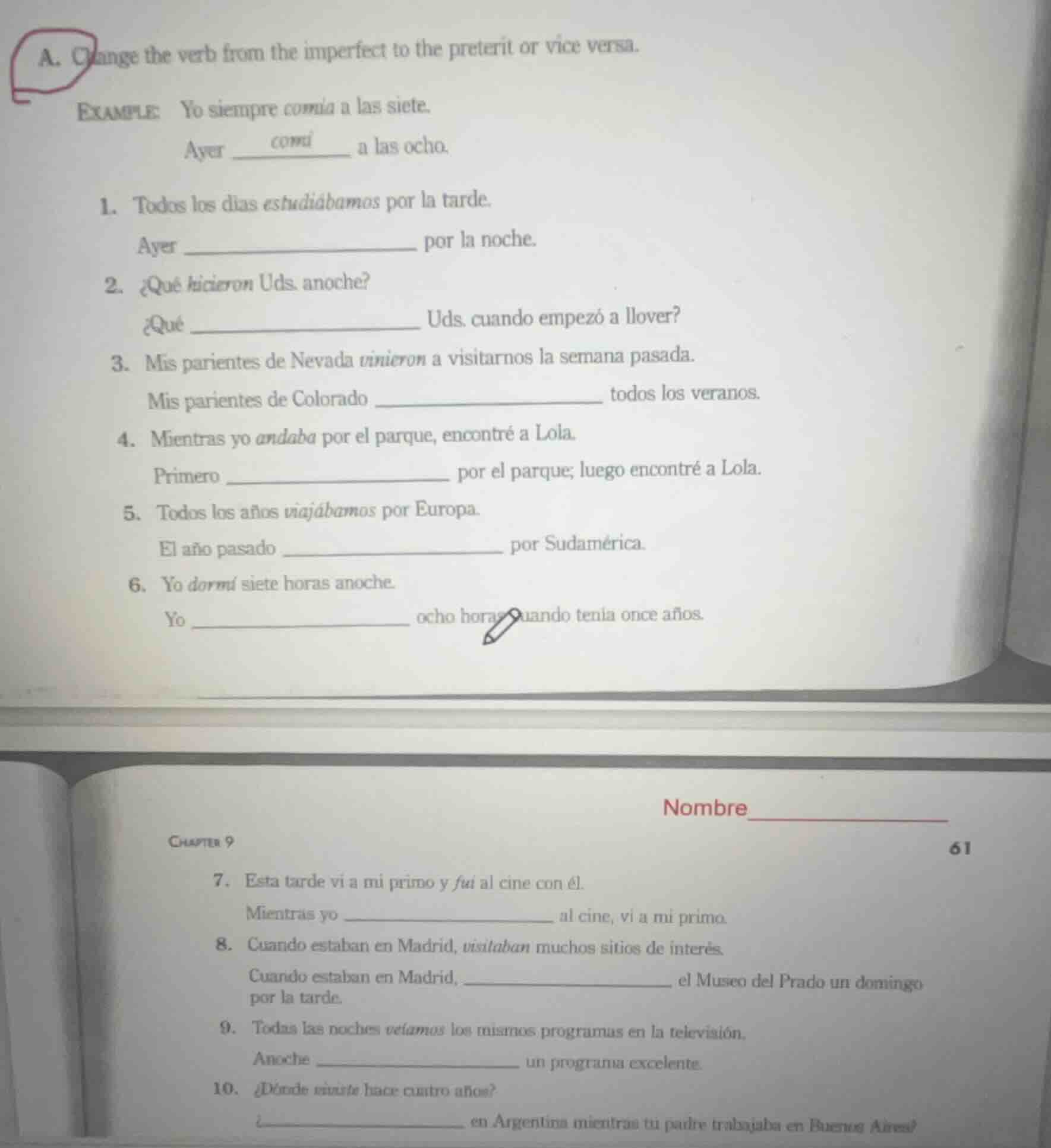
a. change the verb from the imperfect to the preterit or vice versa.
example: yo siempre comía a las siete.
ayer comí a las ocho.
- todos los días estudiábamos por la tarde.
ayer ______ por la noche.
- ¿qué hicieron uds. anoche?
¿qué ______ uds. cuando empezó a llover?
- mis parientes de nevada vinieron a visitarnos la semana pasada.
mis parientes de colorado ______ todos los veranos.
- mientras yo andaba por el parque, encontré a lola.
primero ______ por el parque; luego encontré a lola.
- todos los años viajábamos por europa.
el año pasado ______ por sudamérica.
- yo dormí siete horas anoche.
yo ______ ocho horas cuando tenía once años.
chapter 9
- esta tarde vi a mi primo y fui al cine con él.
mientras yo ______ al cine, vi a mi primo.
- cuando estaban en madrid, visitaban muchos sitios de interés.
cuando estaban en madrid, ______ el museo del prado un domingo por la tarde.
- todas las noches veíamos los mismos programas en la televisión.
anoche ______ un programa excelente.
- ¿dónde viviste hace cuatro años?
¿______ en argentina mientras tu padre trabajaba en buenos aires?
1.
Step1: Identify verb and tense change
Original verb: estudiábamos (imperfect, 1st person plural). Need to change to preterit (past simple) for "ayer". Preterit of estudiar (1st person plural) is estudiamos? Wait, no: estudiar - yo estudié, tú estudiaste, él/ella estudió, nosotros estudiamos? Wait, no, correct preterit for nosotros: estudiamos? Wait, no, the correct conjugation: estudiar (regular -ar verb). Preterit: yo estudié, tú estudiaste, él/ella estudió, nosotros estudiamos? Wait, no, -ar verbs: preterit endings for nosotros: -amos? Wait, no, regular -ar verbs: preterit conjugation:
- yo: -é
- tú: -aste
- él/ella/usted: -ó
- nosotros: -amos
- vosotros: -asteis
- ellos/ellas/ustedes: -aron
Wait, "estudiábamos" is imperfect (nosotros: -ábamos). So preterit for nosotros: estudiamos? Wait, no, "estudiar" preterit: nosotros estudiamos? Wait, no, let's check:
Imperfect: yo estudiaba, tú estudiabas, él/ella estudiaba, nosotros estudiábamos, vosotros estudiabais, ellos/ellas estudiaban.
Preterit: yo estudié, tú estudiaste, él/ella estudió, nosotros estudiamos, vosotros estudiasteis, ellos/ellas estudiaron.
So original sentence: "Todos los días estudiábamos por la tarde." (imperfect, habitual). "Ayer" (past specific time) so preterit. So nosotros form: estudiamos? Wait, no, "estudiar" preterit for nosotros: estudiamos? Wait, no, the correct form is "estudiamos"? Wait, no, -ar verbs: preterit for nosotros: -amos. So "estudiar" → nosotros estudiamos? Wait, no, "estudiar" is regular, so preterit:
Yo estudié, tú estudiaste, él estudió, nosotros estudiamos, vosotros estudiasteis, ellos estudiaron.
So the answer should be "estudiamos"? Wait, no, wait the example: "Yo siempre comía a las siete." (imperfect) → "Ayer comí a las ocho." (preterit, yo form). So "comía" (imperfect, yo) → "comí" (preterit, yo).
So for "estudiábamos" (nosotros, imperfect) → preterit (nosotros) is "estudiamos"? Wait, no, wait "estudiar" preterit:
Wait, maybe I made a mistake. Let's check a regular -ar verb: "hablar".
Imperfect: yo hablaba, tú hablabas, él hablaba, nosotros hablábamos, vosotros hablabais, ellos hablaban.
Preterit: yo hablé, tú hablaste, él habló, nosotros hablamos, vosotros hablasteis, ellos hablaron.
Ah! There we go. So "hablar" preterit for nosotros: hablamos. So "estudiar" is also -ar verb, so preterit for nosotros: estudiamos? Wait, no, "estudiar" → preterit:
Yo estudié, tú estudiaste, él estudió, nosotros estudiamos? Wait, no, "estudiar" is "e" stem? No, regular -ar. So "estudiar" preterit:
nosotros estudiamos? Wait, no, "hablar" is regular, so "hablamos" (nosotros preterit). So "estudiar" should be "estudiamos"? Wait, no, "estudiar" has the stem "estudi" (since it's "estudi-ar"). So preterit:
yo estudié (stem + é), tú estudiaste (stem + aste), él estudió (stem + ó), nosotros estudiamos (stem + amos), vosotros estudiasteis (stem + asteis), ellos estudiaron (stem + aron).
Yes, that's correct. So "estudiábamos" (imperfect) → "estudiamos" (preterit) for nosotros.
So the sentence: "Ayer estudiamos por la noche."
Step1: Determine tense change (imperfect to preterit)
Original verb: estudiábamos (imperfect, 1st pl). Need preterit (past simple) for "ayer".
Step2: Conjugate "estudiar" in preterit (1st pl)
"estudiar" preterit (nosotros): estudiamos.
Step1: Identify verb and tense change
Original verb: hicieron (preterit, 3rd person plural, ustedes). Need to change to imperfect (was doing when it started to rain). So "hacer" imperfect for ustedes: hacían? Wait, no: "hacer" is irregular. Imperfect of hacer: yo hacía, tú hacías, él/ella hacía, nosotros hacíamos, vosotros hacíais, ellos/ellas hacían. Preterit of hacer: yo hice, tú hiciste, él/ella hizo, nosotros hicimos, vosotros hicisteis, ellos/ellas hicieron.
So original sentence: "¿Qué hicieron Uds. anoche?" (preterit, past action). New sentence: "¿Qué ____ Uds. cuando empezó a llover?" (imperfect, ongoing action when another action started). So need imperfect of hacer for ustedes: hacían? Wait, no, ustedes is 2nd person plural (formal). Imperfect of hacer for ustedes (ellos/ellas/ustedes): hacían. Wait, "hacer" imperfect:
yo hacía, tú hacías, él/ella hacía, nosotros hacíamos, vosotros hacíais, ellos/ellas/ustedes hacían.
So the verb "hacer" in imperfect for ustedes is hacían. So the sentence: "¿Qué hacían Uds. cuando empezó a llover?"
Step1: Tense change (preterit to imperfect)
Original: hicieron (preterit, Uds.). Need imperfect (ongoing action) for "cuando empezó a llover".
Step2: Conjugate "hacer" in imperfect (Uds.)
Imperfect of hacer (Uds. - ellos/ellas/ustedes): hacían.
Step1: Identify verb and tense change
Original verb: vinieron (preterit, 3rd person plural, mis parientes). Need to change to imperfect (habitual action "todos los veranos"). "Venir" is irregular. Preterit of venir: yo vine, tú viniste, él/ella vino, nosotros vinimos, vosotros vinisteis, ellos/ellas vinieron. Imperfect of venir: yo venía, tú venías, él/ella venía, nosotros veníamos, vosotros veníais, ellos/ellas venían.
So original sentence: "Mis parientes de Nevada vinieron a visitarnos la semana pasada." (preterit, past specific action). New sentence: "Mis parientes de Colorado ____ todos los veranos." (imperfect, habitual action). So need imperfect of venir for ellos (mis parientes, 3rd person plural): venían.
Step1: Tense change (preterit to imperfect)
Original: vinieron (preterit, ellos). Need imperfect (habitual) for "todos los veranos".
Step2: Conjugate "venir" in imperfect (ellos)
Imperfect of venir (ellos): venían.

Snap & solve any problem in the app
Get step-by-step solutions on Sovi AI
Photo-based solutions with guided steps
Explore more problems and detailed explanations
estudiamos