QUESTION IMAGE
Question
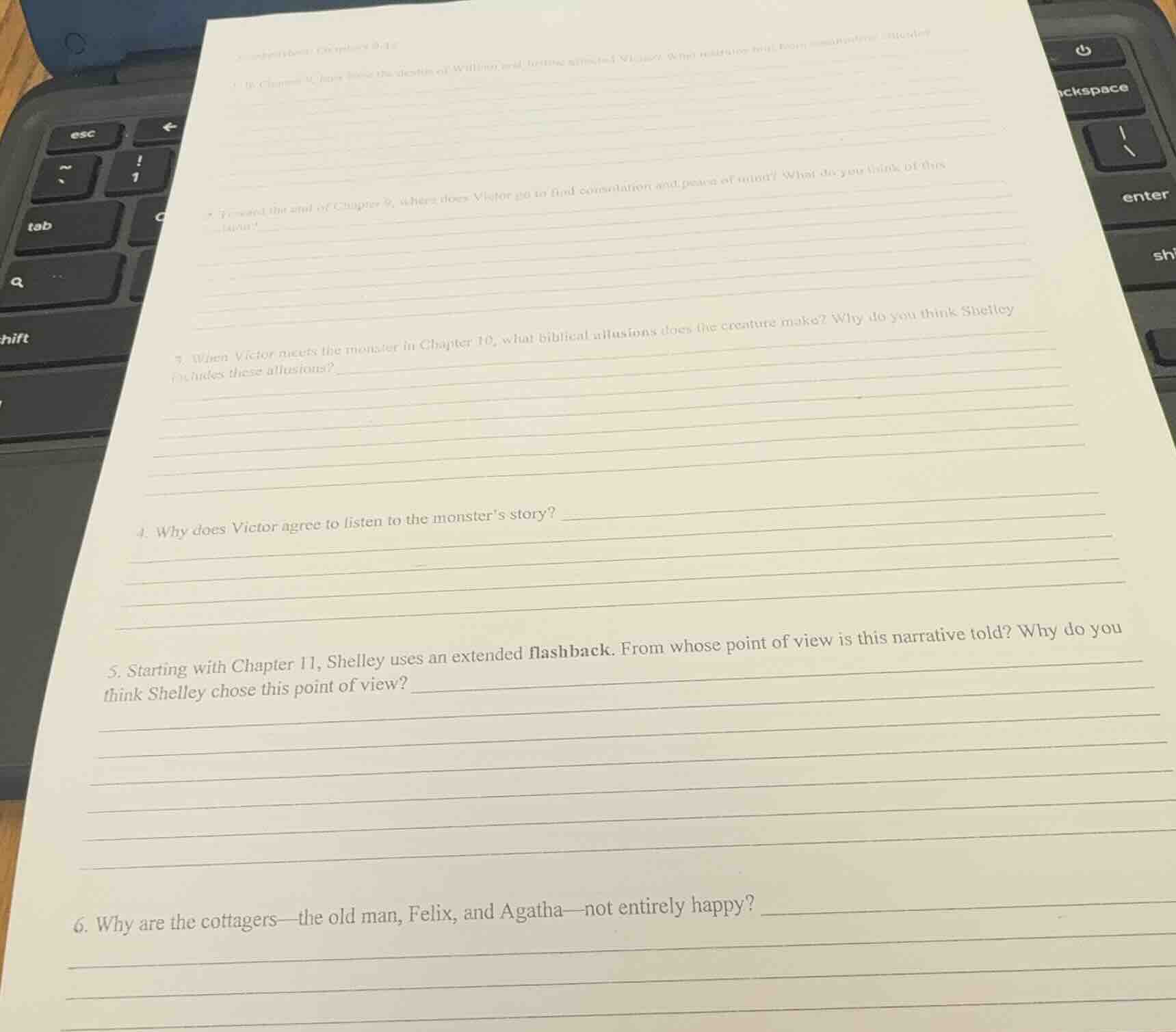
- in chapter 9, after the deaths of william and justine, victor is full of remorse. what does he do?
- toward the end of chapter 9, where does victor go to find consolation and peace of mind? what do you think of this action?
- when victor meets the monster in chapter 10, what biblical allusions does the creature make? why do you think shelley includes these allusions?
- why does victor agree to listen to the monster’s story?
- starting with chapter 11, shelley uses an extended flashback. from whose point of view is this narrative told? why do you think shelley chose this point of view?
- why are the cottagers—the old man, felix, and agatha—not entirely happy?
Brief Explanations
- (Note: Question 1 is partially cut off and unreadable, so it cannot be answered. The below answers apply to questions 2-6, based on Mary Shelley's Frankenstein.)
- Victor travels to the Chamonix valley (specifically the Swiss Alps, including Mont Blanc) to find comfort. This setting mirrors his turbulent mental state, as the vast, imposing landscape both reflects his guilt and offers temporary escape from his trauma.
- The creature compares himself to Adam (the first human, abandoned by his creator) and Satan (a fallen cast-out being from Paradise Lost). Shelley includes these to frame the creature as a tragic, sympathetic figure, not just a monster—his suffering stems from Victor's abandonment, paralleling how Adam and Satan were rejected by their creators.
- Victor feels a sense of responsibility as the creature's creator, and he is also overwhelmed by the creature's anger and threats against his remaining loved ones. He agrees to listen to avoid further violence against his family.
- The narrative shifts to the monster's first-person point of view. Shelley chooses this to humanize the monster, letting readers understand his loneliness, suffering, and the cruelty he endured after his creation, which challenges readers' initial perception of him as a purely evil being.
- The cottagers are exiled from their home in France (Felix helped a political prisoner escape, leading to their banishment) and live in poverty, far from their former lives and status. They mourn their lost social standing, home, and the injustice of their situation.

Snap & solve any problem in the app
Get step-by-step solutions on Sovi AI
Photo-based solutions with guided steps
Explore more problems and detailed explanations
- (Unanswerable: Question text is incomplete/cut off)
- Victor goes to the Swiss Alps (Mont Blanc/Chamonix valley). This remote, grand landscape temporarily eases his guilt and trauma by letting him escape the reminders of his crimes, though it also mirrors his inner turmoil.
- The creature uses allusions to Adam (abandoned by his creator) and Satan (a cast-out, vengeful figure). Shelley uses these to frame the creature as a tragic, sympathetic victim of Victor's neglect, not just a monster.
- Victor agrees out of a sense of creatorly responsibility, and because the monster threatens to harm his remaining family if he refuses.
- The narrative is told from the monster's first-person point of view. Shelley chose this to humanize the monster, revealing his suffering and loneliness to challenge readers' initial judgment of him as evil.
- The cottagers are exiled from France (due to Felix's political activism) and live in poverty, grieving their lost home, social status, and the injustice of their banishment.