QUESTION IMAGE
Question
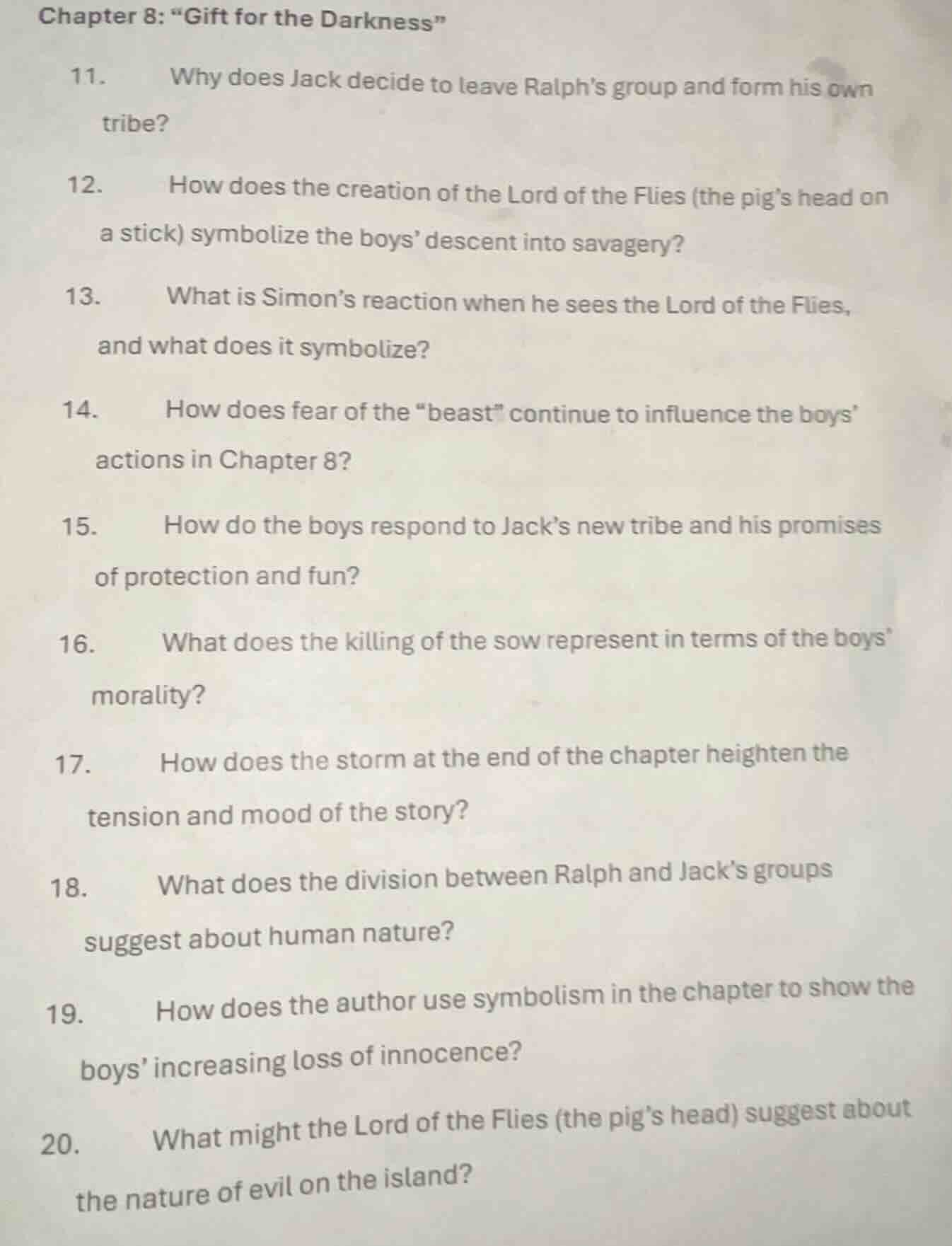
chapter 8: \gift for the darkness\11. why does jack decide to leave ralphs group and form his own tribe?12. how does the creation of the lord of the flies (the pigs head on a stick) symbolize the boys descent into savagery?13. what is simons reaction when he sees the lord of the flies, and what does it symbolize?14. how does fear of the \beast\ continue to influence the boys actions in chapter 8?15. how do the boys respond to jacks new tribe and his promises of protection and fun?16. what does the killing of the sow represent in terms of the boys morality?17. how does the storm at the end of the chapter heighten the tension and mood of the story?18. what does the division between ralph and jacks groups suggest about human nature?19. how does the author use symbolism in the chapter to show the boys increasing loss of innocence?20. what might the lord of the flies (the pigs head) suggest about the nature of evil on the island?
- Question 11: Jack resents Ralph's focus on order and rescue over hunting and power. He is humiliated when his attempt to remove Ralph as chief fails, so he leaves to lead a tribe where his violent, hedonistic values dominate.
- Question 12: The pig's head is a deliberate, brutal offering to the "beast," replacing rationality with ritualistic violence. It marks the boys' shift from civilized rules to primal, cruel behavior centered on fear and savagery.
- Question 13: Simon has a hallucination where the head speaks to him, calling itself the "Lord of the Flies" and revealing the beast is within the boys. This symbolizes his insight into the inherent evil in human nature, a truth the other boys refuse to face.
- Question 14: Fear of the beast makes the boys reject logic, embrace Jack's violent "protection" over Ralph's rescue plan, and participate in brutal rituals (like the pig hunt) to feel in control of their terror.
- Question 15: Most older boys join Jack's tribe, lured by the promise of easy meat, fun, and the illusion of safety from the beast. Only Ralph, Piggy, and Simon initially stay loyal to the original group focused on rescue.
- Question 16: The killing of the sow is a cruel, prolonged act of violence, not just a hunt. It represents the boys' complete abandonment of civilized moral codes, as they prioritize cruelty and primal urges over empathy and restraint.
- Question 17: The storm's chaos mirrors the boys' internal turmoil and descent into savagery. It amplifies the sense of dread, hides Simon's approach to share his insight, and sets the stage for the violent events that follow.
- Question 18: The division suggests human nature has competing impulses: Ralph's group represents the desire for order, reason, and collective survival, while Jack's represents the pull of primal violence, power, and immediate gratification when societal constraints are removed.
- Question 19: Golding uses symbols like the pig's head (primal evil), the broken conch (loss of order), and the boys' painted faces (rejection of identity/civility) to show their innocence fading as they embrace savagery over civilization.
- Question 20: The Lord of the Flies suggests evil is not an external "beast" but an inherent, inescapable part of the boys (and all humans). It thrives when fear and chaos break down civilized norms, manifesting as the boys' own violent, cruel actions.

Snap & solve any problem in the app
Get step-by-step solutions on Sovi AI
Photo-based solutions with guided steps
Explore more problems and detailed explanations
- Jack leaves Ralph's group after failing to overthrow him as chief; he resents Ralph's focus on rescue/order and wants to lead a tribe centered on hunting, power, and indulgence, where his violent values are dominant.
- The pig's head is a ritualistic offering to the "beast," marking the boys' shift from following civilized rules to embracing primal, cruel, fear-driven savagery as a replacement for rationality.
- Simon hallucinates the head speaking to him, revealing the "beast" is the inherent evil within the boys. This symbolizes his unique, tragic insight into human nature's dark core.
- Fear of the beast makes the boys reject Ralph's logical rescue plan, embrace Jack's violent "protection" rituals, and act out of terror rather than reason to feel in control.
- Most older boys join Jack's tribe, drawn by promises of meat, fun, and safety from the beast; only Ralph, Piggy, and Simon initially remain focused on rescue.
- The cruel, prolonged killing of the sow represents the boys' total abandonment of civilized morality, as they prioritize primal violence and cruelty over empathy and restraint.
- The storm mirrors the boys' internal chaos and descent into savagery, amplifying dread, hiding Simon's approach to share his truth, and setting the stage for impending violence.
- The division suggests human nature has conflicting impulses: a drive for order, reason, and collective good (Ralph's group) and a pull toward primal violence, power, and immediate gratification (Jack's group) when societal constraints vanish.
- Golding uses symbols like the pig's head (primal evil), broken conch (lost order), and painted faces (rejected civility) to show the boys' innocence fading as they embrace savagery.
- The Lord of the Flies suggests evil is not an external force but an inherent, inescapable part of human nature. It thrives when fear and chaos break down civilized norms, manifesting as the boys' own violent actions.