QUESTION IMAGE
Question
chapter 6 molecular biology
- mutations which are transferred to offspring.
- mutations that change chromosome structure
- a change in a single nucleotide in dna
- mutation which changes the reading frame of the base sequence after the mutation
- which mutations are usually least dangerous to the organism?
- why?
- chromosomal mutation in which a segment of dna is lost.
- chromosomal mutation in which a segment of dna is repeated.
- chromosomal mutation in which a segment of dna is flipped and then reattached to the same chromosome.
- chromosomal mutation in which a segment of dna from one chromosome is added to another, unrelated chromosome.
- a chromosomal mutation in which two segments from different chromosomes change positions.
- a mutation in which a mutated codon codes for the same amino acid
- a mutation in which a mutated codon codes for a different amino acid.
- a mutation in which a mutated codon is a premature stop codon.
- what causes a frameshift mutation?
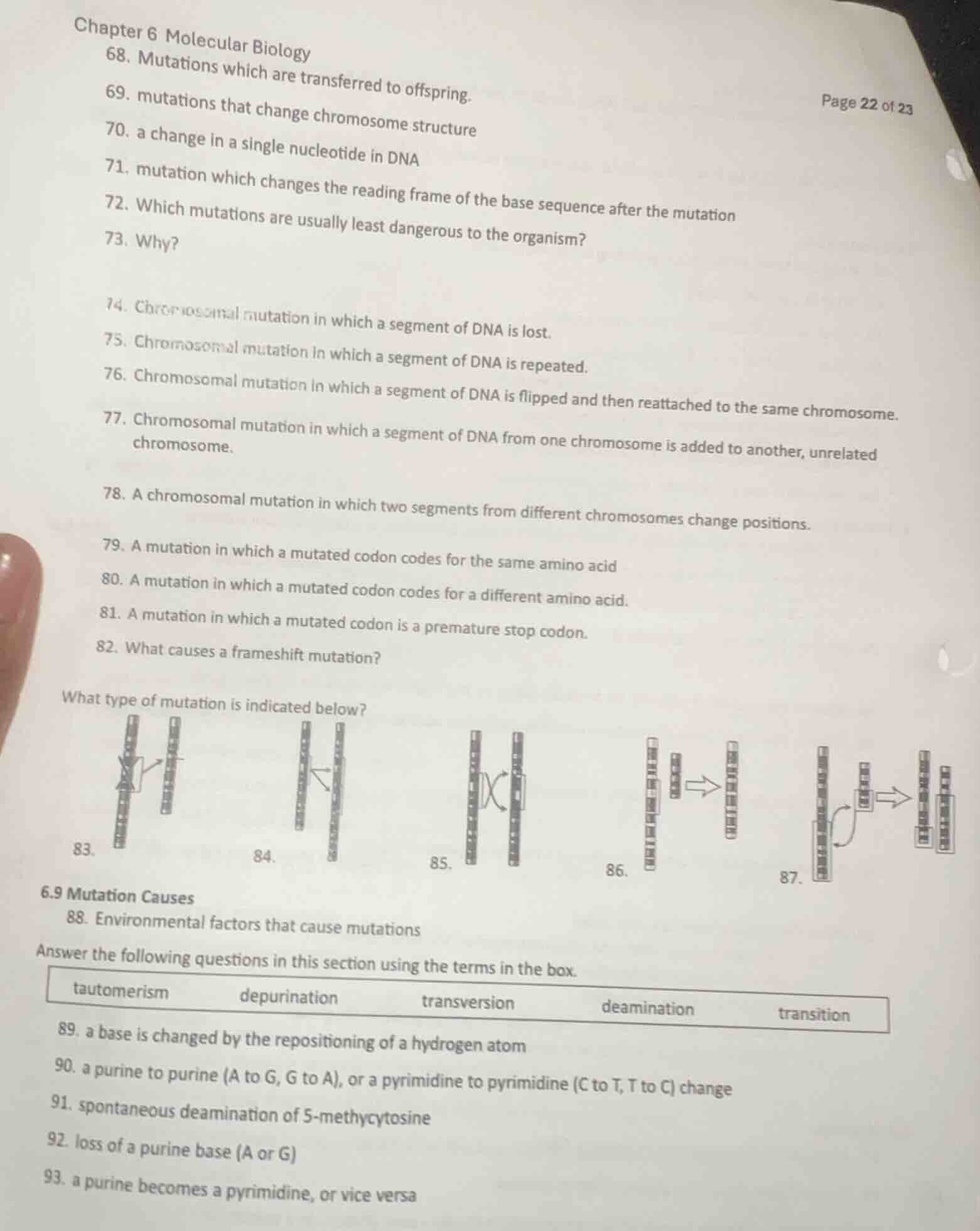
what type of mutation is indicated below?
83.
84.
85.
86.
87.
6.9 mutation causes
- environmental factors that cause mutations
answer the following questions in this section using the terms in the box.
tautomerism depurination transversion deamination transition
- a base is changed by the repositioning of a hydrogen atom
- a purine to purine (a to g, g to a), or a pyrimidine to pyrimidine (c to t, t to c) change
- spontaneous deamination of 5 - methycytosine
- loss of a purine base (a or g)
- a purine becomes a pyrimidine, or vice versa
Brief Explanations
Each answer corresponds to the standard terminology in molecular biology for the described mutation types, causes, and characteristics.

Snap & solve any problem in the app
Get step-by-step solutions on Sovi AI
Photo-based solutions with guided steps
Explore more problems and detailed explanations
- Germline mutation
- Chromosomal mutation
- Point mutation (single nucleotide polymorphism)
- Frameshift mutation
- Silent mutations (or neutral mutations)
- They do not alter the encoded amino acid/protein function, so they have no negative impact on the organism's phenotype or survival.
- Deletion (chromosomal deletion)
- Duplication (chromosomal duplication)
- Inversion (chromosomal inversion)
- Translocation (non-reciprocal translocation)
- Reciprocal translocation
- Silent mutation
- Missense mutation
- Nonsense mutation
- Insertion or deletion of nucleotides that are not in multiples of 3, which shifts the mRNA reading frame.
- Non-reciprocal translocation
- Deletion (chromosomal deletion)
- Inversion (chromosomal inversion)
- Duplication (chromosomal duplication)
- Reciprocal translocation
- Mutagens
- tautomerism
- transition
- deamination
- depurination
- transversion