QUESTION IMAGE
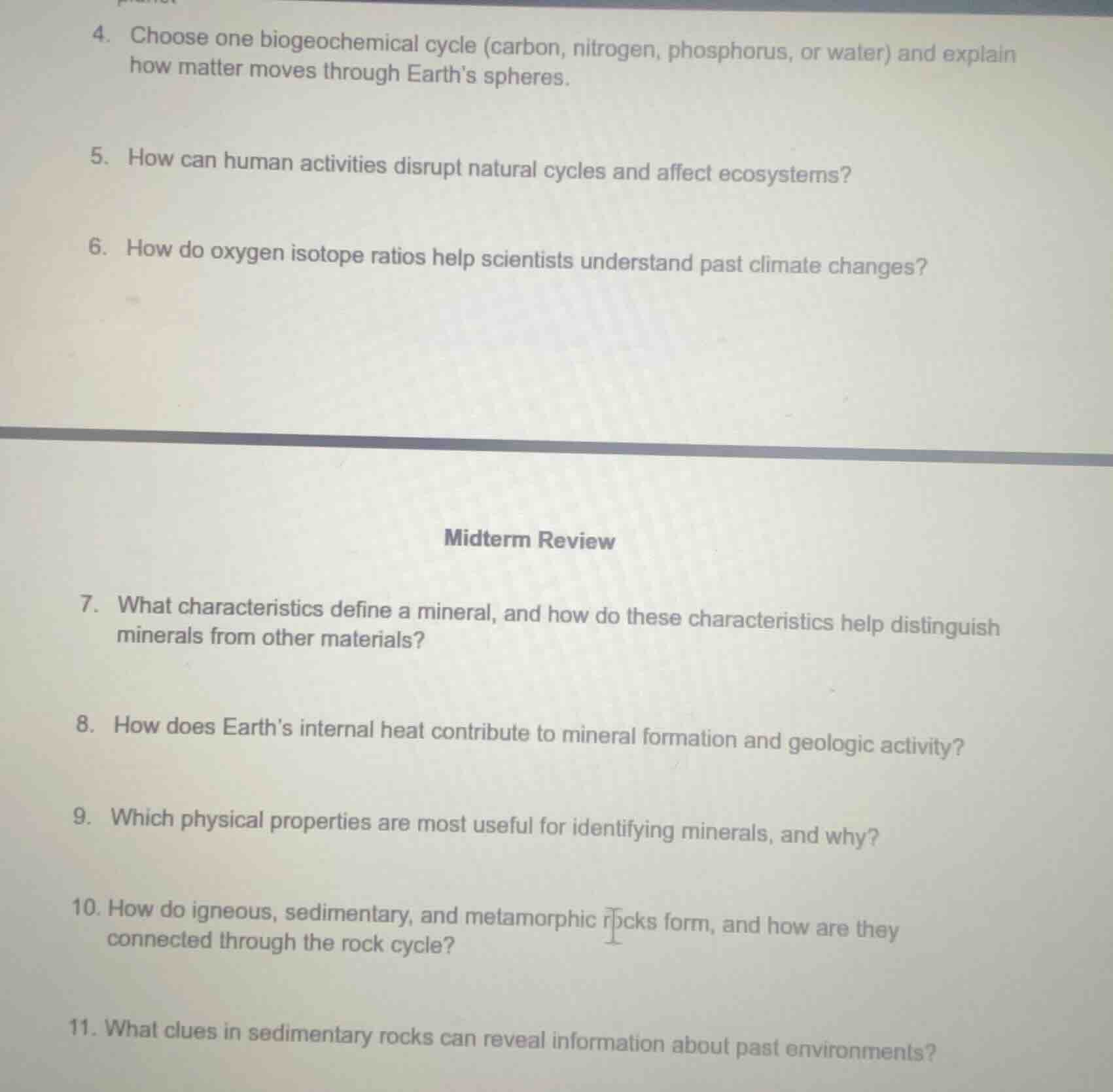
Question
- choose one biogeochemical cycle (carbon, nitrogen, phosphorus, or water) and explain how matter moves through earth’s spheres.
- how can human activities disrupt natural cycles and affect ecosystems?
- how do oxygen isotope ratios help scientists understand past climate changes?
midterm review
- what characteristics define a mineral, and how do these characteristics help distinguish minerals from other materials?
- how does earth’s internal heat contribute to mineral formation and geologic activity?
- which physical properties are most useful for identifying minerals, and why?
- how do igneous, sedimentary, and metamorphic rocks form, and how are they connected through the rock cycle?
- what clues in sedimentary rocks can reveal information about past environments?
Since there are multiple sub - questions, we will use the Answer - Explanation Format for the Natural Science (Geography/Environmental Sciences) discipline.
Question 4
Let's choose the water cycle. Water evaporates from the hydrosphere (oceans, lakes) into the atmosphere. It condenses into clouds and precipitates back to the hydrosphere (as rain, snow) or geosphere (infiltrates soil, forms groundwater). Plants in the biosphere take up water, and animals consume it, then release it via respiration or excretion.
Human activities like burning fossil fuels disrupt the carbon cycle by releasing excess CO₂, causing climate change that affects ecosystems (e.g., coral bleaching). Deforestation reduces carbon uptake and habitat, disrupting nutrient cycles. Agricultural runoff (nitrogen, phosphorus) disrupts the nitrogen and phosphorus cycles, causing eutrophication in water bodies, harming aquatic ecosystems.
Oxygen has isotopes (¹⁶O, ¹⁸O). Lighter ¹⁶O evaporates more easily. In cold periods, more ¹⁶O - rich water is locked in ice, so ocean water has more ¹⁸O. Scientists analyze oxygen isotope ratios in ice cores (from glaciers) or fossil shells (from oceans). Higher ¹⁸O in ice cores or shells indicates colder periods (more ¹⁶O in ice), and lower ¹⁸O indicates warmer periods (less ¹⁶O locked in ice).

Snap & solve any problem in the app
Get step-by-step solutions on Sovi AI
Photo-based solutions with guided steps
Explore more problems and detailed explanations
Taking the water cycle as an example: Water evaporates from the hydrosphere (e.g., oceans, lakes) into the atmosphere. In the atmosphere, water vapor condenses to form clouds. Precipitation (rain, snow) then returns water to the hydrosphere (filling oceans, lakes) or the geosphere (infiltrating the soil to become groundwater). The biosphere (plants and animals) interacts with water too: plants absorb water from the soil (geosphere - biosphere interaction), and animals drink water from the hydrosphere or consume plants with water, then release water through processes like respiration and excretion, which can return water to the hydrosphere or atmosphere.