QUESTION IMAGE
Question
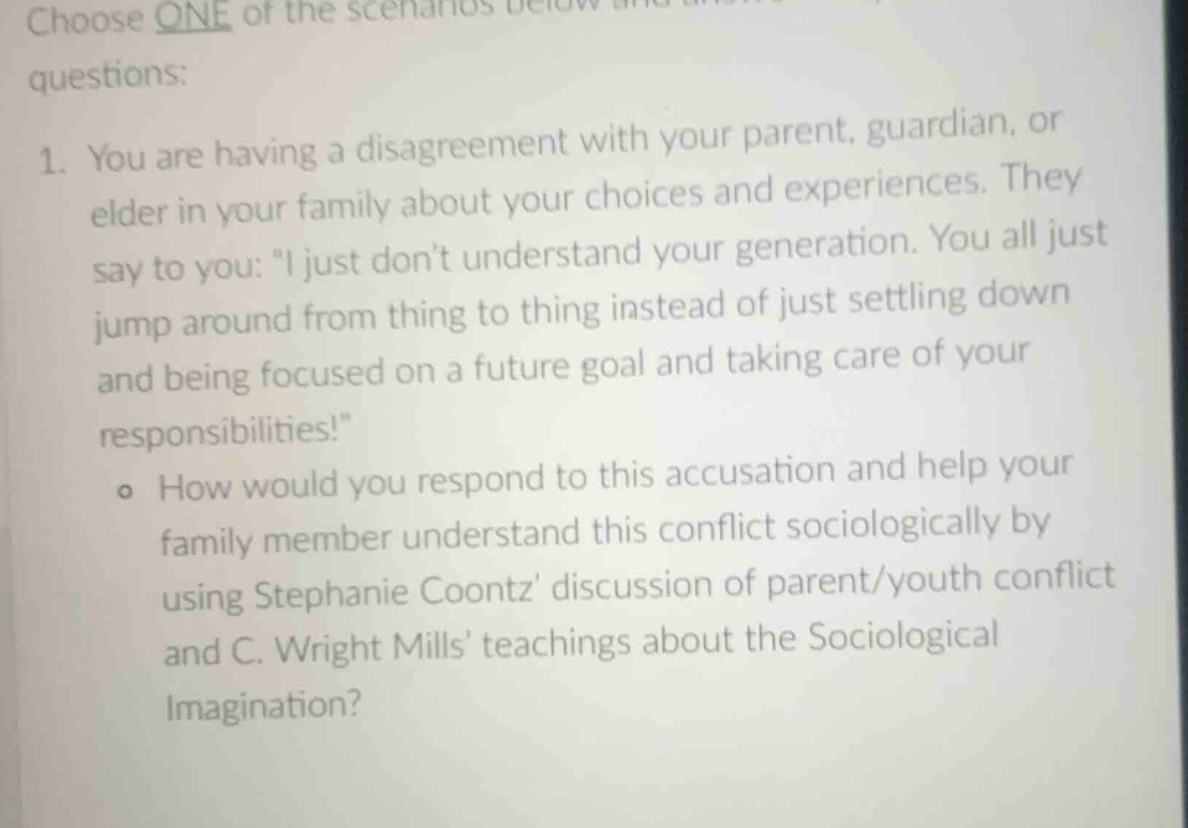
choose one of the scenarios below and questions:
- you are having a disagreement with your parent, guardian, or elder in your family about your choices and experiences. they say to you: \i just dont understand your generation. you all just jump around from thing to thing instead of just settling down and being focused on a future goal and taking care of your responsibilities!\
- how would you respond to this accusation and help your family member understand this conflict sociologically by using stephanie coontz’ discussion of parent/youth conflict and c. wright mills’ teachings about the sociological imagination?
- First, apply C. Wright Mills' Sociological Imagination: frame the conflict not as a personal failing, but as a clash between historical generational contexts. Your generation faces structural shifts (gig economy, rapid tech change, precarious career paths) that make linear "settling down" far less feasible than it was for their generation.
- Then, use Stephanie Coontz' work on parent/youth conflict: note that intergenerational tension often stems from differing cultural scripts for adulthood. Your family member’s idea of "responsibility" is rooted in their era’s stable social norms, while your choices adapt to a more flexible, uncertain modern social landscape. Frame the conversation as a misunderstanding of structural differences, not a lack of focus.
- Structure the response to validate their perspective first, then introduce these sociological frameworks to reframe the conflict as a product of broader social forces, not personal behavior.

Snap & solve any problem in the app
Get step-by-step solutions on Sovi AI
Photo-based solutions with guided steps
Explore more problems and detailed explanations
I would respond by saying:
"I understand why this would look like I'm not focused, and I get that this feels frustrating from your perspective. But what if we look at this bigger picture? C. Wright Mills talked about the 'sociological imagination'—how personal troubles are often tied to bigger social issues. Your generation had more stable jobs, a clearer path to 'settling down' that was supported by the world around you. But right now, things are so different: jobs change fast, we have to adapt to new technology all the time, and the idea of staying in one career or one path forever just isn't as possible for many of us.
Stephanie Coontz also wrote about how parent-youth conflicts often come from different ideas of what adulthood should look like, shaped by the times we grew up in. When I switch between experiences or choices, it's not that I'm avoiding responsibility—it's that I'm trying to build a future that fits the world I live in, not the one you grew up in. This isn't about me being unfocused; it's about how the world has changed between our generations, and we're both just going by the rules we learned growing up."