QUESTION IMAGE
Question
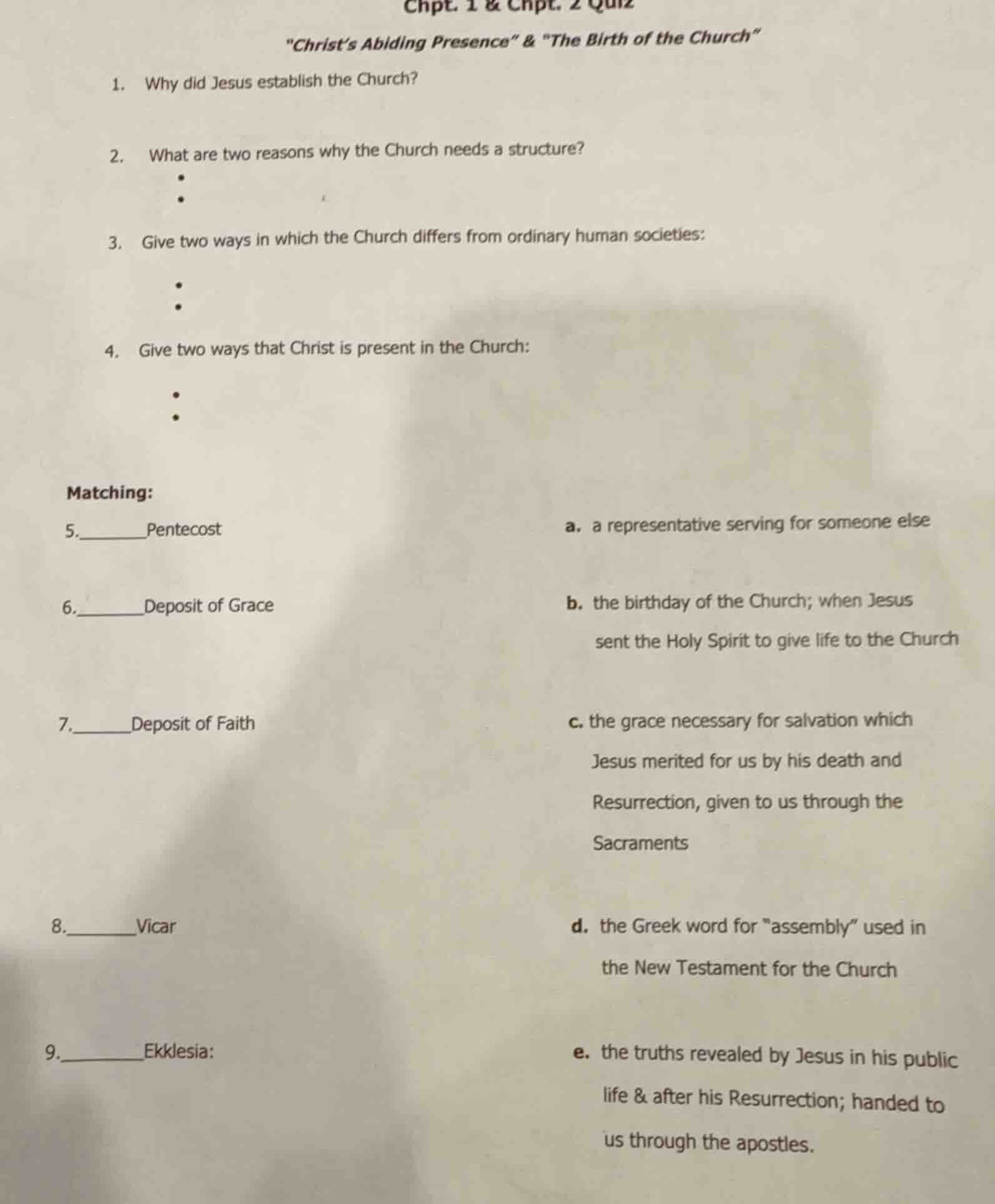
chpt. 1 & chpt. 2 quiz
\christ’s abiding presence\ & \the birth of the church\
- why did jesus establish the church?
- what are two reasons why the church needs a structure?
•
•
- give two ways in which the church differs from ordinary human societies:
•
•
- give two ways that christ is present in the church:
•
•
matching:
- ______pentecost a. a representative serving for someone else
- ______deposit of grace b. the birthday of the church; when jesus
sent the holy spirit to give life to the church
- ______deposit of faith c. the grace necessary for salvation which
jesus merited for us by his death and
resurrection, given to us through the
sacraments
- ______vicar d. the greek word for \assembly\ used in
the new testament for the church
- ______ekklesia: e. the truths revealed by jesus in his public
life & after his resurrection; handed to
us through the apostles.
Brief Explanations
- Jesus established the Church to continue his mission of salvation, to spread his teachings, and to be a community where believers can receive grace through the sacraments.
- Church structure ensures clear leadership to guide the faithful, and it helps maintain unity in doctrine and practice across the global community.
- The Church is divinely founded (not just human-made) and exists for spiritual salvation rather than just secular goals.
- Christ is present in the Eucharist, and through the ordained clergy who act in his person.
- Pentecost is the event marking the Church's founding with the Holy Spirit's arrival.
- Deposit of Grace refers to the salvific grace given through Christ's work and the sacraments.
- Deposit of Faith is the revealed truths passed down through the apostles.
- A Vicar is a representative acting on another's behalf.
- Ekklesia is the Greek term for the Church as an assembly.

Snap & solve any problem in the app
Get step-by-step solutions on Sovi AI
Photo-based solutions with guided steps
Explore more problems and detailed explanations
- To continue his redemptive mission, provide a community for believers to grow in faith, and administer the sacraments for grace and salvation.
2.
- To maintain doctrinal unity and orthodoxy
- To provide clear leadership for pastoral care
3.
- It is divinely instituted (founded by Jesus) rather than a purely human creation
- Its core purpose is spiritual salvation, not just secular or social goals
4.
- In the Eucharist (the consecrated bread and wine)
- Through the College of Bishops and Pope, who act in his authority
- b. the birthday of the Church; when Jesus sent the Holy Spirit to give life to the Church
- c. the grace necessary for salvation which Jesus merited for us by his death and Resurrection, given to us through the Sacraments
- e. the truths revealed by Jesus in his public life & after his Resurrection; handed to us through the apostles.
- a. a representative serving for someone else
- d. the Greek word for "assembly" used in the New Testament for the Church