QUESTION IMAGE
Question
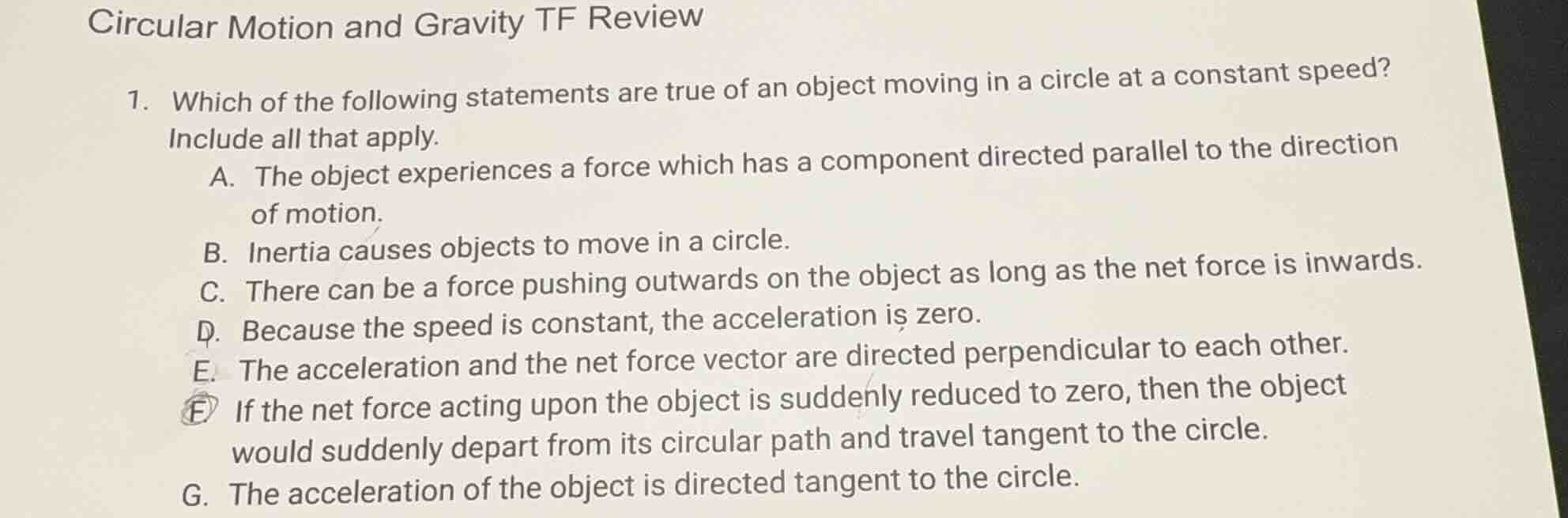
circular motion and gravity tf review
- which of the following statements are true of an object moving in a circle at a constant speed?
include all that apply.
a. the object experiences a force which has a component directed parallel to the direction
of motion.
b. inertia causes objects to move in a circle.
c. there can be a force pushing outwards on the object as long as the net force is inwards.
d. because the speed is constant, the acceleration is zero.
e. the acceleration and the net force vector are directed perpendicular to each other.
f. if the net force acting upon the object is suddenly reduced to zero, then the object
would suddenly depart from its circular path and travel tangent to the circle.
g. the acceleration of the object is directed tangent to the circle.
- Option A: For uniform circular motion, the net force is centripetal (perpendicular to motion), so no parallel component. False.
- Option B: Inertia makes objects move in straight lines; centripetal force causes circular motion. False.
- Option C: Multiple forces can act, as long as the net force points inward (centripetal). True.
- Option D: Constant speed does not mean zero acceleration—direction changes, so centripetal acceleration exists. False.
- Option E: Net force and acceleration are in the same direction (inward, parallel), not perpendicular. False.
- Option F: If net force is zero, inertia makes the object move in a straight line tangent to the circle. True.
- Option G: Acceleration is centripetal (toward the center), not tangent. False.

Snap & solve any problem in the app
Get step-by-step solutions on Sovi AI
Photo-based solutions with guided steps
Explore more problems and detailed explanations
C. There can be a force pushing outwards on the object as long as the net force is inwards.
F. If the net force acting upon the object is suddenly reduced to zero, then the object would suddenly depart from its circular path and travel tangent to the circle.