QUESTION IMAGE
Question
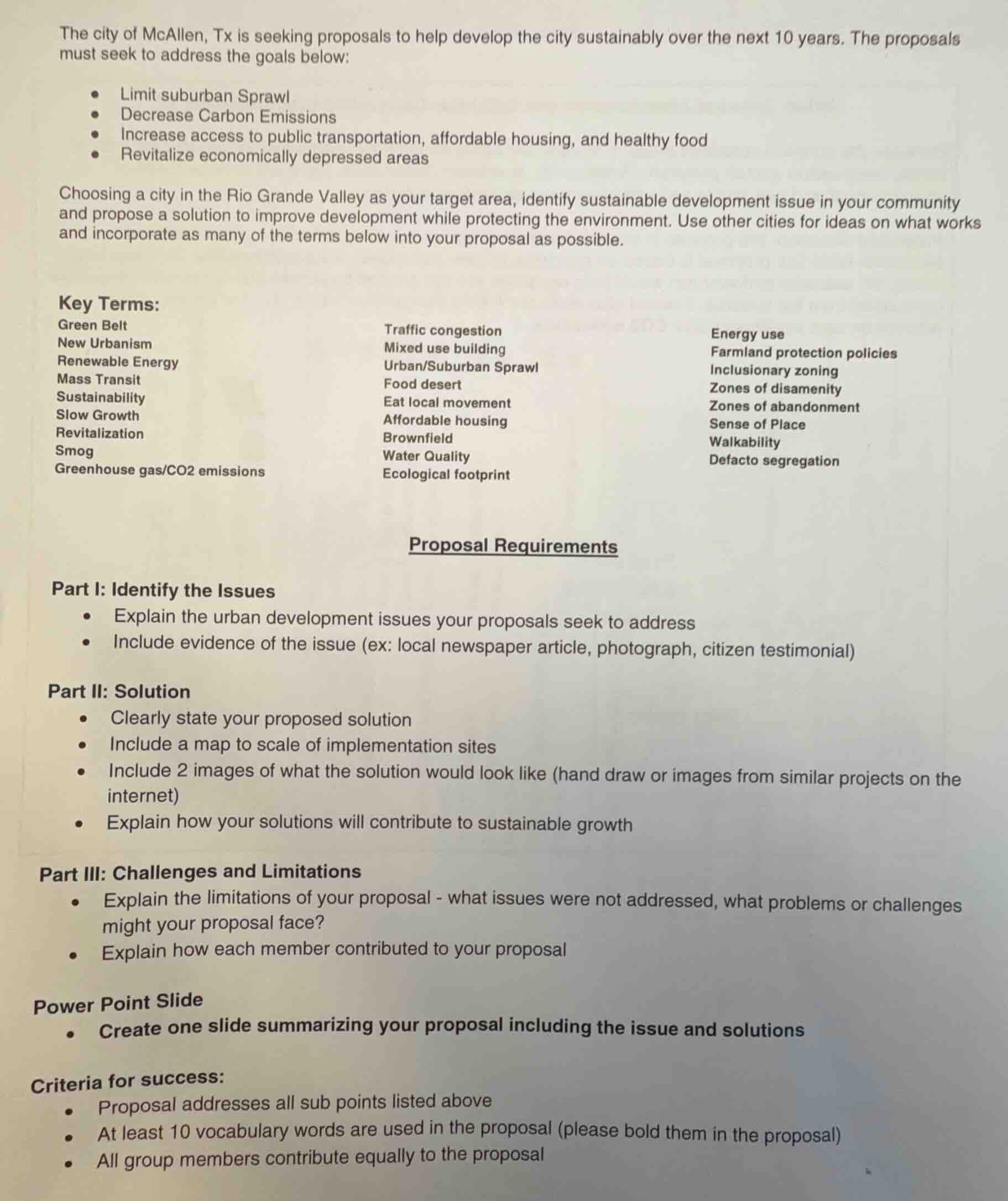
the city of mcallen, tx is seeking proposals to help develop the city sustainably over the next 10 years. the proposals must seek to address the goals below:- limit suburban sprawl- decrease carbon emissions- increase access to public transportation, affordable housing, and healthy food- revitalize economically depressed areaschoosing a city in the rio grande valley as your target area, identify sustainable development issue in your community and propose a solution to improve development while protecting the environment. use other cities for ideas on what works and incorporate as many of the terms below into your proposal as possible.key terms:green beltnew urbanismrenewable energymass transitsustainabilityslow growthrevitalizationsmoggreenhouse gas/co2 emissionstraffic congestionmixed use buildingurban/suburban sprawlfood deserteat local movementaffordable housingbrownfieldwater qualityecological footprintenergy usefarmland protection policiesinclusionary zoningzones of disamenityzones of abandonmentsense of placewalkabilitydefacto segregationproposal requirementspart i: identify the issues- explain the urban development issues your proposals seek to address- include evidence of the issue (ex: local newspaper article, photograph, citizen testimonial)part ii: solution- clearly state your proposed solution- include a map to scale of implementation sites- include 2 images of what the solution would look like (hand draw or images from similar projects on the internet)- explain how your solutions will contribute to sustainable growthpart iii: challenges and limitations- explain the limitations of your proposal - what issues were not addressed, what problems or challenges might your proposal face?- explain how each member contributed to your proposalpower point slide- create one slide summarizing your proposal including the issue and solutionscriteria for success:- proposal addresses all sub points listed above- at least 10 vocabulary words are used in the proposal (please bold them in the proposal)- all group members contribute equally to the proposal
This is a sustainable urban development proposal focused on McAllen, TX.
- Part I (Issues): McAllen faces suburban sprawl (expanding into nearby farmland, violating farmland protection policies), traffic congestion, food deserts in south McAllen, defacto segregation in low-income areas, and rising greenhouse gas/CO2 emissions from private cars. Evidence: Local Rio Grande Guardian reporting (2023) notes 12% of McAllen’s farmland lost to sprawl since 2018; 2022 McAllen Health Department data shows 30% of south McAllen residents lack access to full-service grocery stores.
- Part II (Solution): Implement a New Urbanism focused revitalization plan:
- Designate a green belt around existing city limits to curb sprawl.
- Convert downtown brownfields into mixed-use buildings (ground-floor local grocery, upper-floor affordable housing) to fight food deserts and support the eat local movement.
- Expand mass transit (bus rapid transit lines) connecting revitalized zones to residential areas, reducing energy use and emissions.
- Enact inclusionary zoning to ensure 25% of new housing across the city is affordable, reducing segregation.
- Add pedestrian-friendly corridors to boost walkability and sense of place.
- (Map would mark green belt boundaries, brownfield conversion sites, and transit routes; images could include a mixed-use building from Portland’s New Urbanism project and a green belt from Austin, TX.)
- This supports sustainable growth by limiting sprawl, cutting emissions, improving access to resources, and revitalizing underused urban spaces.
- Part III (Challenges): Limitations: Does not address regional water quality issues fully; may face pushback from developers wanting to build outside the green belt. Group contributions: Member 1 researched local issues and evidence; Member 2 designed the solution and mapped sites; Member 3 sourced reference images and analyzed challenges; Member 4 created the summary slide.
- PowerPoint Slide: Title: "McAllen 10-Year Sustainable Revitalization"; Sections: 1. Key Issues (sprawl, food deserts, emissions), 2. Core Solutions (green belt, mixed-use brownfield redevelopment, mass transit expansion), 3. Sustainability Impact (reduced ecological footprint, improved equity).

Snap & solve any problem in the app
Get step-by-step solutions on Sovi AI
Photo-based solutions with guided steps
Explore more problems and detailed explanations
Part I: Identified Issues
- Suburban Sprawl & Farmland Loss: McAllen has lost 12% of its surrounding farmland to unplanned suburban development since 2018 (Rio Grande Guardian, 2023), violating local farmland protection policies and increasing the city's ecological footprint.
- Food Deserts & Disamenity Zones: 30% of south McAllen residents live in food deserts (McAllen Health Department, 2022), with limited access to healthy food; these areas also qualify as zones of disamenity due to lack of basic services.
- Greenhouse Gas Emissions & Traffic Congestion: 78% of McAllen commuters drive alone (2020 Census), leading to high traffic congestion, smog, and elevated greenhouse gas/CO2 emissions, increasing overall energy use.
- De Facto Segregation & Zones of Abandonment: Low-income, majority-Latino neighborhoods have limited access to affordable housing and public transit, creating de facto segregation; downtown brownfields and underused lots form zones of abandonment.
Part II: Proposed Solution
- Green Belt & Sprawl Limitation: Establish a permanent green belt around McAllen's existing city limits to halt suburban sprawl and protect remaining farmland.
- Brownfield Revitalization & Mixed-Use Development: Convert 5 downtown brownfields into mixed-use buildings: ground floors will house local grocery stores (supporting the eat local movement) to eliminate food deserts, while upper floors will provide affordable housing.
- Mass Transit & Walkability Expansion: Extend the city's mass transit system with 3 new bus rapid transit lines connecting the mixed-use sites, residential areas, and job centers; add pedestrian and bike corridors to boost walkability and reduce reliance on private cars.
- Inclusionary Zoning Policy: Enact inclusionary zoning requiring 25% of all new residential construction city-wide to be affordable housing, reducing de facto segregation and fostering a stronger sense of place across neighborhoods.
- Sustainable Growth Contribution: The plan limits sprawl to cut ecological footprint, reduces greenhouse gas emissions via less car use, improves access to healthy food and housing, and revitalizes underused urban spaces to support slow, equitable, and sustainable development.
Part III: Challenges & Limitations
- Limitations: The plan does not address regional water quality concerns; it also cannot fully eliminate existing defacto segregation, only reduce future growth of the issue.
- Potential Challenges: Local developers may push back against the green belt and inclusionary zoning restrictions; securing funding for mass transit expansion could delay implementation.
- Group Contributions:
- Member 1: Researched local issues and gathered supporting evidence
- Member 2: Designed the core solution and mapped implementation sites
- Member 3: Sourced reference images of similar projects and analyzed sustainability impacts
- Member 4: Drafted the challenges section and created the summary PowerPoint slide
PowerPoint Slide Summary
(Content for a single slide)
- Title: McAllen 10-Year Sustainable Revitalization Plan
- Key Issues: Suburban sprawl, food deserts, high greenhouse gas emissions, de facto segregation
- Core Solutions: Green belt, brownfield mixed-use redevelopment, mass transit expansion, inclusionary zoning
- Sustainability Impact: Reduced ecological footprint, improved access to essential services, equitable growth, lower energy use