QUESTION IMAGE
Question
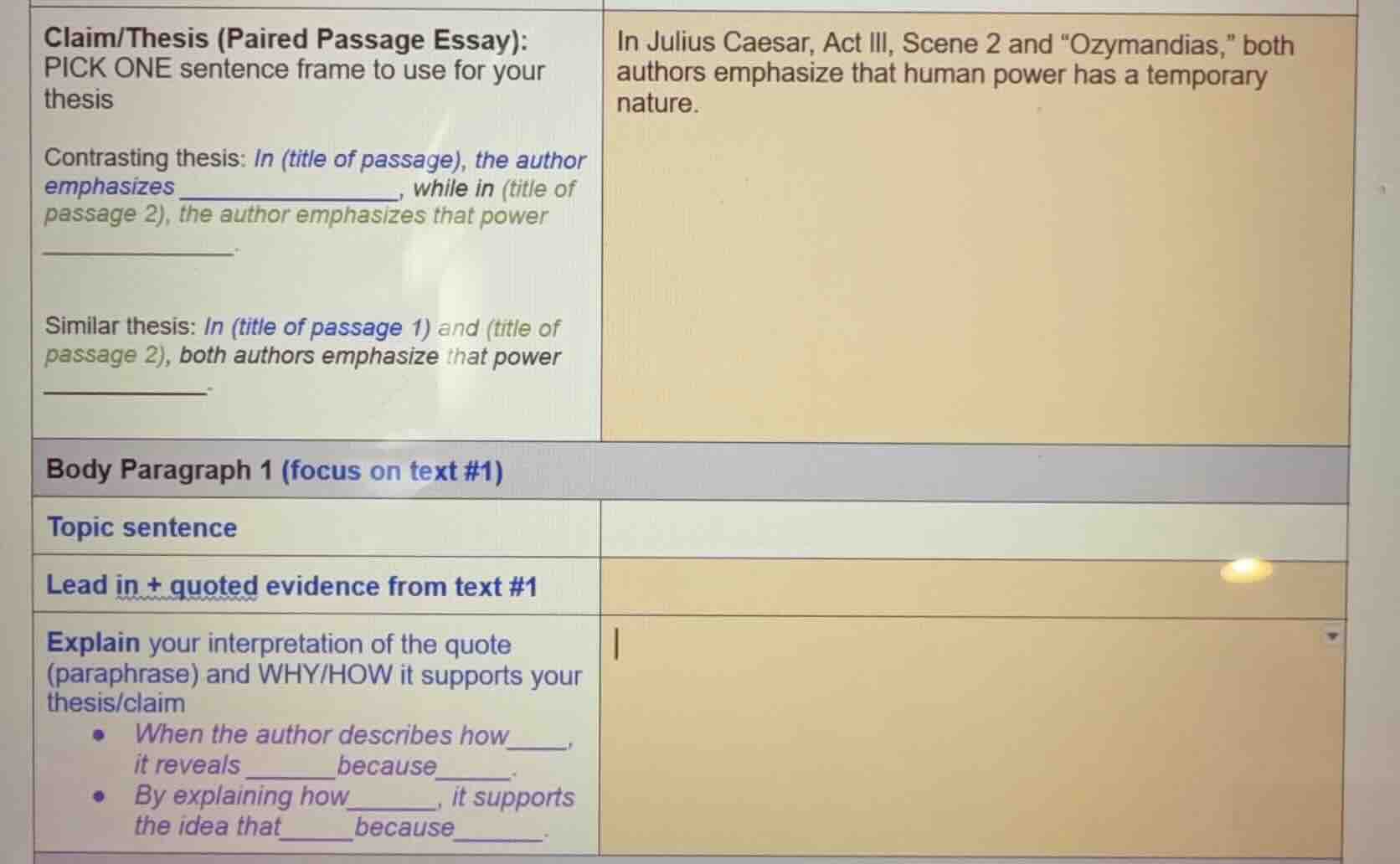
claim/thesis (paired passage essay):
pick one sentence frame to use for your
thesis
contrasting thesis: in (title of passage), the author
emphasizes _______________, while in (title of
passage 2), the author emphasizes that power
_______________.
similar thesis: in (title of passage 1) and (title of
passage 2), both authors emphasize that power
_______________.
in julius caesar, act iii, scene 2 and \ozymandias,\ both
authors emphasize that human power has a temporary
nature.
body paragraph 1 (focus on text #1)
topic sentence
lead in + quoted evidence from text #1
explain your interpretation of the quote
(paraphrase) and why/how it supports your
thesis/claim
- when the author describes how______,
it reveals ____because____.
- by explaining how______, it supports
the idea that____because____.
This builds a paired passage essay focused on the temporary nature of human power. For Julius Caesar, Act III, Scene 2, we use Antony's speech to show Caesar's fallen power; for Ozymandias, we use the ruined statue to illustrate the king's faded legacy.

Snap & solve any problem in the app
Get step-by-step solutions on Sovi AI
Photo-based solutions with guided steps
Explore more problems and detailed explanations
Claim/Thesis (Paired Passage Essay):
In Julius Caesar, Act III, Scene 2 and "Ozymandias," both authors emphasize that power is fleeting and cannot withstand the test of time.
Body Paragraph 1 (focus on text #1: Julius Caesar, Act III, Scene 2)
Topic sentence:
Julius Caesar’s sudden fall exposes how quickly absolute power can vanish.
Lead in + quoted evidence from text #1:
After Caesar’s assassination, Mark Antony addresses the crowd, stating, "The noble Brutus Hath told you Caesar was ambitious: If it were so, it was a grievous fault, And grievously hath Caesar answer'd it" (III.ii.79-82), later adding "My heart is in the coffin there with Caesar, And I must pause till it come back to me" (III.ii.106-107).
Explain your interpretation of the quote (paraphrase) and WHY/HOW it supports your thesis/claim:
- When the author describes how Caesar, once a revered ruler, is reduced to a corpse whose legacy is debated, it reveals that even the most powerful figures can be toppled overnight because power relies on the support and perception of others, which can shift instantly.
- By explaining how Antony’s speech highlights the fragility of Caesar’s power, it supports the idea that human power is temporary because Caesar’s authority dissolves the moment he is killed, with no way to maintain his control from the grave.