QUESTION IMAGE
Question
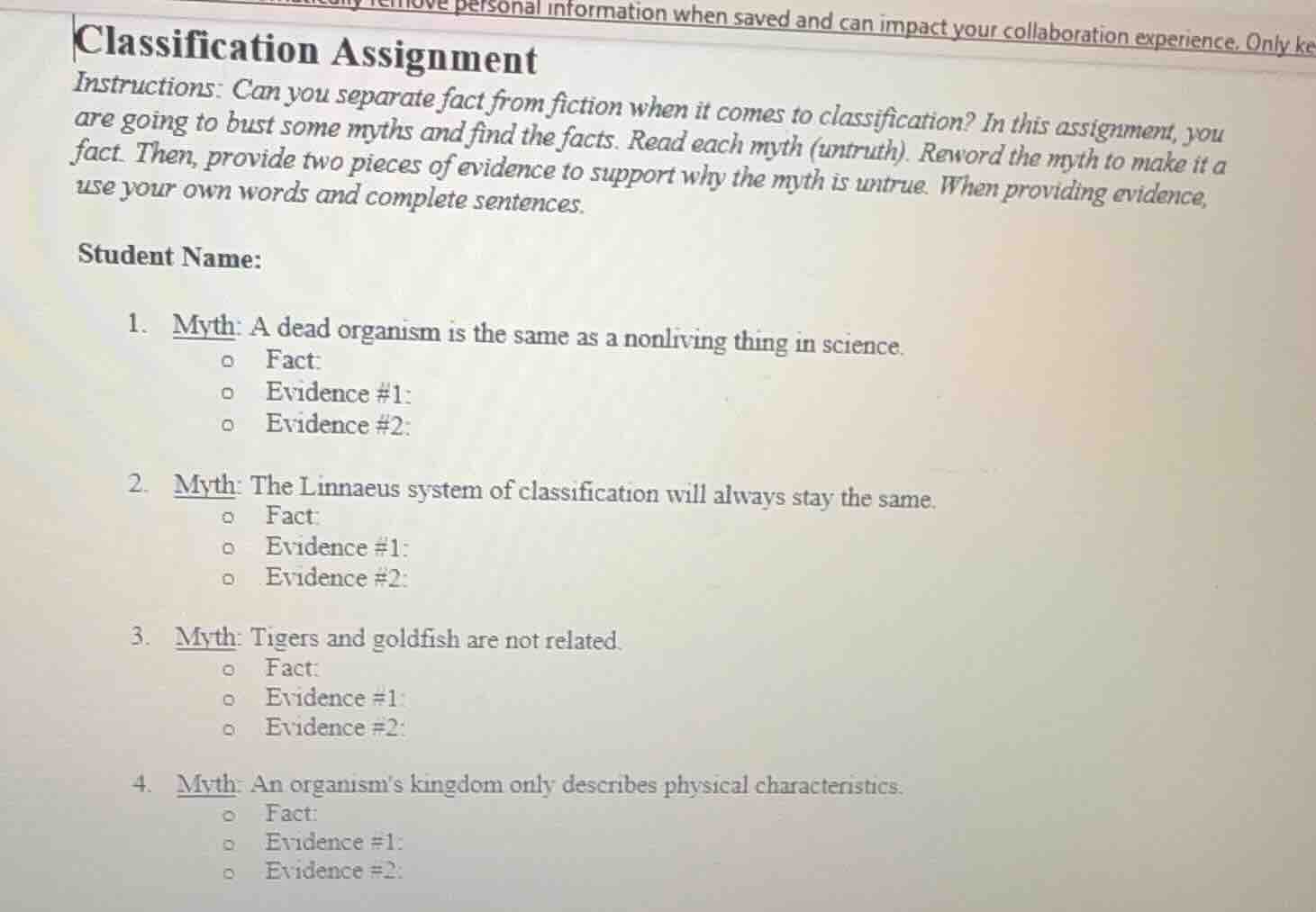
classification assignment
instructions: can you separate fact from fiction when it comes to classification? in this assignment, you are going to bust some myths and find the facts. read each myth (untruth). reword the myth to make it a fact. then, provide two pieces of evidence to support why the myth is untrue. when providing evidence, use your own words and complete sentences.
student name:
- myth: a dead organism is the same as a nonliving thing in science.
- fact:
- evidence #1:
- evidence #2:
- myth: the linnaeus system of classification will always stay the same.
- fact:
- evidence #1:
- evidence #2:
- myth: tigers and goldfish are not related.
- fact:
- evidence #1:
- evidence #2:
- myth: an organisms kingdom only describes physical characteristics.
- fact:
- evidence #1:
- evidence #2:
Brief Explanations
- For the first myth: Distinguish dead organisms from nonliving things by their past biological function and cellular structure.
- Fact: A dead organism is biologically distinct from a nonliving thing in science.
- Evidence #1: Dead organisms were once living and had cellular structures that performed life functions, while nonliving things never had these.
- Evidence #2: Dead organisms can undergo decomposition by other living organisms, a process that does not occur with nonliving objects like rocks.
- For the second myth: Note that scientific classification systems evolve with new evidence.
- Fact: The Linnaeus system of classification is updated as new scientific data emerges.
- Evidence #1: The addition of the domain taxonomic level above kingdom was a later revision to the original Linnaean system.
- Evidence #2: Genetic sequencing has led to reclassification of some organisms, like moving fungi from the plant kingdom to their own separate kingdom.
- For the third myth: Establish the shared evolutionary ancestry of tigers and goldfish.
- Fact: Tigers and goldfish share a distant evolutionary relationship.
- Evidence #1: Both are classified as animals (kingdom Animalia), meaning they are multicellular, heterotrophic eukaryotes.
- Evidence #2: Genetic studies show both have common ancestral eukaryotic organisms that lived hundreds of millions of years ago.
- For the fourth myth: Explain that kingdom classification includes more than just physical traits.
- Fact: An organism's kingdom describes biological, genetic, and functional traits, not just physical characteristics.
- Evidence #1: Fungi were reclassified from plants to their own kingdom based on their heterotrophic nutrition (absorbing nutrients) rather than photosynthesis, despite some superficial physical similarities to plants.
- Evidence #2: Protists are grouped by their cellular complexity and evolutionary history, not just uniform physical features, as they include single-celled and multicellular forms.

Snap & solve any problem in the app
Get step-by-step solutions on Sovi AI
Photo-based solutions with guided steps
Explore more problems and detailed explanations
1.
- Fact: A dead organism is biologically distinct from a nonliving thing in science.
- Evidence #1: Dead organisms were once living and had cellular structures that performed life functions, while nonliving things never had these.
- Evidence #2: Dead organisms can undergo decomposition by other living organisms, a process that does not occur with nonliving objects like rocks.
2.
- Fact: The Linnaeus system of classification is updated as new scientific data emerges.
- Evidence #1: The addition of the domain taxonomic level above kingdom was a later revision to the original Linnaean system.
- Evidence #2: Genetic sequencing has led to reclassification of some organisms, like moving fungi from the plant kingdom to their own separate kingdom.
3.
- Fact: Tigers and goldfish share a distant evolutionary relationship.
- Evidence #1: Both are classified as animals (kingdom Animalia), meaning they are multicellular, heterotrophic eukaryotes.
- Evidence #2: Genetic studies show both have common ancestral eukaryotic organisms that lived hundreds of millions of years ago.
4.
- Fact: An organism's kingdom describes biological, genetic, and functional traits, not just physical characteristics.
- Evidence #1: Fungi were reclassified from plants to their own kingdom based on their heterotrophic nutrition (absorbing nutrients) rather than photosynthesis, despite some superficial physical similarities to plants.
- Evidence #2: Protists are grouped by their cellular complexity and evolutionary history, not just uniform physical features, as they include single-celled and multicellular forms.