QUESTION IMAGE
Question
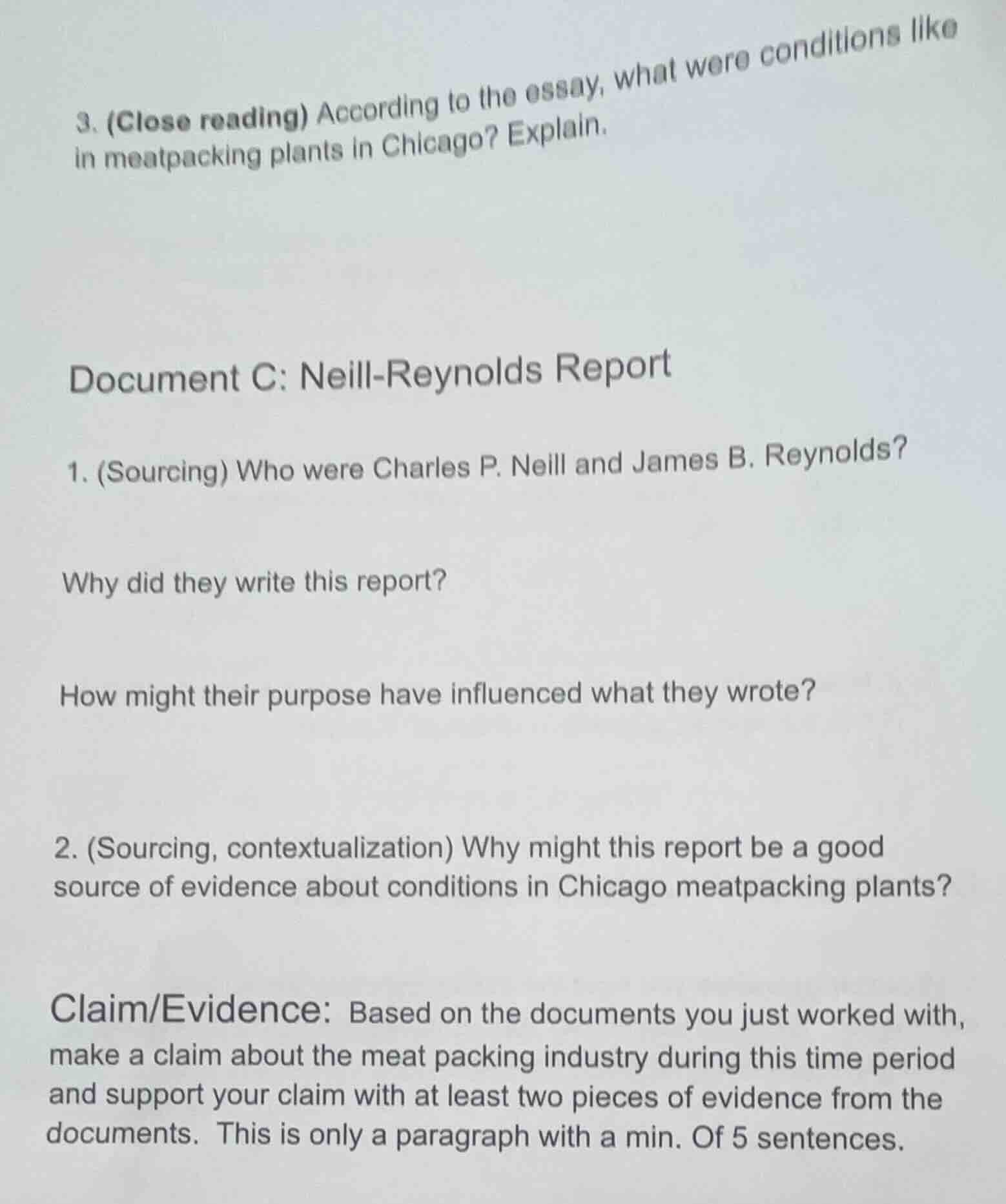
- (close reading) according to the essay, what were conditions like in meatpacking plants in chicago? explain.
document c: neill-reynolds report
- (sourcing) who were charles p. neill and james b. reynolds?
why did they write this report?
how might their purpose have influenced what they wrote?
- (sourcing, contextualization) why might this report be a good source of evidence about conditions in chicago meatpacking plants?
claim/evidence: based on the documents you just worked with, make a claim about the meat packing industry during this time period and support your claim with at least two pieces of evidence from the documents. this is only a paragraph with a min. of 5 sentences.
To answer these questions, we analyze each part:
Question 1 (Sourcing):
- Who were Charles P. Neill and James B. Reynolds?
Charles P. Neill and James B. Reynolds were government investigators (often linked to labor or industry oversight) tasked with examining conditions in Chicago’s meatpacking plants, likely during the era of Upton Sinclair’s The Jungle (late 19th/early 20th century).
- Why did they write this report?
They wrote the report to document working and sanitary conditions in meatpacking plants, likely to inform policy or expose issues (e.g., labor exploitation, unsanitary practices) for reform.
- How might their purpose have influenced what they wrote?
Their goal of exposing problems would lead them to emphasize negative conditions (e.g., unsafe workspaces, unsanitary food handling) to persuade policymakers or the public to act.
Question 2 (Sourcing, Contextualization):
This report is a good source because:
- Primary Source: It is a firsthand account from investigators who observed the plants directly, reducing bias from secondary interpretation.
- Objective (Likely): As government agents, their role was to document facts (not sensationalize, unlike Sinclair’s novel), so their observations are more fact - based.
- Timeliness: Written during the era of meatpacking industry growth, it captures conditions in real - time, making it relevant to the period.
Claim/Evidence (Meatpacking Industry Conditions):
The meatpacking industry during this period had abysmal working and sanitary conditions. First, the Neill - Reynolds Report (Document C) likely documented unsafe workspaces, where workers faced hazardous machinery and long hours with little protection. Second, other contemporary accounts (like The Jungle) and this report reveal unsanitary practices, such as meat being contaminated by dirt, rat droppings, or diseased animals, showing the industry prioritized profit over worker safety or food purity. These conditions highlight a system where exploitation of labor and disregard for public health were rampant, leading to calls for regulatory reform (e.g., the Pure Food and Drug Act).
(Note: For full accuracy, access the actual Neill - Reynolds Report or contextual documents. The above is based on historical knowledge of the era’s meatpacking industry and typical sourcing analysis.)

Snap & solve any problem in the app
Get step-by-step solutions on Sovi AI
Photo-based solutions with guided steps
Explore more problems and detailed explanations
To answer these questions, we analyze each part:
Question 1 (Sourcing):
- Who were Charles P. Neill and James B. Reynolds?
Charles P. Neill and James B. Reynolds were government investigators (often linked to labor or industry oversight) tasked with examining conditions in Chicago’s meatpacking plants, likely during the era of Upton Sinclair’s The Jungle (late 19th/early 20th century).
- Why did they write this report?
They wrote the report to document working and sanitary conditions in meatpacking plants, likely to inform policy or expose issues (e.g., labor exploitation, unsanitary practices) for reform.
- How might their purpose have influenced what they wrote?
Their goal of exposing problems would lead them to emphasize negative conditions (e.g., unsafe workspaces, unsanitary food handling) to persuade policymakers or the public to act.
Question 2 (Sourcing, Contextualization):
This report is a good source because:
- Primary Source: It is a firsthand account from investigators who observed the plants directly, reducing bias from secondary interpretation.
- Objective (Likely): As government agents, their role was to document facts (not sensationalize, unlike Sinclair’s novel), so their observations are more fact - based.
- Timeliness: Written during the era of meatpacking industry growth, it captures conditions in real - time, making it relevant to the period.
Claim/Evidence (Meatpacking Industry Conditions):
The meatpacking industry during this period had abysmal working and sanitary conditions. First, the Neill - Reynolds Report (Document C) likely documented unsafe workspaces, where workers faced hazardous machinery and long hours with little protection. Second, other contemporary accounts (like The Jungle) and this report reveal unsanitary practices, such as meat being contaminated by dirt, rat droppings, or diseased animals, showing the industry prioritized profit over worker safety or food purity. These conditions highlight a system where exploitation of labor and disregard for public health were rampant, leading to calls for regulatory reform (e.g., the Pure Food and Drug Act).
(Note: For full accuracy, access the actual Neill - Reynolds Report or contextual documents. The above is based on historical knowledge of the era’s meatpacking industry and typical sourcing analysis.)