QUESTION IMAGE
Question
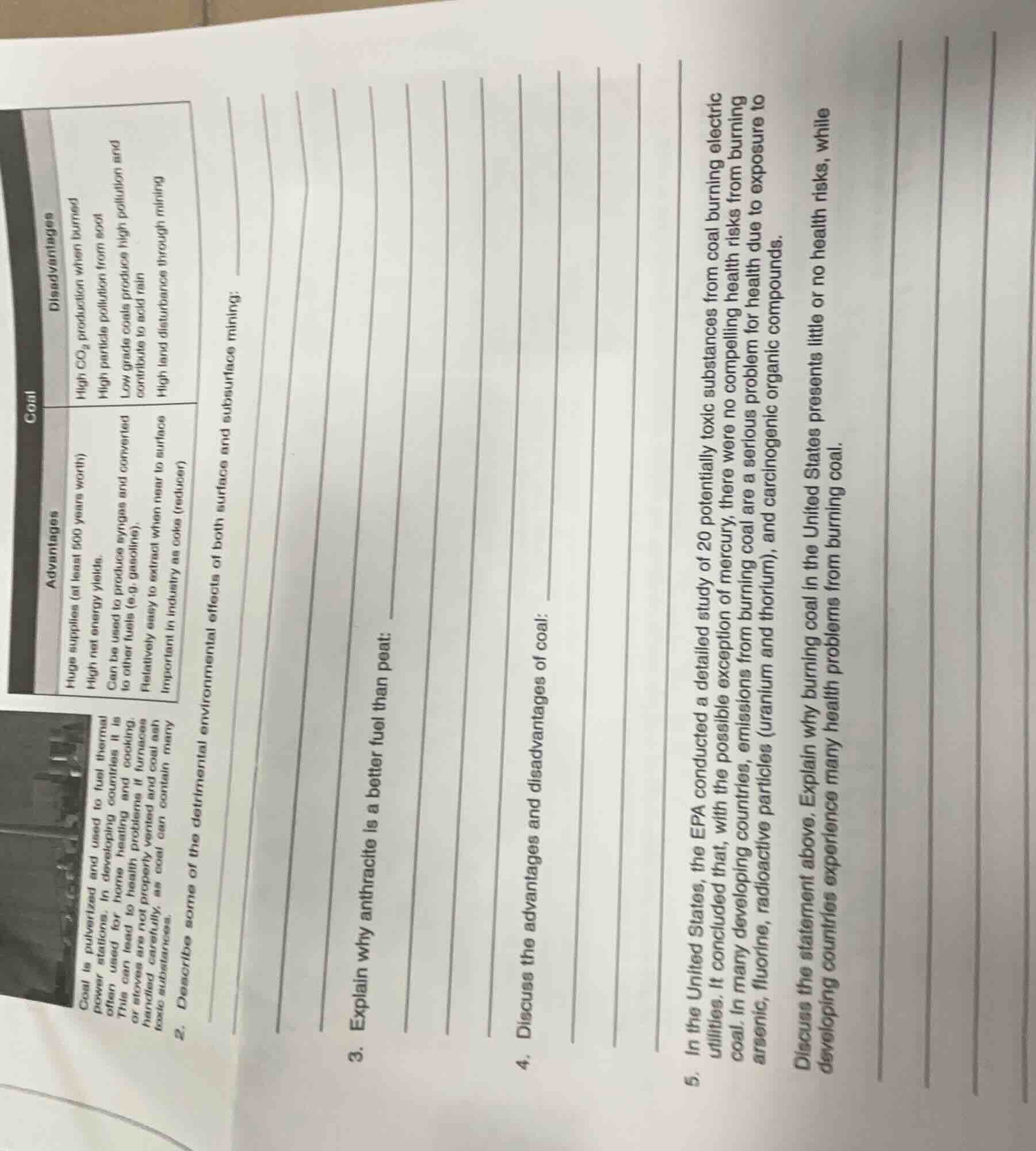
coal
advantages
huge supplies (at least 500 years worth)
high net energy yields.
can be used to produce syngas and converted to other fuels (e.g gasoline).
relatively easy to extract when near to surface
important in industry as coke (reducer)
disadvantages
high co₂ production when burned
high particle pollution from soot
low grade coals produce high pollution and contributes to acid rain
high land disturbance through mining
coal is pulverized and used to fuel thermal power stations. in developing countries often used for home heating and cooking. this can lead to health problems if furnaces or stoves are not properly vented and coal ash handled carefully, as coal can contain many toxic substances
- describe some of the detrimental environmental effects of both surface and subsurface mining:
- explain why anthracite is a better fuel than peat:
- discuss the advantages and disadvantages of coal:
- in the united states, the epa conducted a detailed study of 20 potentially toxic substances from coal burning electric utilities. it concluded that, with the exception of mercury, there were no compelling health risks from burning coal. in many developing countries, emissions from burning coal are a serious problem for health due to exposure to arsenic, fluorine, radioactive particles (uranium and thorium), and carcinogenic organic compounds.
discuss the statement above. explain why burning coal in the united states presents little or no health risks, while developing countries experience many health problems from burning coal.
Question 2: Describe some of the detrimental environmental effects of both surface and subsurface mining.
- Surface Mining (e.g., Strip Mining):
- Habitat Destruction: Large areas of land are cleared, removing vegetation and disrupting ecosystems, which displaces wildlife and reduces biodiversity.
- Soil Erosion: Exposed soil is vulnerable to erosion by wind and water, leading to sedimentation in nearby water bodies, which can harm aquatic life and degrade water quality.
- Water Pollution: Mining activities can contaminate surface water with heavy metals (like mercury, lead) and chemicals used in the mining process. Runoff from mines can also carry sediment and pollutants into rivers, lakes, and wetlands.
- Land Degradation: The mined area often becomes a barren landscape (spoil banks) that is difficult to rehabilitate, as the topsoil and natural vegetation are removed.
- Subsurface Mining (e.g., Underground Mining):
- Subsidence: Underground mines can cause the land surface to sink (subsidence) or collapse, damaging infrastructure (buildings, roads) and altering landscapes. This can also affect groundwater tables and surface water flow.
- Water Contamination: Underground mines can release acidic mine drainage (AMD) when sulfide minerals (e.g., pyrite) react with water and oxygen, producing sulfuric acid. AMD is highly acidic and can leach heavy metals from rocks, contaminating groundwater and surface water, making it toxic to plants, animals, and humans.
- Air Pollution: Ventilation systems in underground mines can release dust, methane (a greenhouse gas), and other pollutants into the atmosphere. Methane emissions contribute to climate change, and dust can cause respiratory problems for miners and nearby communities.
- Habitat Disruption: Although less direct than surface mining, subsurface mining can still disrupt ecosystems by altering groundwater flow, which affects vegetation and wildlife that depend on stable water sources.
- Energy Content (Calorific Value): Anthracite is a high - rank coal with a high carbon content (around 86 - 98% carbon) and low moisture and volatile matter. This gives it a much higher energy content (calorific value) per unit mass compared to peat. Peat is an early - stage fossil fuel with a low carbon content (around 50 - 60% carbon) and high moisture content (up to 90% in some cases). When burned, anthracite releases more heat energy per gram than peat.
- Combustion Efficiency: Anthracite burns more cleanly and efficiently than peat. Peat has a high moisture content, which means a significant amount of the energy released during combustion is used to vaporize the water, reducing its overall efficiency. Anthracite, with its low moisture and volatile matter, burns with less smoke, soot, and unburnt residues.
- Pollution Levels: Peat combustion produces more pollutants per unit of energy released. Its high moisture and volatile matter content lead to higher emissions of particulate matter, carbon monoxide, and unburnt hydrocarbons. Anthracite, being a high - carbon, low - volatile fuel, produces fewer pollutants like particulate matter and volatile organic compounds during combustion.
- Availability and Handling: Anthracite is more compact and less bulky than peat, making it easier to transport, store, and handle. Peat is often spongy, has a low density, and is more difficult to handle and transport efficiently.
- Advantages of Coal:
- Abundant Supply: Coal reserves are large globally, providing a reliable and long - term energy source (e.g., the text mentions “huge supplies (at least 500 years worth)” in some regions).
- High Energy Density: Coal has a relatively high energy content, meaning it can produce a large amount of heat energy when burned, making it effective for electricity generation, industrial processes (e.g., steel production), and heating.
- Versatility: It can be used for multiple purposes: electricity generation in power plants, as a reducing agent in the iron and steel industry (coke production), and can be converted into synthetic fuels (syngas, gasoline) through processes like gasification and liquefaction.
- Infrastructure and Employment: There is a well - established infrastructure for coal mining, transportation, and power generation, which supports jobs in mining, transportation, and power plant operations, contributing to local and national economies.
- Disadvantages of Coal:
- Environmental Pollution (Burning):
- Greenhouse Gas Emissions: Burning coal releases large amounts of carbon dioxide ($\ce{CO_2}$), a major greenhouse gas, contributing to climate change and global warming.
- Particulate Matter and Air Pollution: Coal combustion produces soot, particulate matter (PM), and other pollutants (e.g., sulfur dioxide, nitrogen oxides) that cause respiratory problems, smog, and acid rain. Sulfur dioxide ($\ce{SO_2}$) and nitrogen oxides ($\ce{NO_x}$) react with water in the atmosphere to form sulfuric and nitric acids, leading to acid rain, which damages forests, lakes, and buildings.
- Toxic Emissions: Burning coal can release toxic substances like mercury, arsenic, and radioactive particles (uranium, thorium), which can contaminate air, water, and soil, posing health risks (e.g., mercury bioaccumulates in the food chain, affecting human health).
- Environmental Impact (Mining):
- Surface Mining: Causes habitat destruction, soil erosion, water pollution, and land degradation (as discussed in Question 2).
- Subsurface Mining: Leads to subsidence, water contamination (acidic mine drainage), and air pollution (methane, dust).
- Non - Renewable: Coal is a non - renewable resource, meaning it will eventually be depleted, and its extraction and use are not sustainable in the long term without transitioning to renewable energy sources.

Snap & solve any problem in the app
Get step-by-step solutions on Sovi AI
Photo-based solutions with guided steps
Explore more problems and detailed explanations
- Surface Mining: Causes habitat destruction (clearing vegetation, displacing wildlife), soil erosion (sedimentation in water bodies), water pollution (heavy metals, chemicals in runoff), and land degradation (barren spoil banks).
- Subsurface Mining: Leads to subsidence (land sinking/collapse, damaging infrastructure), water contamination (acidic mine drainage with heavy metals), air pollution (methane, dust emissions), and habitat disruption (altered groundwater flow).