QUESTION IMAGE
Question
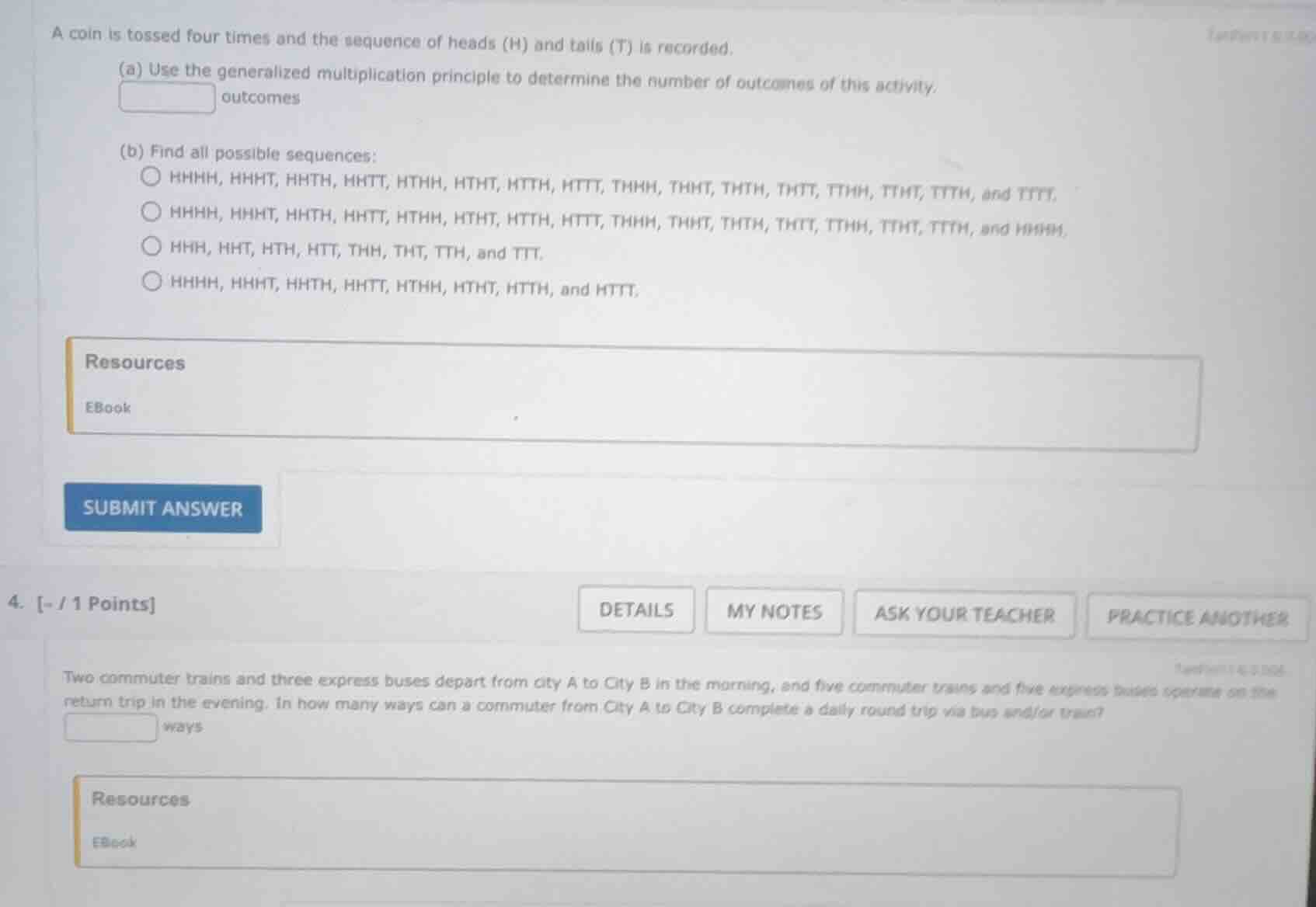
a coin is tossed four times and the sequence of heads (h) and tails (t) is recorded.
(a) use the generalized multiplication principle to determine the number of outcomes of this activity.
□ outcomes
(b) find all possible sequences:
○ hhhh, hhht, hhth, hhtt, hthh, htht, htth, httt, thhh, thht, thth, thtt, tthh, ttht, ttth, and tttt.
○ hhhh, hhht, hhth, hhtt, hthh, htht, htth, httt, thhh, thht, thth, thtt, tthh, ttht, ttth, and hhhh.
○ hhh, hht, hth, htt, thh, tht, tth, and ttt.
○ hhhh, hhht, hhth, hhtt, hthh, htht, htth, and httt.
resources
ebook
submit answer
- - / 1 points
details my notes ask your teacher practice another
two commuter trains and three express buses depart from city a to city b in the morning, and five commuter trains and five express buses operate on the return trip in the evening. in how many ways can a commuter from city a to city b complete a daily round trip via bus and/or train?
□ ways
resources
ebook
Step1: Calculate coin toss outcomes
Each toss has 2 results. For 4 tosses: $2 \times 2 \times 2 \times 2 = 2^4$
Step2: Evaluate the coin toss total
$2^4 = 16$
Step3: Morning travel options
Add trains and buses: $2 + 3 = 5$
Step4: Evening travel options
Add trains and buses: $5 + 5 = 10$
Step5: Calculate round trip ways
Multiply morning and evening options: $5 \times 10 = 50$
Step6: Verify coin sequences
List all 4-length H/T sequences (16 total)

Snap & solve any problem in the app
Get step-by-step solutions on Sovi AI
Photo-based solutions with guided steps
Explore more problems and detailed explanations
- (a) 16
(b) HHHH, HHHT, HHTH, HHTT, HTHH, HTHT, HTTH, HTTT, THHH, THHT, THTH, THTT, TTHH, TTHT, TTTH, and TTTT
- 50