QUESTION IMAGE
Question
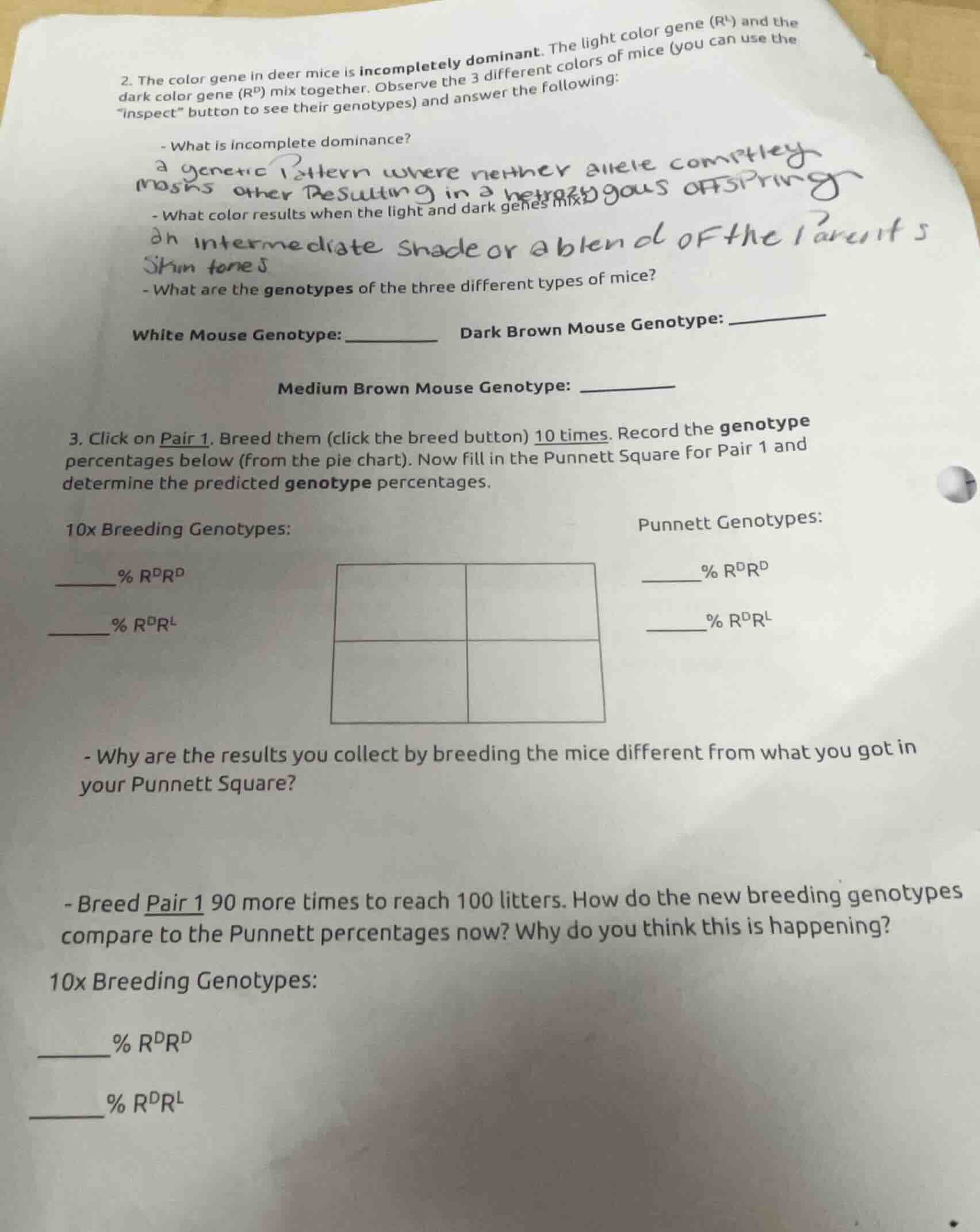
- the color gene in deer mice is incompletely dominant. the light color gene (r^l) and the dark color gene (r^d) mix together. observe the 3 different colors of mice (you can use the \inspect\ button to see their genotypes) and answer the following:
- what is incomplete dominance?
- what color results when the light and dark genes mix?
- what are the genotypes of the three different types of mice?
white mouse genotype: ____ dark brown mouse genotype: ____
medium brown mouse genotype: ______
- click on pair 1. breed them (click the breed button) 10 times. record the genotype percentages below (from the pie chart). now fill in the punnett square for pair 1 and determine the predicted genotype percentages.
10x breeding genotypes: \t\t\tpunnett genotypes:
____% r^d r^d \t\t\t____% r^d r^d
____% r^d r^l \t\t\t____% r^d r^l
- why are the results you collect by breeding the mice different from what you got in your punnett square?
- breed pair 1 90 more times to reach 100 litters. how do the new breeding genotypes compare to the punnett percentages now? why do you think this is happening?
10x breeding genotypes:
______% r^d r^d
______% r^d r^l
Question 2 (Genotypes of Mice)
For incomplete dominance, it's a genetic scenario where neither allele fully dominates the other, so the heterozygous offspring show a phenotype that's an intermediate blend of the two parental phenotypes. When light (\(R^L\)) and dark (\(R^D\)) genes mix, the resulting color is a medium brown (intermediate between light and dark). For genotypes:
- White (light) mouse: Since it's the light - colored phenotype and the light gene is \(R^L\), and in incomplete dominance for this case, the homozygous for light would be \(R^L R^L\) (assuming \(R^L\) is the allele for light color).
- Dark brown mouse: The dark - colored phenotype would be homozygous for the dark allele, so \(R^D R^D\).
- Medium brown mouse: This is the heterozygous case where both alleles are present, so \(R^D R^L\) (as the alleles mix to give an intermediate phenotype).
The Punnett Square gives the predicted theoretical probability of genotypes based on the laws of segregation and independent assortment. When we breed the mice 10 times, it's a small sample size. In small samples, random chance (sampling error) can cause the observed results (from breeding) to deviate from the expected probabilities calculated by the Punnett Square. For example, if the expected probability of a genotype is 50%, in 10 trials, we might get 40% or 60% due to the random nature of which gametes fuse during fertilization.
When we increase the number of breeding trials to 100 (10 + 90), the observed genotype percentages from breeding will get closer to the Punnett Square - predicted percentages. This is due to the law of large numbers. As the sample size (number of trials) increases, the effect of random chance (sampling error) decreases, and the observed frequencies approach the theoretical probabilities. For example, if the Punnett Square predicts 50% of a genotype, with 100 trials, the observed percentage will be much closer to 50% than with 10 trials.

Snap & solve any problem in the app
Get step-by-step solutions on Sovi AI
Photo-based solutions with guided steps
Explore more problems and detailed explanations
White Mouse Genotype: \(R^L R^L\)
Dark Brown Mouse Genotype: \(R^D R^D\)
Medium Brown Mouse Genotype: \(R^D R^L\)