QUESTION IMAGE
Question
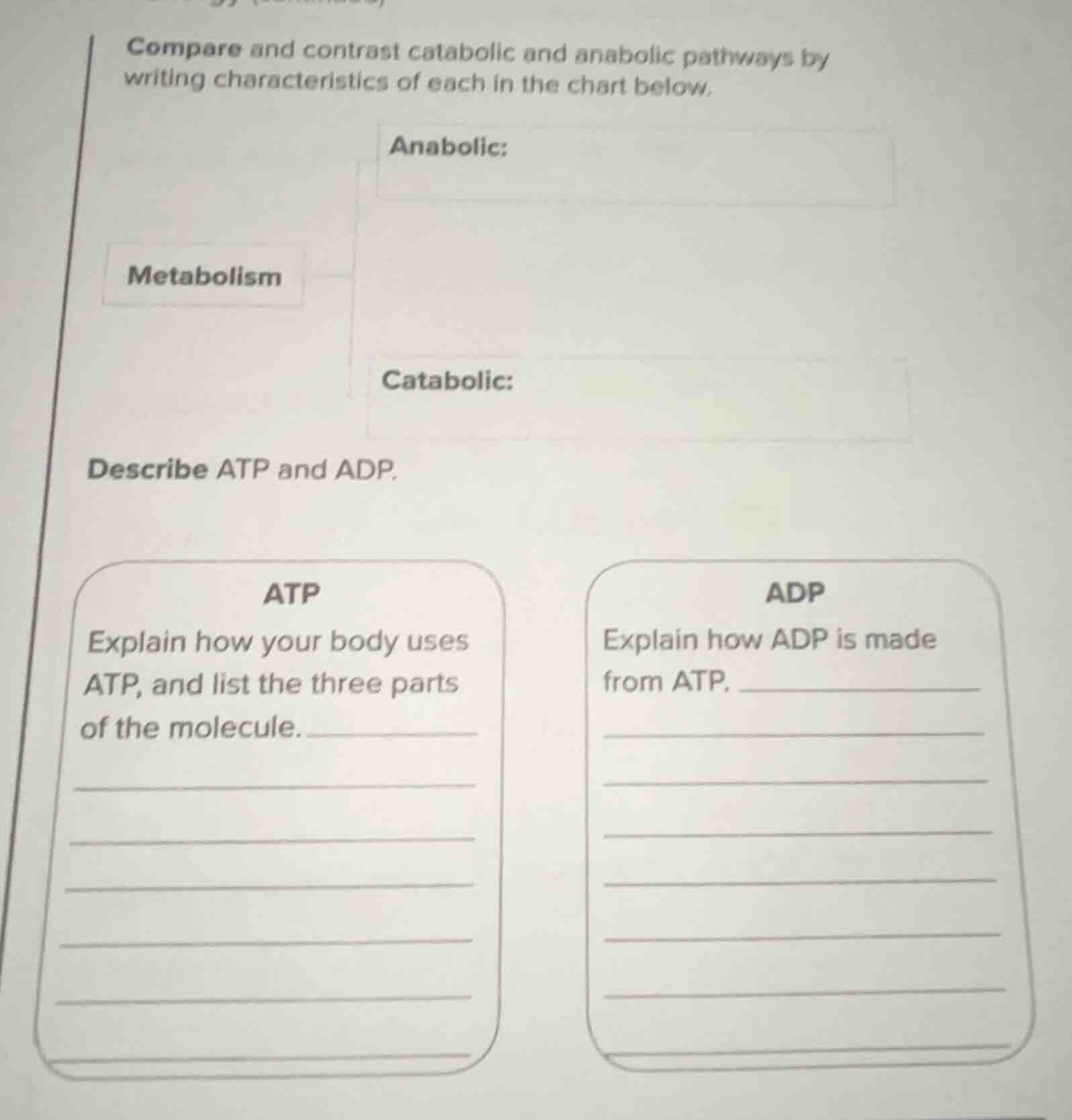
compare and contrast catabolic and anabolic pathways by writing characteristics of each in the chart below.
anabolic:
metabolism
catabolic:
describe atp and adp.
atp
explain how your body uses atp, and list the three parts of the molecule.
adp
explain how adp is made from atp.
Response
Part 1: Compare Anabolic and Catabolic Pathways (Chart)
| Metabolism Type | Characteristics |
|---|---|
| Catabolic | - Breaks down complex molecules into simpler ones <br> - Releases energy (exergonic) <br> - Example: Cellular respiration (breaking down glucose to release energy), digestion (breaking down food into nutrients) |
Part 2: Describe ATP and ADP
ATP (Adenosine Triphosphate)
- Structure: ATP is composed of three parts: a nitrogenous base (adenine), a five - carbon sugar (ribose), and three phosphate groups ($\text{PO}_4^{3 - }$).
- Function in the body: The body uses ATP as the primary energy currency. When a cell needs energy for processes like muscle contraction, active transport across cell membranes, or synthesis of macromolecules (like DNA or proteins), the high - energy bond between the second and third phosphate groups in ATP is broken. This releases energy that the cell can use to perform work.
ADP (Adenosine Diphosphate)
- Formation from ATP: ADP is formed when ATP undergoes hydrolysis. In this process, one of the phosphate groups is removed from ATP. The reaction can be represented as: $\text{ATP}\xrightarrow{\text{Water}} \text{ADP}+\text{Pi}+\text{Energy}$ (where $\text{Pi}$ is an inorganic phosphate group). When this phosphate group is removed, energy is released, and ATP is converted to ADP. This process is reversible, and ADP can be converted back to ATP during cellular respiration when a phosphate group is added back to ADP using energy from food breakdown.

Snap & solve any problem in the app
Get step-by-step solutions on Sovi AI
Photo-based solutions with guided steps
Explore more problems and detailed explanations
Part 1: Compare Anabolic and Catabolic Pathways (Chart)
| Metabolism Type | Characteristics |
|---|---|
| Catabolic | - Breaks down complex molecules into simpler ones <br> - Releases energy (exergonic) <br> - Example: Cellular respiration (breaking down glucose to release energy), digestion (breaking down food into nutrients) |
Part 2: Describe ATP and ADP
ATP (Adenosine Triphosphate)
- Structure: ATP is composed of three parts: a nitrogenous base (adenine), a five - carbon sugar (ribose), and three phosphate groups ($\text{PO}_4^{3 - }$).
- Function in the body: The body uses ATP as the primary energy currency. When a cell needs energy for processes like muscle contraction, active transport across cell membranes, or synthesis of macromolecules (like DNA or proteins), the high - energy bond between the second and third phosphate groups in ATP is broken. This releases energy that the cell can use to perform work.
ADP (Adenosine Diphosphate)
- Formation from ATP: ADP is formed when ATP undergoes hydrolysis. In this process, one of the phosphate groups is removed from ATP. The reaction can be represented as: $\text{ATP}\xrightarrow{\text{Water}} \text{ADP}+\text{Pi}+\text{Energy}$ (where $\text{Pi}$ is an inorganic phosphate group). When this phosphate group is removed, energy is released, and ATP is converted to ADP. This process is reversible, and ADP can be converted back to ATP during cellular respiration when a phosphate group is added back to ADP using energy from food breakdown.