QUESTION IMAGE
Question
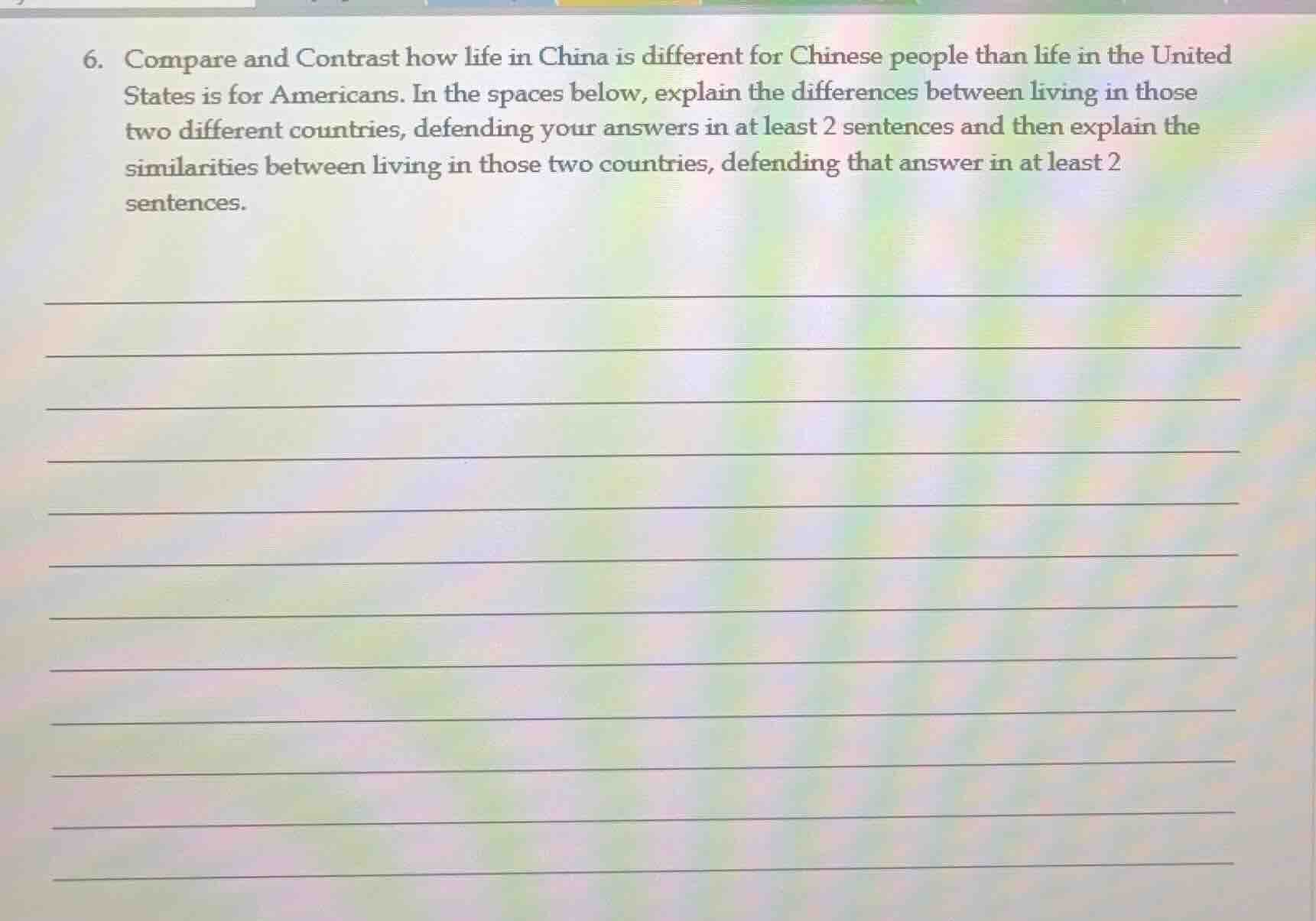
- compare and contrast how life in china is different for chinese people than life in the united states is for americans. in the spaces below, explain the differences between living in those two different countries, defending your answers in at least 2 sentences and then explain the similarities between living in those two countries, defending that answer in at least 2 sentences.
Differences:
One key difference is the emphasis on social collectivism in China versus individualism in the United States. In daily life, this means Chinese people often prioritize group goals, such as family or workplace harmony, over personal desires, for example, many young adults live with or financially support extended family members well into adulthood. In contrast, Americans typically focus on individual achievement and independence, with most young adults moving out of their family home in their late teens or early twenties to pursue their own education, careers, and living arrangements. Another difference lies in public infrastructure and daily convenience: China has a highly developed, low-cost public transit network (including high-speed rail, subways, and shared bikes) that makes urban and intercity travel accessible for most people, while the U.S. relies heavily on private automobiles, as public transit is limited or non-existent in many rural and suburban areas, creating higher transportation costs and barriers for those without access to a car.
Similarities:
Both countries have diverse, dynamic urban centers that attract people from across the nation and world for economic and cultural opportunities. In cities like Shanghai, Beijing, New York, and Los Angeles, residents have access to global cuisine, international art exhibits, and a wide range of professional fields, from tech to finance, that draw a multicultural workforce. Additionally, both populations place a high value on education as a path to upward mobility: Chinese families often invest heavily in after-school tutoring and extracurricular activities to help children gain admission to top universities, while American families prioritize college applications, standardized test preparation, and extracurricular achievements to secure spots in competitive higher education institutions, as a college degree is widely seen as a requirement for high-paying careers in both nations.

Snap & solve any problem in the app
Get step-by-step solutions on Sovi AI
Photo-based solutions with guided steps
Explore more problems and detailed explanations
Differences:
- China centers on collectivism, with daily life prioritizing group (family/work) harmony over individual needs; many adults support or live with extended family. The U.S. emphasizes individualism, with most young adults moving out independently in their late teens/early 20s to pursue personal goals.
- China has extensive, low-cost public transit (high-speed rail, subways) making travel accessible nationwide. The U.S. relies heavily on private cars, as public transit is limited in most non-urban areas, raising transportation costs for many.
Similarities:
- Both have diverse, globalized urban centers (Shanghai, Beijing, New York, LA) that attract multicultural populations, offering access to international culture, cuisine, and high-paying professional opportunities in fields like tech and finance.
- Education is widely viewed as a critical path to upward mobility in both countries; families in China and the U.S. invest heavily in tutoring, test prep, and extracurriculars to help children gain admission to top universities for better career prospects.