QUESTION IMAGE
Question
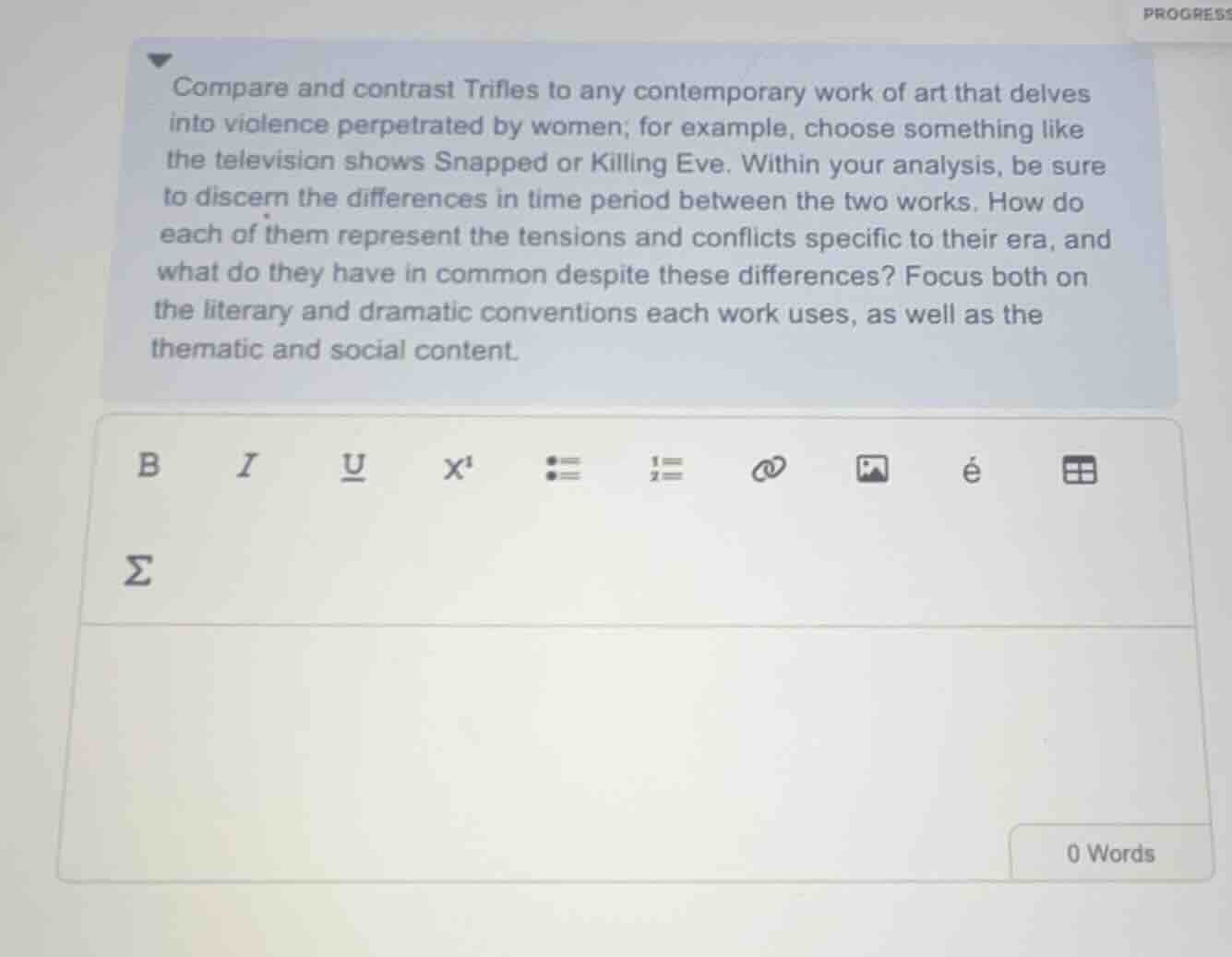
compare and contrast trifles to any contemporary work of art that delves into violence perpetrated by women; for example, choose something like the television shows snapped or killing eve. within your analysis, be sure to discern the differences in time period between the two works. how do each of them represent the tensions and conflicts specific to their era, and what do they have in common despite these differences? focus both on the literary and dramatic conventions each work uses, as well as the thematic and social content.
To address this, we analyze Trifles (a 1916 play by Susan Glaspell) and Killing Eve (a contemporary TV series).
1. Time Period & Social Context
- Trifles (Early 20th Century): Set in a patriarchal society where women’s lives were confined to domestic roles. Violence (Mrs. Wright’s murder of her husband) stems from emotional oppression and lack of agency.
- Killing Eve (21st Century): Operates in a global, post-feminist context. Villanelle’s violence is performative, rooted in trauma, agency, and complex power dynamics (vs. institutional patriarchy in Trifles).
2. Literary/Dramatic Conventions
- Trifles: Uses realism (subtle dialogue, domestic setting) to reveal gendered tensions. The “trifles” (quilting, preserves) symbolize women’s overlooked experiences.
- Killing Eve: Employs modern TV conventions (fast-paced editing, antiheroes, dark humor) to explore violence as entertainment and psychological manipulation.
3. Thematic Common Ground
Both explore women’s violence as a response to oppression (Mrs. Wright: marital abuse; Villanelle: systemic neglect/trauma). They critique how society marginalizes women, though Trifles focuses on domesticity, while Killing Eve emphasizes global power structures.
4. Contrasts
- Motivation: Trifles = survival of emotional abuse; Killing Eve = agency, trauma, and existential boredom.
- Form: Trifles (static, realist play) vs. Killing Eve (dynamic, genre-bending TV).
In sum, Trifles and Killing Eve reflect their eras’ gender politics but share a core theme: women’s violence as a cry against invisibility.

Snap & solve any problem in the app
Get step-by-step solutions on Sovi AI
Photo-based solutions with guided steps
Explore more problems and detailed explanations
To compare Trifles (Susan Glaspell, 1916) and Killing Eve (contemporary TV), we analyze time period, literary/dramatic conventions, and thematic content:
1. Time & Social Context
- Trifles (Early 20th Century): Set in a rigidly patriarchal society where women’s lives were confined to domesticity. Mrs. Wright’s murder of her husband stems from emotional oppression (marital abuse, loss of identity).
- Killing Eve (21st Century): Operates in a global, post-feminist context. Villanelle’s violence is rooted in trauma, agency, and complex power dynamics (vs. institutional patriarchy in Trifles).
2. Literary/Dramatic Conventions
- Trifles: Uses realism (subtle dialogue, domestic setting) to reveal gendered tensions. “Trifles” (quilting, preserves) symbolize women’s overlooked experiences.
- Killing Eve: Employs modern TV conventions (fast-paced editing, antiheroes, dark humor) to explore violence as entertainment and psychological manipulation.
3. Thematic Common Ground
Both portray women’s violence as a response to oppression:
- Trifles: Mrs. Wright acts out against marital abuse and erasure.
- Killing Eve: Villanelle’s violence reflects trauma, agency, and rejection of societal constraints.
Both critique how society marginalizes women, though Trifles focuses on domesticity, while Killing Eve emphasizes global power structures.
4. Contrasts
- Motivation: Trifles = survival of emotional abuse; Killing Eve = agency, trauma, and existential boredom.
- Form: Trifles (static, realist play) vs. Killing Eve (dynamic, genre-bending TV).
Conclusion
While Trifles and Killing Eve reflect their eras’ gender politics (domestic patriarchy vs. global power dynamics), they share a core theme: women’s violence as a cry against invisibility. Trifles uses realism to expose domestic oppression, while Killing Eve uses modern TV tropes to explore violence as agency in a chaotic world.