QUESTION IMAGE
Question
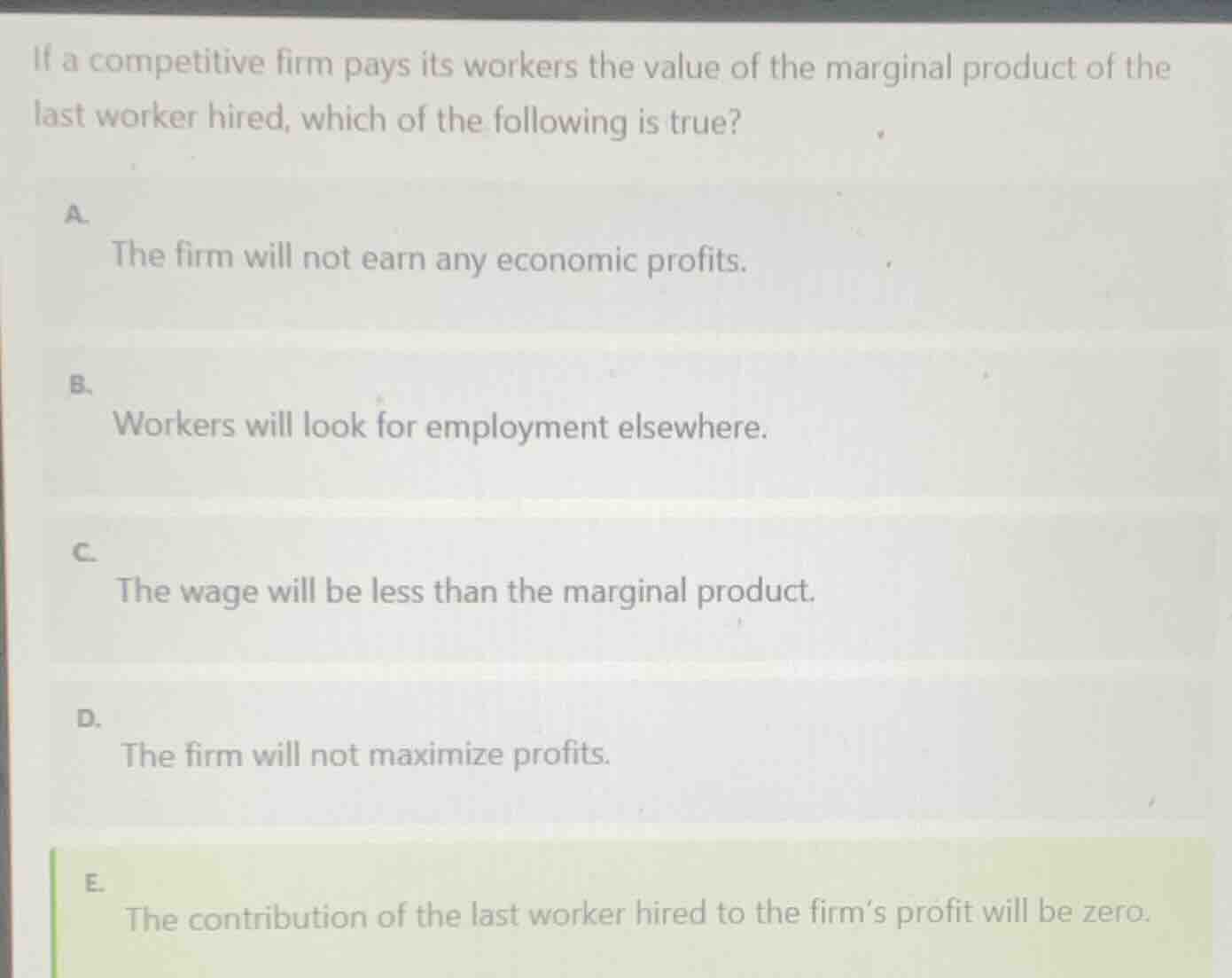
if a competitive firm pays its workers the value of the marginal product of the last worker hired, which of the following is true? a. the firm will not earn any economic profits. b. workers will look for employment elsewhere. c. the wage will be less than the marginal product. d. the firm will not maximize profits. e. the contribution of the last worker hired to the firm’s profit will be zero.
In competitive labor markets, a profit-maximizing firm hires workers up to the point where the wage equals the value of the marginal product of labor ($W = VMPL$). The value of the marginal product is the additional revenue the last worker generates. If the firm pays the worker exactly this value, the additional profit from hiring that last worker is $VMPL - W = 0$.
- Option A is false because the firm can still earn economic profits from earlier workers whose $VMPL$ exceeds the wage.
- Option B is false because workers are paid the market wage (equal to their marginal value), so no incentive to leave.
- Option C is false; the wage equals the value of the marginal product (not the marginal product itself, but the statement incorrectly frames the comparison).
- Option D is false; this is the profit-maximizing hiring rule, so the firm does maximize profits.

Snap & solve any problem in the app
Get step-by-step solutions on Sovi AI
Photo-based solutions with guided steps
Explore more problems and detailed explanations
E. The contribution of the last worker hired to the firm's profit will be zero.