QUESTION IMAGE
Question
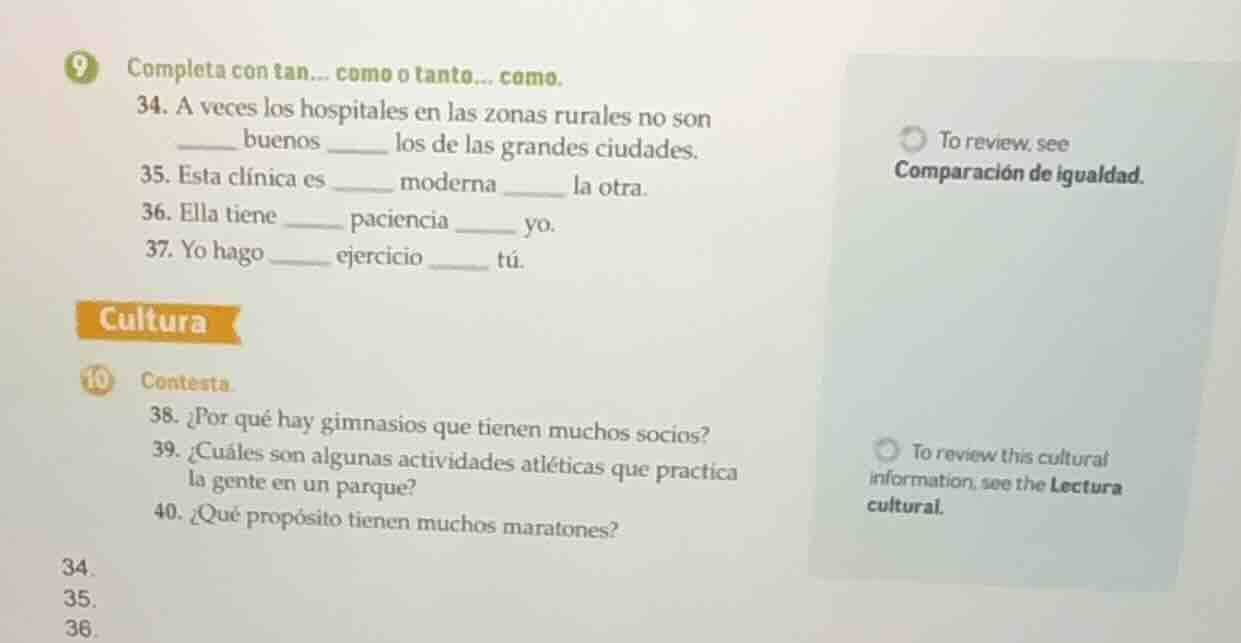
9 completa con tan... como o tanto... como.
- a veces los hospitales en las zonas rurales no son
____ buenos ____ los de las grandes ciudades.
- esta clínica es ____ moderna ____ la otra.
- ella tiene ____ paciencia ____ yo.
- yo hago ____ ejercicio ____ tú.
cultura
10 contesta
- ¿por qué hay gimnasios que tienen muchos socios?
- ¿cuáles son algunas actividades atléticas que practica
la gente en un parque?
- ¿qué propósito tienen muchos maratones?
to review, see comparación de igualdad.
to review this cultural information, see the lectura cultural.
34.
35.
36.
To solve these fill - in - the - blank questions, we need to recall the usage of “tan... como” and “tanto... como” in Spanish for equality comparisons. “Tan” is used before adjectives or adverbs, and “tanto” (with appropriate gender and number agreement) is used before nouns.
Question 34
The word “buenos” is an adjective (masculine plural). So we use “tan” before the adjective and “como” to complete the comparison structure.
So the answer is: tan; como
Question 35
The word “moderna” is an adjective (feminine singular). We use “tan” before the adjective and “como” to show the equality comparison.
So the answer is: tan; como
Question 36
The word “paciencia” is a feminine singular noun. We need to use “tanta” (the feminine singular form of “tanto”) before the noun and “como” to complete the structure.
So the answer is: tanta; como
Question 37
The word “ejercicio” is a masculine singular noun. We use “tanto” (masculine singular form) before the noun and “como” to show the equality comparison.
So the answer is: tanto; como

Snap & solve any problem in the app
Get step-by-step solutions on Sovi AI
Photo-based solutions with guided steps
Explore more problems and detailed explanations
To solve these fill - in - the - blank questions, we need to recall the usage of “tan... como” and “tanto... como” in Spanish for equality comparisons. “Tan” is used before adjectives or adverbs, and “tanto” (with appropriate gender and number agreement) is used before nouns.
Question 34
The word “buenos” is an adjective (masculine plural). So we use “tan” before the adjective and “como” to complete the comparison structure.
So the answer is: tan; como
Question 35
The word “moderna” is an adjective (feminine singular). We use “tan” before the adjective and “como” to show the equality comparison.
So the answer is: tan; como
Question 36
The word “paciencia” is a feminine singular noun. We need to use “tanta” (the feminine singular form of “tanto”) before the noun and “como” to complete the structure.
So the answer is: tanta; como
Question 37
The word “ejercicio” is a masculine singular noun. We use “tanto” (masculine singular form) before the noun and “como” to show the equality comparison.
So the answer is: tanto; como