QUESTION IMAGE
Question
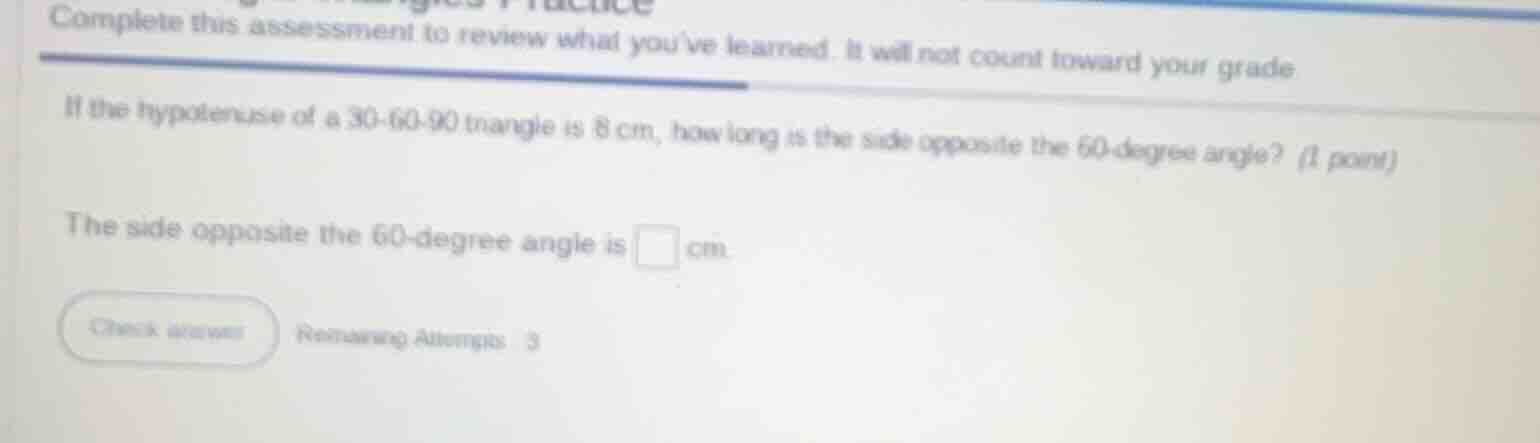
complete this assessment to review what youve learned. it will not count toward your grade. if the hypotenuse of a 30 - 60 - 90 triangle is 8 cm, how long is the side opposite the 60 - degree angle? (1 point) the side opposite the 60 - degree angle is \\(\square\\) cm. check answer remaining attempts: 3
Step1: Recall 30-60-90 triangle ratios
In a 30-60-90 triangle, the sides are in the ratio \(1 : \sqrt{3} : 2\), where the side opposite 30° is the shortest (\(x\)), opposite 60° is \(x\sqrt{3}\), and hypotenuse is \(2x\).
Step2: Find \(x\) from hypotenuse
Given hypotenuse \(2x = 8\) cm. Solve for \(x\): \(x=\frac{8}{2}=4\) cm.
Step3: Calculate side opposite 60°
Side opposite 60° is \(x\sqrt{3}\). Substitute \(x = 4\): \(4\sqrt{3}\) cm. Wait, no—wait, hypotenuse is \(2x\), so \(x = 4\), then side opposite 60° is \(x\sqrt{3}=4\sqrt{3}\)? Wait, no, wait: Wait, 30-60-90 triangle: sides are \(x\) (opposite 30°), \(x\sqrt{3}\) (opposite 60°), \(2x\) (hypotenuse). So hypotenuse is \(2x = 8\), so \(x = 4\). Then side opposite 60° is \(x\sqrt{3}=4\sqrt{3}\)? Wait, no, wait, maybe I mixed up. Wait, no: Let's recheck. In 30-60-90 triangle, the sides are: opposite 30°: \(x\), opposite 60°: \(x\sqrt{3}\), hypotenuse: \(2x\). So if hypotenuse is 8, then \(2x = 8\) → \(x = 4\). Then side opposite 60° is \(x\sqrt{3}=4\sqrt{3}\)? Wait, but 4√3 is about 6.928. Wait, maybe I made a mistake. Wait, no—wait, maybe the ratio is different? Wait, no, 30-60-90 triangle: the sides are in the ratio 1 : √3 : 2, where 1 is opposite 30°, √3 opposite 60°, 2 hypotenuse. So if hypotenuse is 8 (which is 2 parts), then 1 part is 4, so √3 part is 4√3. Yes, that's correct. Wait, but let's confirm with trigonometry. Using sine: \(\sin(60^\circ)=\frac{\text{opposite}}{\text{hypotenuse}}\). So \(\sin(60^\circ)=\frac{\sqrt{3}}{2}\), so opposite = hypotenuse × \(\sin(60^\circ)\) = 8 × \(\frac{\sqrt{3}}{2}\) = 4√3. Yes, that's the same. So that's correct.

Snap & solve any problem in the app
Get step-by-step solutions on Sovi AI
Photo-based solutions with guided steps
Explore more problems and detailed explanations
\(4\sqrt{3}\) (or approximately 6.93, but exact form is \(4\sqrt{3}\))