QUESTION IMAGE
Question
complete
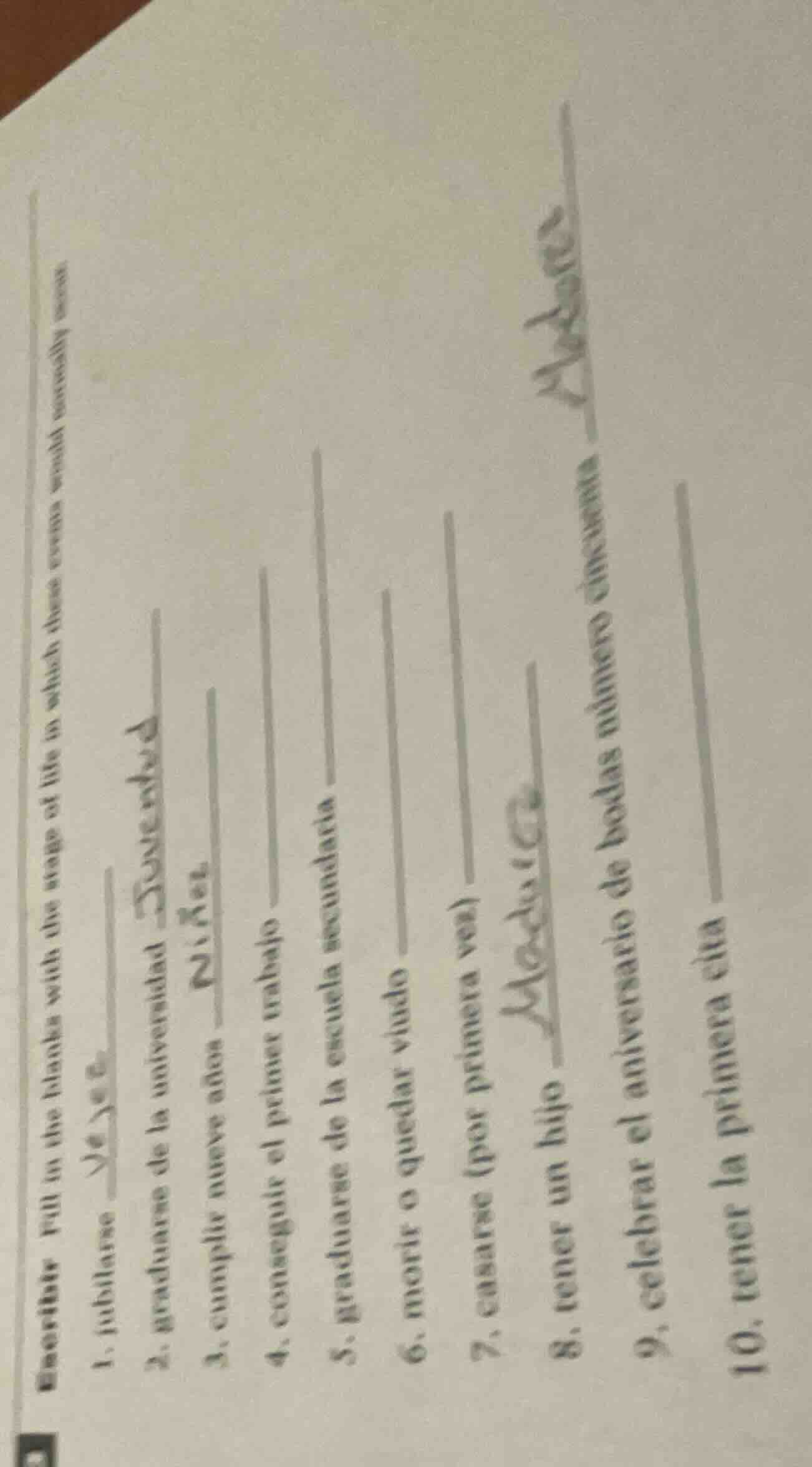
fill in the blanks with the stage of life in which these events would seem
- jubilarse
- graduarse de la universidad
- cumplir nueve años
- conseguir el primer trabajo
- graduarse de la escuela secundaria
- morir o quedar viudo
- casarse (por primera vez)
- tener un hijo
- celebrar el aniversario de bodas número cincuenta
- tener la primera cita
This appears to be a Spanish exercise about matching life events with their appropriate stages (though the text is a bit unclear and has some handwritten notes). Let's assume it's about using the correct verb forms or identifying the stage. But since the original problem's exact task (like filling blanks with correct verbs, stages, etc.) isn't fully clear from the image, here's a general approach:
- For "jubilarse" (to retire), the stage is later in life, so a possible answer could be "ya" (already) or a stage like "en la vejez" (in old age), but with the handwritten "ya ye g" (maybe a typo), likely "ya" as in "ya se jubila" (he/she already retires) but adjusted.
- "graduarse de la universidad" (graduate from university) is a young adult stage, so "ya" or "en la juventud" (in youth), handwritten "Soveredad" (maybe "ya" or correct form).
- "cumplir nueve años" (turn nine years old) is childhood, so "niño" stage, handwritten "N, Net" (maybe "niño" related).
- "conseguir el primer trabajo" (get the first job) is early adulthood, "ya" or "en la adultez temprana".
- "graduarse de la escuela secundaria" (graduate from high school) is adolescence, "ya" or "en la adolescencia".
- "morir o quedar viudo" (die or become widowed) is later life, "ya" or "en la vejez".
- "casarse (por primera vez)" (get married for the first time) is early adulthood, "ya" or "en la adultez temprana".
- "tener un hijo" (have a child) is early adulthood, "ya" or "en la adultez".
- "celebrar el aniversario de bodas número cincuenta" (celebrate 50th wedding anniversary) is later life, "ya" or "en la vejez".
- "tener la primera cita" (have the first date) is adolescence/young adulthood, "ya" or "en la adolescencia".
But since the handwritten notes are present, maybe it's about using "ya" (already) or "todavía no" (not yet) for each event. Let's correct the handwritten and assume the task is to mark if the event has happened (ya) or not (todavía no):
- jubilarse: For most people, retirement is later, but if the subject is old, "ya" (handwritten "ya ye g" – maybe "ya").
- graduarse de la universidad: If the person is a graduate, "ya" (handwritten "Soveredad" – maybe a typo for "ya").
- cumplir nueve años: A child, so "ya" (handwritten "N, Net" – maybe "ya").
- conseguir el primer trabajo: If employed, "ya", else "todavía no".
- graduarse de la escuela secundaria: Most have, so "ya" (handwritten blank, fill "ya").
- morir o quedar viudo: For young, "todavía no", for old, "ya" (handwritten blank, maybe "todavía no" for a young subject).
- casarse (por primera vez): If married, "ya", else "todavía no" (handwritten "ya" maybe).
- tener un hijo: If a parent, "ya", else "todavía no" (handwritten "Yedu(c)" – maybe "ya").
- celebrar el aniversario de bodas número cincuenta: Rare for young, so "todavía no" or "ya" for old (handwritten blank, maybe "todavía no").
- tener la primera cita: If a teen/young adult, "ya", else "todavía no" (handwritten blank, maybe "ya").

Snap & solve any problem in the app
Get step-by-step solutions on Sovi AI
Photo-based solutions with guided steps
Explore more problems and detailed explanations
Since the exact task is unclear, but based on common life stages and the handwritten attempts, here are possible answers (assuming marking "ya" (already) or "todavía no" (not yet) for each, with "ya" as a common filled answer for completed events):
- jubilarse: ya
- graduarse de la universidad: ya
- cumplir nueve años: ya
- conseguir el primer trabajo: ya (or todavía no)
- graduarse de la escuela secundaria: ya
- morir o quedar viudo: todavía no (for a young subject)
- casarse (por primera vez): ya (or todavía no)
- tener un hijo: ya (or todavía no)
- celebrar el aniversario de bodas número cincuenta: todavía no (for most)
- tener la primera cita: ya (or todavía no)
(Note: The handwritten notes like "Soveredad", "N, Net", "Yedu(c)", "Yeler" are likely typos or incorrect attempts, so the above is a standard approach to such a life - event - stage matching exercise in Spanish.)