QUESTION IMAGE
Question
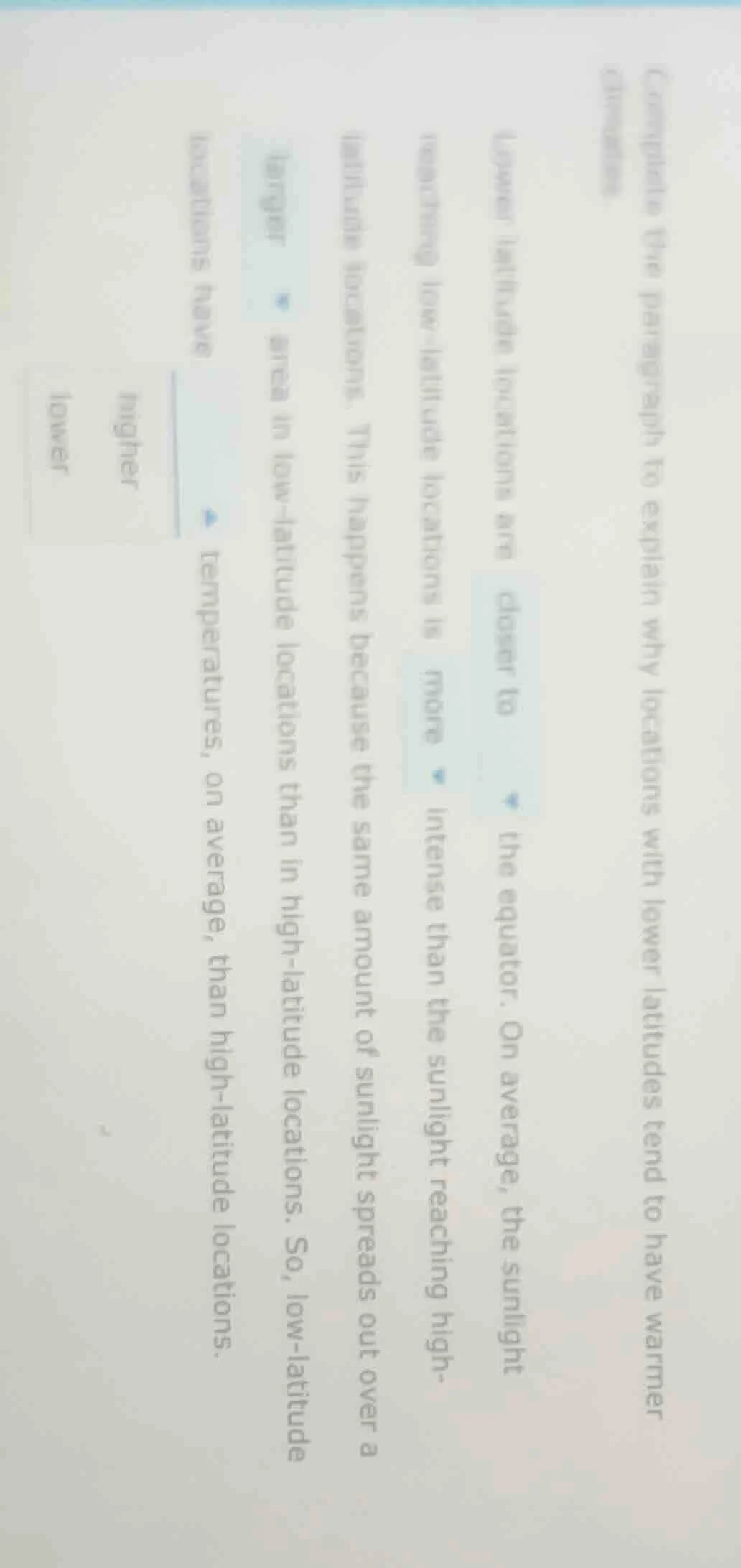
(complete the paragraph to explain why locations with lower latitudes tend to have warmer (1)first, (2)lower - latitude locations are closer to the equator. on average, the sunlight (3)reaching low - latitude locations is more intense than the sunlight reaching high - latitude locations. this happens because the same amount of sunlight spreads out over a (4)larger area in low - latitude locations than in high - latitude locations. so, low - latitude locations have (5)higher temperatures, on average, than high - latitude locations.
To solve the fill - in - the - blanks for this paragraph about the relationship between latitude and temperature, we analyze each blank:
Step 1: First blank
The first sentence is about the position of lower - latitude locations relative to the equator. Lower - latitude locations are closer to the equator. So the first blank should be filled with “the equator”.
Step 2: Second blank
We know that the sunlight reaching low - latitude locations is more intense than that reaching high - latitude locations. So the second blank is “more”.
Step 3: Third blank
The same amount of sunlight spreads out over a larger area in low - latitude locations? No, wait. Actually, the same amount of sunlight spreads out over a smaller area in low - latitude locations (because they are closer to the equator and the sun's rays are more direct) and a larger area in high - latitude locations. Wait, no, let's re - examine. The idea is that for low - latitude locations, the area over which the same amount of sunlight spreads is smaller than in high - latitude locations? Wait, no, the original sentence structure: “This happens because the same amount of sunlight spreads out over a [blank] area in low - latitude locations than in high - latitude locations.” Wait, no, if low - latitude locations have more intense sunlight, it means that the same amount of sunlight is concentrated over a smaller area. So the correct word here is “smaller”? Wait, no, maybe I got it wrong. Wait, the next part says that low - latitude locations have higher temperatures. Let's think again. The key is the distribution of sunlight. Low - latitude areas (closer to the equator) receive more direct sunlight, so the same amount of solar energy is spread over a smaller area, making the sunlight more intense. So the blank here: “This happens because the same amount of sunlight spreads out over a [smaller] area in low - latitude locations than in high - latitude locations.” Wait, but the options? Wait, maybe the third blank is “smaller”? Wait, no, maybe the original problem has options? Wait, the user's image shows some blanks. Wait, maybe I misread. Let's look at the last part: “low - latitude locations have [blank] temperatures, on average, than high - latitude locations.” We know that low - latitude locations are warmer, so they have higher temperatures. So the last blank is “higher”.
Wait, let's re - structure:
- Lower - latitude locations are closer to \(\boldsymbol{\text{the equator}}\).
- On average, the sunlight reaching low - latitude locations is \(\boldsymbol{\text{more}}\) intense than the sunlight reaching high - latitude locations.
- This happens because the same amount of sunlight spreads out over a \(\boldsymbol{\text{smaller}}\) area in low - latitude locations than in high - latitude locations. (Wait, maybe the third blank is “smaller”, but maybe the original problem's third blank is “smaller” or maybe I made a mistake. Wait, no, let's check the temperature part. Low - latitude locations have \(\boldsymbol{\text{higher}}\) temperatures, on average, than high - latitude locations.
So the filled - in paragraph is:
(1) Lower - latitude locations are closer to \(\boldsymbol{\text{the equator}}\). On average, the sunlight reaching low - latitude locations is \(\boldsymbol{\text{more}}\) intense than the sunlight reaching high - latitude locations. This happens because the same amount of sunlight spreads out over a \(\boldsymbol{\text{smaller}}\) area in low - latitude locations than in high - latitude locations. So, low - latitude locations have \(\boldsymbol{\te…

Snap & solve any problem in the app
Get step-by-step solutions on Sovi AI
Photo-based solutions with guided steps
Explore more problems and detailed explanations
To solve the fill - in - the - blanks for this paragraph about the relationship between latitude and temperature, we analyze each blank:
Step 1: First blank
The first sentence is about the position of lower - latitude locations relative to the equator. Lower - latitude locations are closer to the equator. So the first blank should be filled with “the equator”.
Step 2: Second blank
We know that the sunlight reaching low - latitude locations is more intense than that reaching high - latitude locations. So the second blank is “more”.
Step 3: Third blank
The same amount of sunlight spreads out over a larger area in low - latitude locations? No, wait. Actually, the same amount of sunlight spreads out over a smaller area in low - latitude locations (because they are closer to the equator and the sun's rays are more direct) and a larger area in high - latitude locations. Wait, no, let's re - examine. The idea is that for low - latitude locations, the area over which the same amount of sunlight spreads is smaller than in high - latitude locations? Wait, no, the original sentence structure: “This happens because the same amount of sunlight spreads out over a [blank] area in low - latitude locations than in high - latitude locations.” Wait, no, if low - latitude locations have more intense sunlight, it means that the same amount of sunlight is concentrated over a smaller area. So the correct word here is “smaller”? Wait, no, maybe I got it wrong. Wait, the next part says that low - latitude locations have higher temperatures. Let's think again. The key is the distribution of sunlight. Low - latitude areas (closer to the equator) receive more direct sunlight, so the same amount of solar energy is spread over a smaller area, making the sunlight more intense. So the blank here: “This happens because the same amount of sunlight spreads out over a [smaller] area in low - latitude locations than in high - latitude locations.” Wait, but the options? Wait, maybe the third blank is “smaller”? Wait, no, maybe the original problem has options? Wait, the user's image shows some blanks. Wait, maybe I misread. Let's look at the last part: “low - latitude locations have [blank] temperatures, on average, than high - latitude locations.” We know that low - latitude locations are warmer, so they have higher temperatures. So the last blank is “higher”.
Wait, let's re - structure:
- Lower - latitude locations are closer to \(\boldsymbol{\text{the equator}}\).
- On average, the sunlight reaching low - latitude locations is \(\boldsymbol{\text{more}}\) intense than the sunlight reaching high - latitude locations.
- This happens because the same amount of sunlight spreads out over a \(\boldsymbol{\text{smaller}}\) area in low - latitude locations than in high - latitude locations. (Wait, maybe the third blank is “smaller”, but maybe the original problem's third blank is “smaller” or maybe I made a mistake. Wait, no, let's check the temperature part. Low - latitude locations have \(\boldsymbol{\text{higher}}\) temperatures, on average, than high - latitude locations.
So the filled - in paragraph is:
(1) Lower - latitude locations are closer to \(\boldsymbol{\text{the equator}}\). On average, the sunlight reaching low - latitude locations is \(\boldsymbol{\text{more}}\) intense than the sunlight reaching high - latitude locations. This happens because the same amount of sunlight spreads out over a \(\boldsymbol{\text{smaller}}\) area in low - latitude locations than in high - latitude locations. So, low - latitude locations have \(\boldsymbol{\text{higher}}\) temperatures, on average, than high - latitude locations.
(Note: If there are specific options for each blank, the above analysis is based on the general knowledge of the relationship between latitude and solar radiation intensity and temperature.)
Final Answers for each blank:
- the equator
- more
- smaller (assuming the context of solar radiation distribution; if there are other options, adjust accordingly)
- higher