QUESTION IMAGE
Question
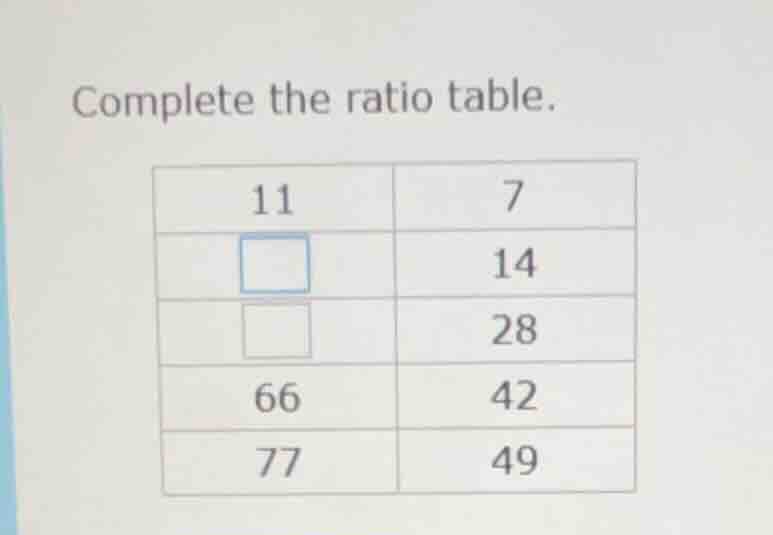
complete the ratio table.
11 7
□ 14
□ 28
66 42
77 49
Step1: Find the ratio multiplier
First, observe the relationship between the first column and the second column. For the first row, \(11\) and \(7\). Let's check the fourth row: \(66\) and \(42\). Calculate \(66\div11 = 6\) and \(42\div7 = 6\). Similarly, fifth row: \(77\div11 = 7\) and \(49\div7 = 7\). So the ratio of the first column to the second column is constant, and the multiplier from the second column to the first column is \(11\div7=\frac{11}{7}\), or from the first to the second is \(7\div11=\frac{7}{11}\). Alternatively, we can see that when the second column value is multiplied by \(2\) (from \(7\) to \(14\)), the first column should also be multiplied by \(2\) (from \(11\) to \(22\)). Let's verify with the third row: \(28\) is \(7\times4\), so first column should be \(11\times4 = 44\).
Step2: Calculate the first missing value (second row)
The second column value is \(14\), which is \(7\times2\). So the first column value should be \(11\times2 = 22\).
Step3: Calculate the second missing value (third row)
The second column value is \(28\), which is \(7\times4\). So the first column value should be \(11\times4 = 44\).

Snap & solve any problem in the app
Get step-by-step solutions on Sovi AI
Photo-based solutions with guided steps
Explore more problems and detailed explanations
The first missing number (second row) is \(22\), the second missing number (third row) is \(44\). So the completed table (for the missing cells) has \(22\) (second row, first column) and \(44\) (third row, first column).