QUESTION IMAGE
Question
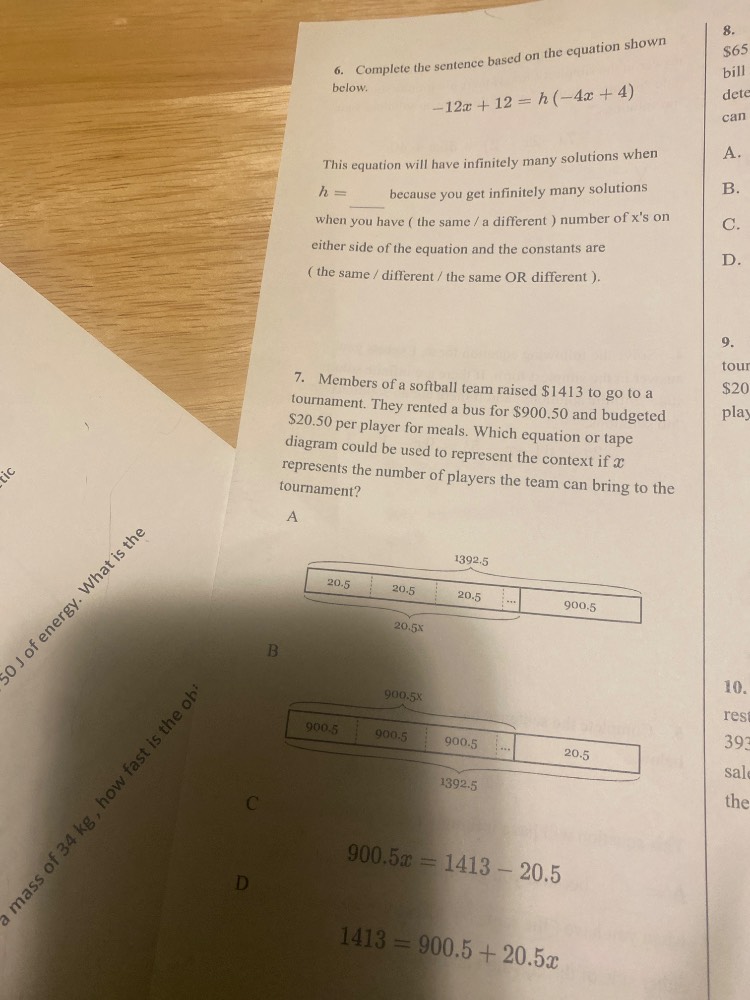
- complete the sentence based on the equation shown below.
$-12x + 12 = h(-4x + 4)$
this equation will have infinitely many solutions when $h =$ ____ because you get infinitely many solutions when you have ( the same / a different ) number of xs on either side of the equation and the constants are ( the same / different / the same or different ).
- members of a softball team raised $1413 to go to a tournament. they rented a bus for $900.50 and budgeted $20.50 per player for meals. which equation or tape diagram could be used to represent the context if $x$ represents the number of players the team can bring to the tournament?
a
tape diagram with 20.5 repeated x times and 900.5, total 1392.5
b
tape diagram with 900.5 repeated x times and 20.5, total 1392.5
c
$900.5x = 1413 - 20.5$
d
$1413 = 900.5 + 20.5x$
Question 6
Step 1: Analyze the equation structure
We have the equation \(-12x + 12 = h(-4x + 4)\). For an equation to have infinitely many solutions, both sides must be identical (same coefficients for \(x\) and same constants).
Step 2: Distribute \(h\) on the right side
Distribute \(h\) in \(h(-4x + 4)\) to get \(-4hx + 4h\).
Step 3: Equate coefficients of \(x\)
Set the coefficients of \(x\) equal: \(-12 = -4h\). Solve for \(h\): divide both sides by \(-4\), so \(h=\frac{-12}{-4}=3\).
Step 4: Check the constant term
Now check the constant term. Substitute \(h = 3\) into \(4h\), we get \(4\times3 = 12\), which matches the constant term on the left side (\(12\)). So when \(h = 3\), the equation becomes \(-12x + 12=-12x + 12\), which has infinitely many solutions (same number of \(x\)'s and same constants).
The total amount raised is \(\$1413\). The cost of the bus is a fixed cost of \(\$900.50\) and the cost for meals is \(\$20.50\) per player. If \(x\) is the number of players, the total cost for meals is \(20.5x\). The total cost (bus + meals) should equal the total amount raised. So the equation is \(1413=900.5 + 20.5x\). Let's analyze the options:
- Option A: The tape diagram has \(20.5x\) and \(900.5\) adding to \(1392.5\), which is incorrect as total raised is \(1413\).
- Option B: The tape diagram structure is incorrect (mixing the fixed and per - player cost in a wrong way).
- Option C: The equation \(900.5x=1413 - 20.5\) is incorrect as the bus cost is a fixed cost, not a per - player cost.
- Option D: The equation \(1413 = 900.5+20.5x\) correctly represents the total amount raised (\(1413\)) as the sum of the bus cost (\(900.5\)) and the meal cost for \(x\) players (\(20.5x\)).

Snap & solve any problem in the app
Get step-by-step solutions on Sovi AI
Photo-based solutions with guided steps
Explore more problems and detailed explanations
\(h = \boldsymbol{3}\); because you get infinitely many solutions when you have (the same) number of \(x\)'s on either side of the equation and the constants are (the same).