QUESTION IMAGE
Question
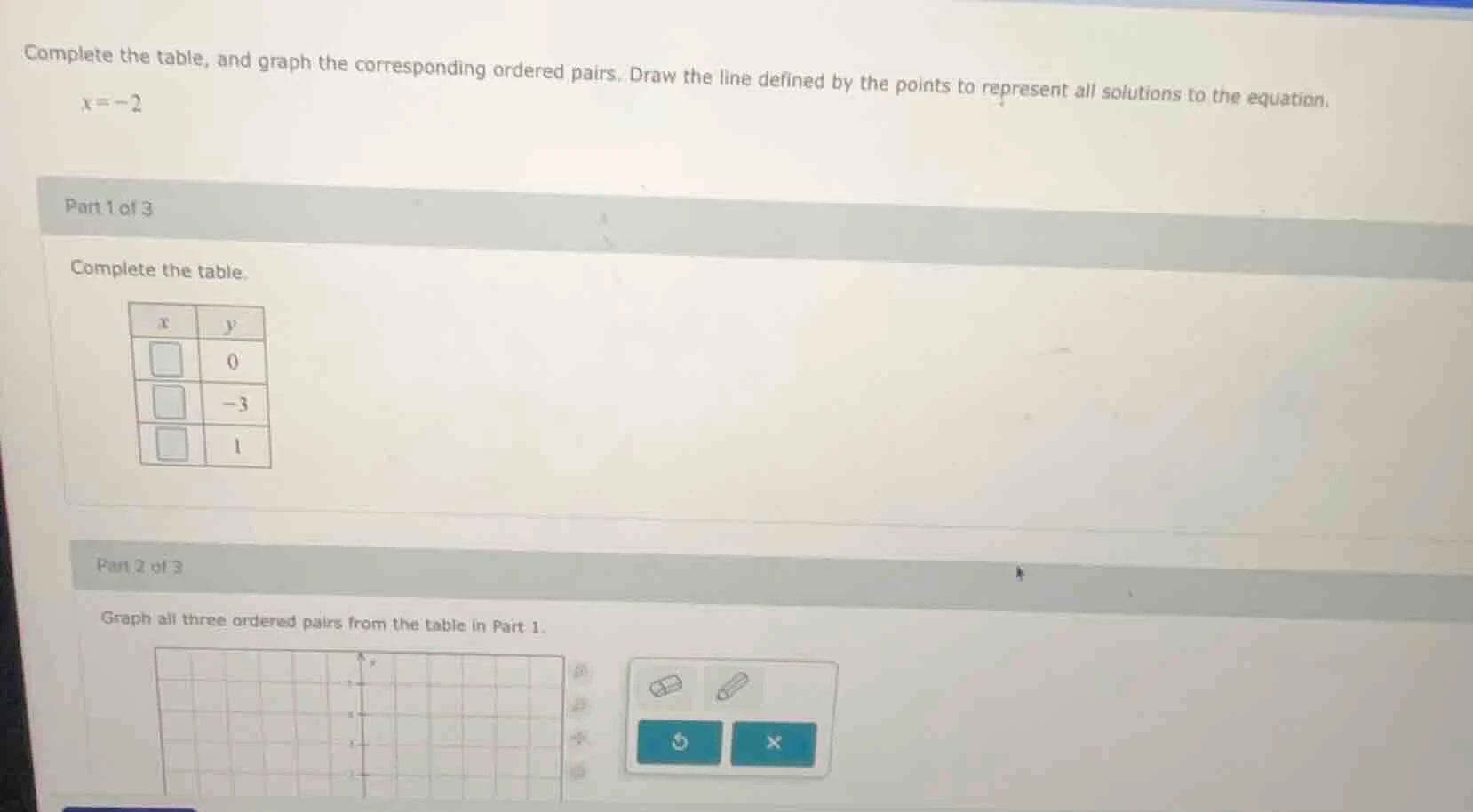
complete the table, and graph the corresponding ordered pairs. draw the line defined by the points to represent all solutions to the equation.
\\( x = -2 \\)
part 1 of 3
complete the table.
| \\( x \\) | \\( y \\) |
|---|---|
| \\( \square \\) | -3 |
| \\( \square \\) | 1 |
part 2 of 3
graph all three ordered pairs from the table in part 1.
Step1: Recall the equation
The equation is \( x = -2 \). This is a vertical line where the \( x \)-coordinate is always -2, regardless of the \( y \)-value.
Step2: Find \( x \) for \( y = 0 \)
For the first row where \( y = 0 \), since \( x = -2 \) for all \( y \), the \( x \)-value is -2.
Step3: Find \( x \) for \( y = -3 \)
For the second row where \( y = -3 \), using the equation \( x = -2 \), the \( x \)-value is -2.
Step4: Find \( x \) for \( y = 1 \)
For the third row where \( y = 1 \), using the equation \( x = -2 \), the \( x \)-value is -2.

Snap & solve any problem in the app
Get step-by-step solutions on Sovi AI
Photo-based solutions with guided steps
Explore more problems and detailed explanations
The completed table is:
| \( x \) | \( y \) |
|---|---|
| -2 | -3 |
| -2 | 1 |
For the graphing part, the three ordered pairs are \((-2, 0)\), \((-2, -3)\), and \((-2, 1)\). To graph them, plot each point on the coordinate plane where the \( x \)-coordinate is -2 and the \( y \)-coordinate is as given. Then draw a vertical line through these points (since \( x = -2 \) is a vertical line) to represent all solutions.