QUESTION IMAGE
Question
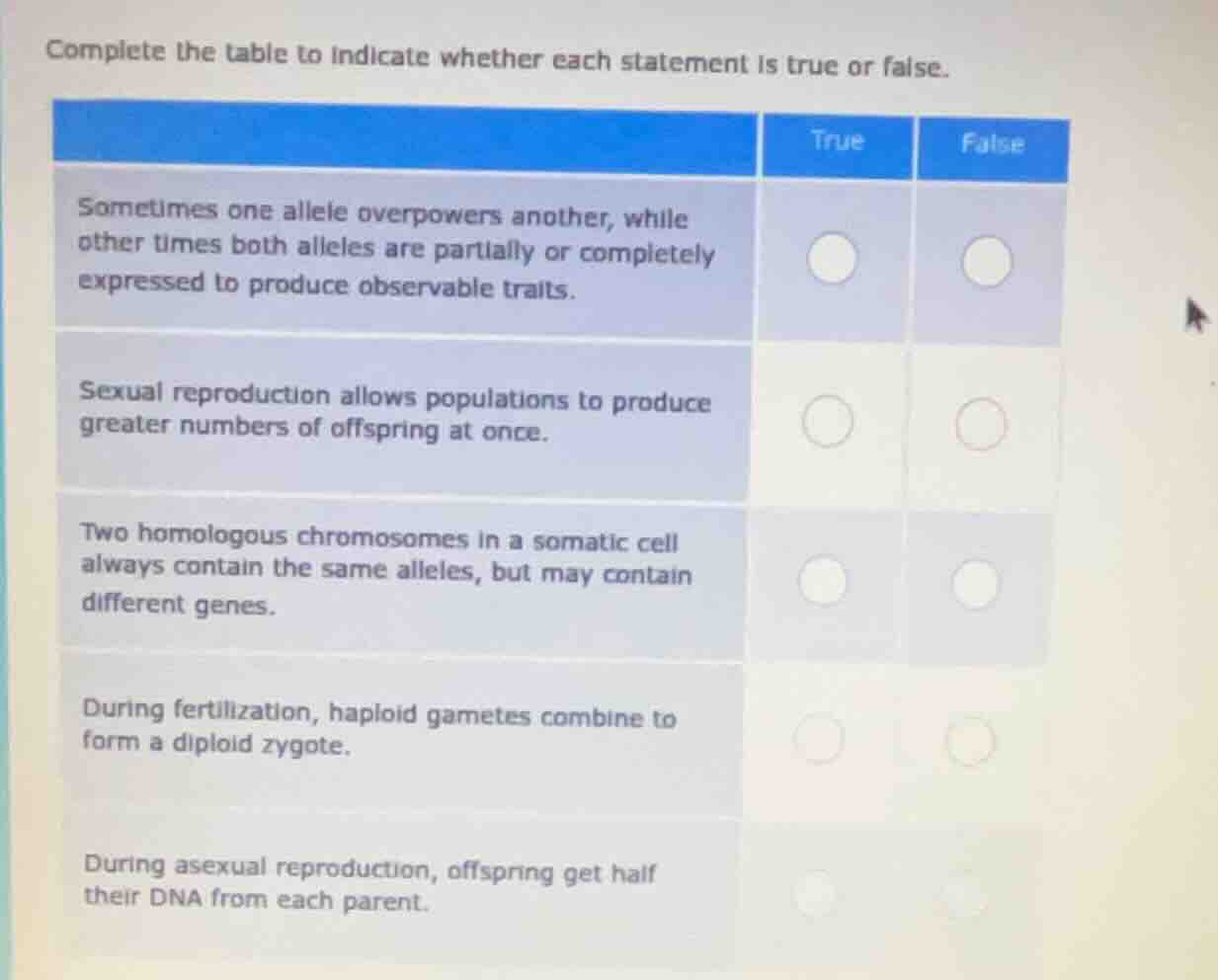
complete the table to indicate whether each statement is true or false.
- sometimes one allele overpowers another, while other times both alleles are partially or completely expressed to produce observable traits.
- sexual reproduction allows populations to produce greater numbers of offspring at once.
- two homologous chromosomes in a somatic cell always contain the same alleles, but may contain different genes.
- during fertilization, haploid gametes combine to form a diploid zygote.
- during asexual reproduction, offspring get half their dna from each parent.
Brief Explanations
- Allele expression includes complete dominance (one allele overpowering another), incomplete dominance (partial expression of both), and codominance (full expression of both), all leading to observable traits.
- Asexual reproduction typically produces far more offspring at once than sexual reproduction, which requires mating and fewer gamete fusions.
- Homologous chromosomes in a somatic cell carry the same genes (in the same loci) but can have different alleles for those genes.
- Gametes are haploid (1 set of chromosomes, $n$); their fusion during fertilization creates a diploid zygote with 2 sets of chromosomes ($2n$).
- Asexual reproduction involves only one parent, so offspring inherit an identical copy of the parent's DNA, not half from two parents.

Snap & solve any problem in the app
Get step-by-step solutions on Sovi AI
Photo-based solutions with guided steps
Explore more problems and detailed explanations
| Statement | True | False |
|---|---|---|
| Sexual reproduction allows populations to produce greater numbers of offspring at once. | $\circ$ | $\boldsymbol{\odot}$ |
| Two homologous chromosomes in a somatic cell always contain the same alleles, but may contain different genes. | $\circ$ | $\boldsymbol{\odot}$ |
| During fertilization, haploid gametes combine to form a diploid zygote. | $\boldsymbol{\odot}$ | $\circ$ |
| During asexual reproduction, offspring get half their DNA from each parent. | $\circ$ | $\boldsymbol{\odot}$ |