QUESTION IMAGE
Question
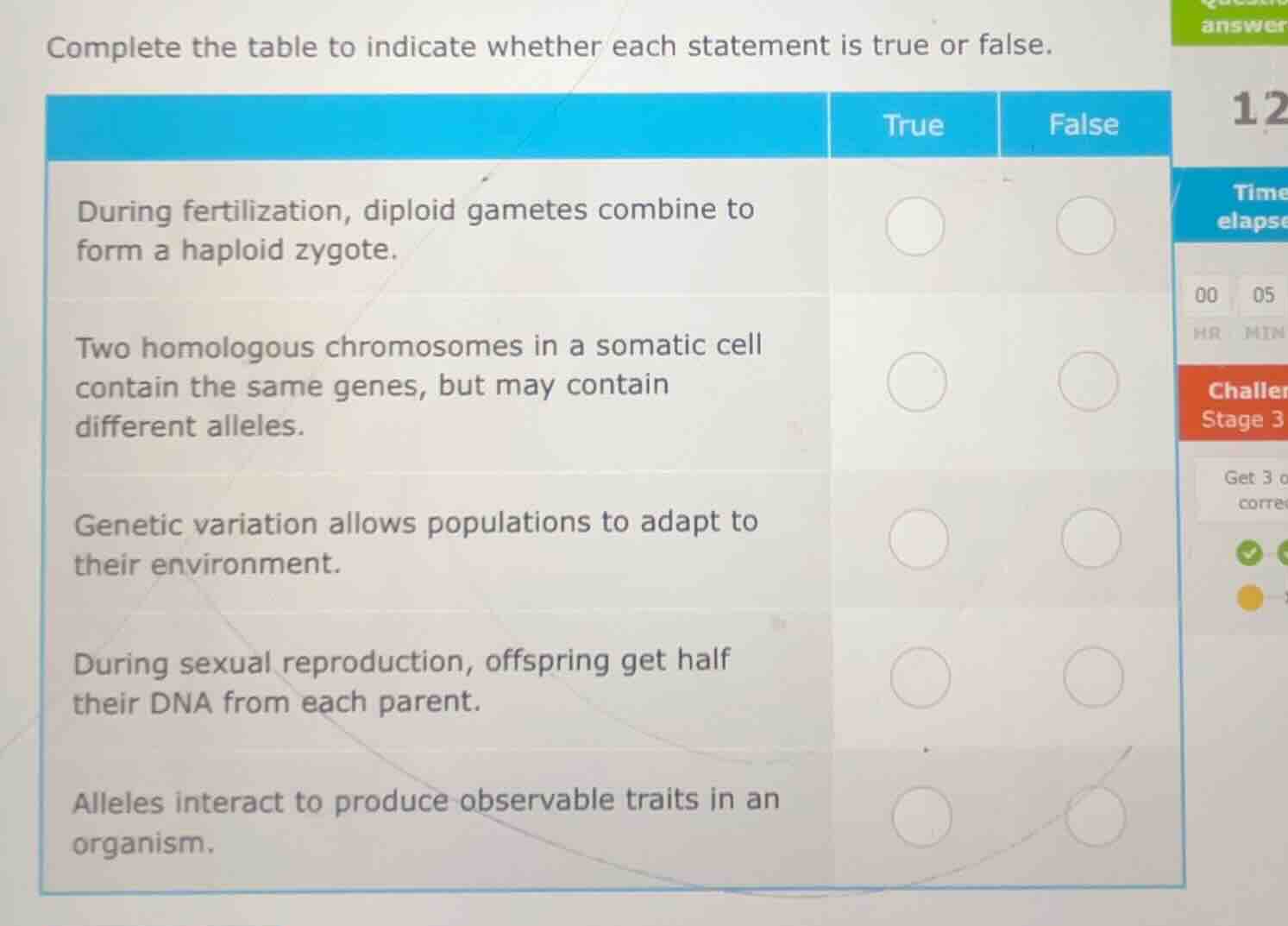
complete the table to indicate whether each statement is true or false.
during fertilization, diploid gametes combine to form a haploid zygote.
two homologous chromosomes in a somatic cell contain the same genes, but may contain different alleles.
genetic variation allows populations to adapt to their environment.
during sexual reproduction, offspring get half their dna from each parent.
alleles interact to produce observable traits in an organism.
Brief Explanations
- Gametes are haploid (1 set of chromosomes), and they fuse to form a diploid zygote (2 sets of chromosomes).
- Homologous chromosomes carry the same gene loci, but can have different versions (alleles) of those genes.
- Genetic variation creates differences in traits; populations with beneficial variations survive and adapt to environmental changes.
- In sexual reproduction, each parent contributes one haploid gamete, so offspring inherit 50% of their DNA from each.
- Alleles (gene variants) interact (e.g., dominant/recessive, codominant) to determine an organism's observable phenotypic traits.

Snap & solve any problem in the app
Get step-by-step solutions on Sovi AI
Photo-based solutions with guided steps
Explore more problems and detailed explanations
- During fertilization, diploid gametes combine to form a haploid zygote.: False
- Two homologous chromosomes in a somatic cell contain the same genes, but may contain different alleles.: True
- Genetic variation allows populations to adapt to their environment.: True
- During sexual reproduction, offspring get half their DNA from each parent.: True
- Alleles interact to produce observable traits in an organism.: True