QUESTION IMAGE
Question
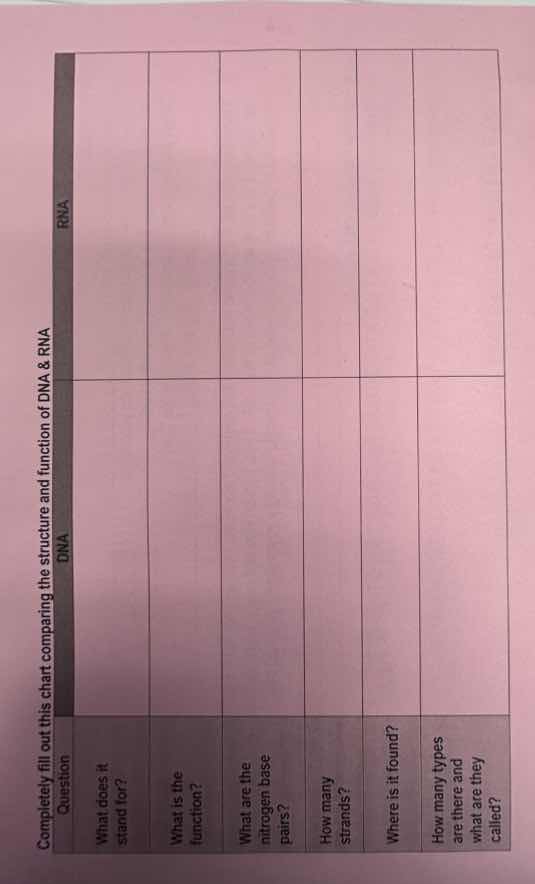
completely fill out this chart comparing the structure and function of dna & rna
question
dna
rna
what does it stand for?
what is the function?
what are the nitrogen base pairs?
how many strands?
where is it found?
how many types are there and what are they called?
Brief Explanations
This is a comparison of core structural and functional traits of DNA and RNA, key molecules in genetics.
- Abbreviation: DNA is a double-stranded nucleic acid, RNA is single-stranded.
- Function: DNA stores genetic information; RNA executes genetic instructions.
- Base Pairs: Follows complementary base pairing rules, with uracil replacing thymine in RNA.
- Strand Count: Defines their core structural difference.
- Location: DNA is mostly confined to the nucleus; RNA is mobile across cell compartments.
- Types: RNA has specialized functional subtypes, while DNA has no major functional subtypes.

Snap & solve any problem in the app
Get step-by-step solutions on Sovi AI
Photo-based solutions with guided steps
Explore more problems and detailed explanations
| Question | DNA | RNA |
|---|---|---|
| What is the function? | Stores long-term genetic information | Carries, decodes, and expresses genetic information; aids in protein synthesis |
| What are the nitrogen base pairs? | Adenine (A) pairs with Thymine (T); Cytosine (C) pairs with Guanine (G) | Adenine (A) pairs with Uracil (U); Cytosine (C) pairs with Guanine (G) |
| How many strands? | 2 (double-stranded helix) | 1 (single-stranded) |
| Where is it found? | Mainly in the cell nucleus; small amounts in mitochondria/chloroplasts | Nucleus, cytoplasm, and ribosomes |
| How many types are there and what are they called? | No major functional subtypes (only structural variations like chromosomal and plasmid DNA) | 3 main types: Messenger RNA (mRNA), Transfer RNA (tRNA), Ribosomal RNA (rRNA) |