QUESTION IMAGE
Question
composition of functions and modeling
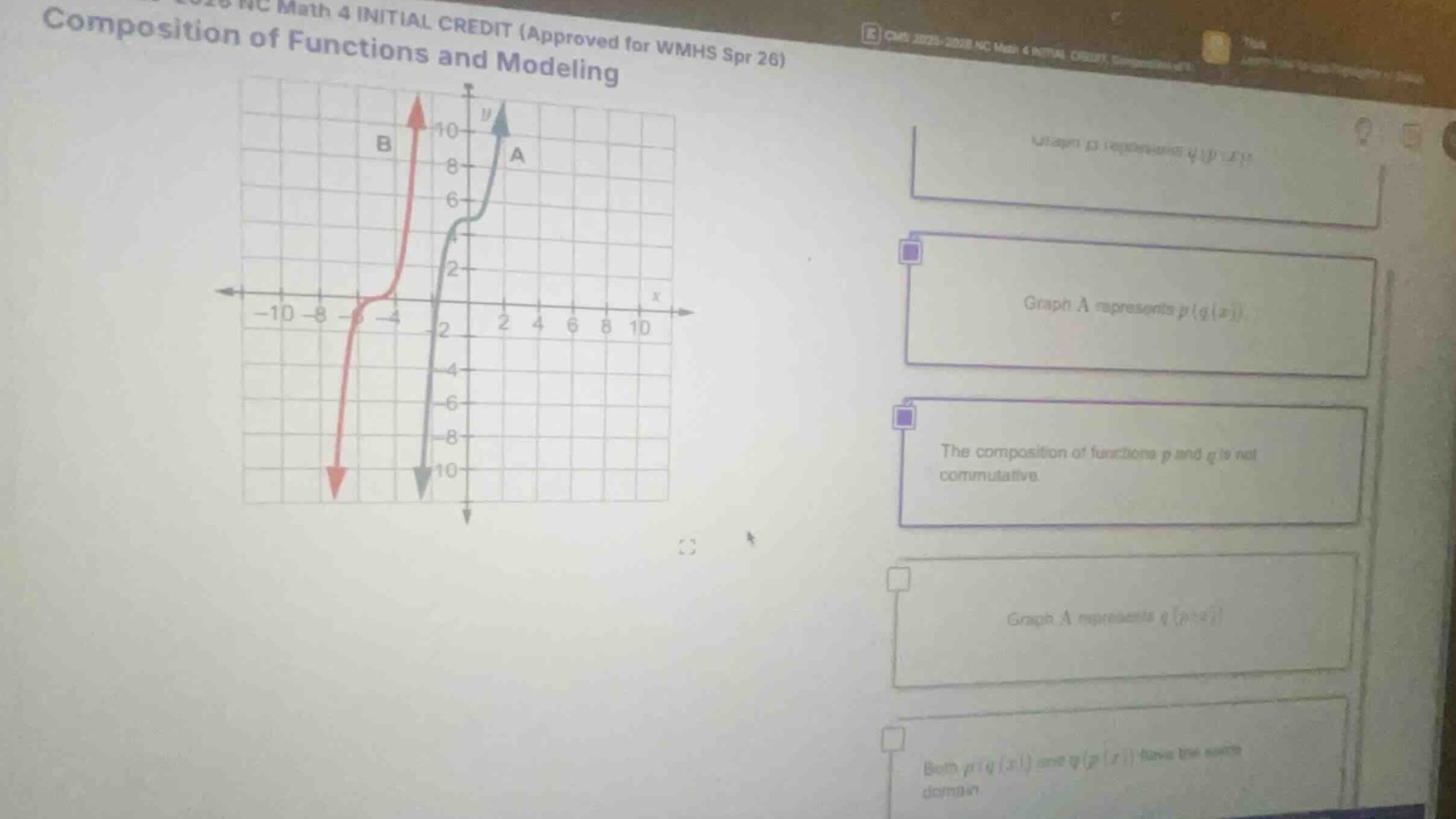
(there is a coordinate system with two function graphs, a (green) and b (red). on the right, there are multiple - choice options:
- (option content is reversed, should be which graph represents..., here we assume the original question - related option is about function composition graph judgment)
- graph a represents $p(g(x))$
- the composition of functions $p$ and $g$ is not commutative.
- graph a represents $g(p(x))$
- both $p(g(x))$ and $g(p(x))$ have the same domain)
Brief Explanations
- Identify graph domains: Graph A has a domain of $x \geq -2$, while Graph B has a domain of $x \geq -6$.
- Analyze $p(q(x))$: This means input $x$ into $q(x)$ first, then use that output as input for $p(x)$. For $q(x)$ (matching Graph B, domain $x \geq -6$), its output is all real numbers. The domain of $p(x)$ (matching Graph A) requires inputs $\geq -2$, so we restrict $q(x)$ outputs to $\geq -2$, which corresponds to $x \geq -2$. This matches the domain of Graph A, so Graph A represents $p(q(x))$.
- Analyze $q(p(x))$: This means input $x$ into $p(x)$ first, then use that output as input for $q(x)$. For $p(x)$ (Graph A, domain $x \geq -2$), its output is all real numbers $\geq 0$. The domain of $q(x)$ (Graph B) allows all inputs $\geq -6$, so the full domain of $p(x)$ is valid, resulting in a domain of $x \geq -2$, but the shape will differ from $p(q(x))$.
- Check commutativity: Since $p(q(x))$ (Graph A) and $q(p(x))$ have different graphs/behavior, function composition is not commutative here.
- Check domain equality: $p(q(x))$ has domain $x \geq -2$, while $q(p(x))$ has domain $x \geq -2$ (same domain, but this does not make the functions equal, and the statement about Graph A representing $q(p(x))$ is false).

Snap & solve any problem in the app
Get step-by-step solutions on Sovi AI
Photo-based solutions with guided steps
Explore more problems and detailed explanations
- Graph A represents $p(q(x))$
- The composition of functions $p$ and $q$ is not commutative