QUESTION IMAGE
Question
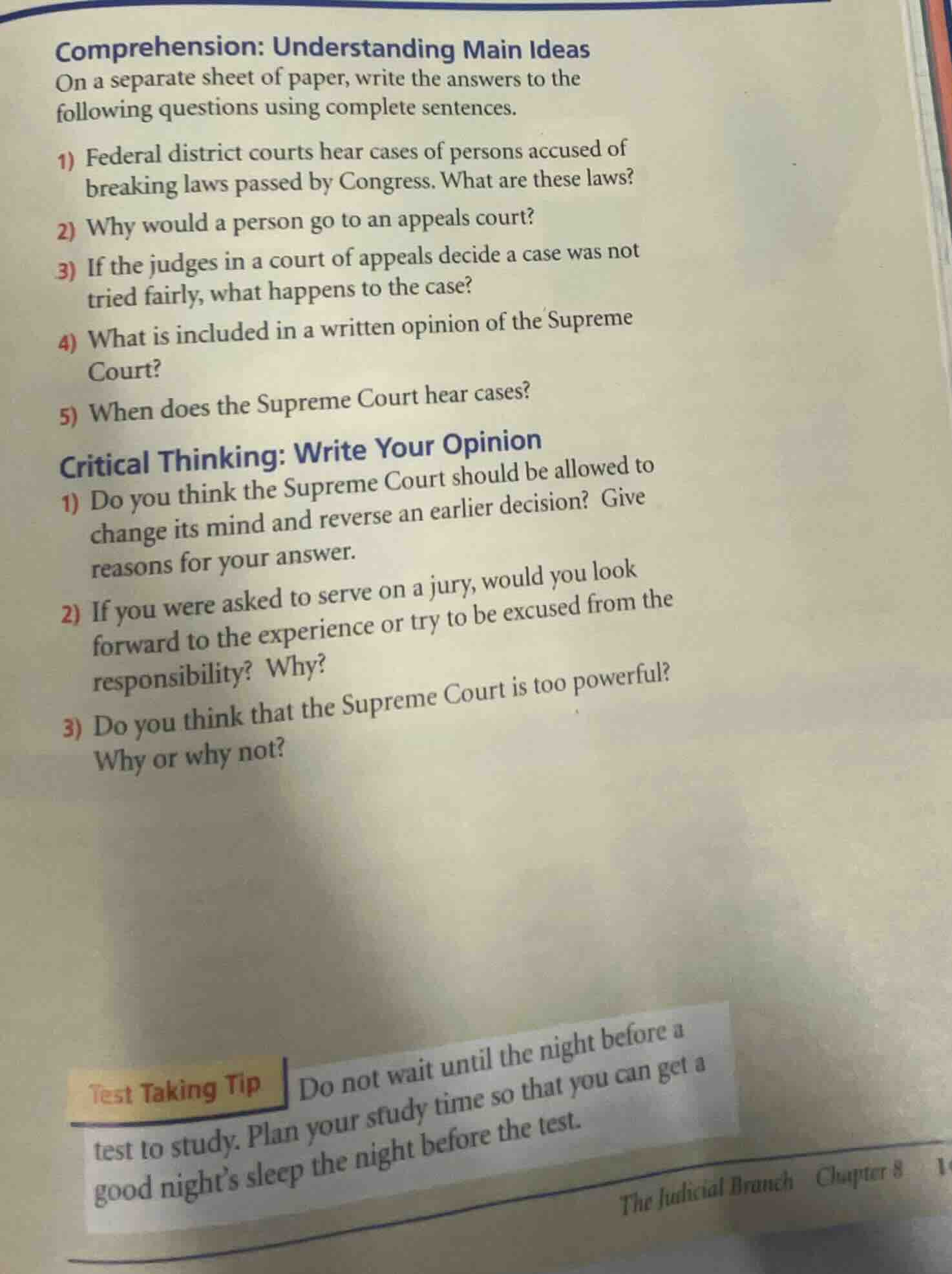
comprehension: understanding main ideas
on a separate sheet of paper, write the answers to the
following questions using complete sentences.
- federal district courts hear cases of persons accused of
breaking laws passed by congress. what are these laws?
- why would a person go to an appeals court?
- if the judges in a court of appeals decide a case was not
tried fairly, what happens to the case?
- what is included in a written opinion of the supreme
court?
- when does the supreme court hear cases?
critical thinking: write your opinion
- do you think the supreme court should be allowed to
change its mind and reverse an earlier decision? give
reasons for your answer.
- if you were asked to serve on a jury, would you look
forward to the experience or try to be excused from the
responsibility? why?
- do you think that the supreme court is too powerful?
why or why not?
test taking tip do not wait until the night before a
test to study. plan your study time so that you can get a
good night’s sleep the night before the test.
the judicial branch chapter 8
Comprehension: Understanding Main Ideas
- Brief Explanations: Laws passed by Congress are federal statutes, which are laws enacted by the legislative branch at the federal level to govern various aspects of the nation.

Snap & solve any problem in the app
Get step-by-step solutions on Sovi AI
Photo-based solutions with guided steps
Explore more problems and detailed explanations
**: These laws are federal statutes (or federal laws) passed by the legislative branch of the United States government, Congress, to regulate different areas of national life.
- Brief Explanations: A person goes to an appeals court when they believe there was an error in the legal process or the application of law in the trial court (like district court) and want a higher court to review and potentially reverse or modify the lower - court decision.