QUESTION IMAGE
Question
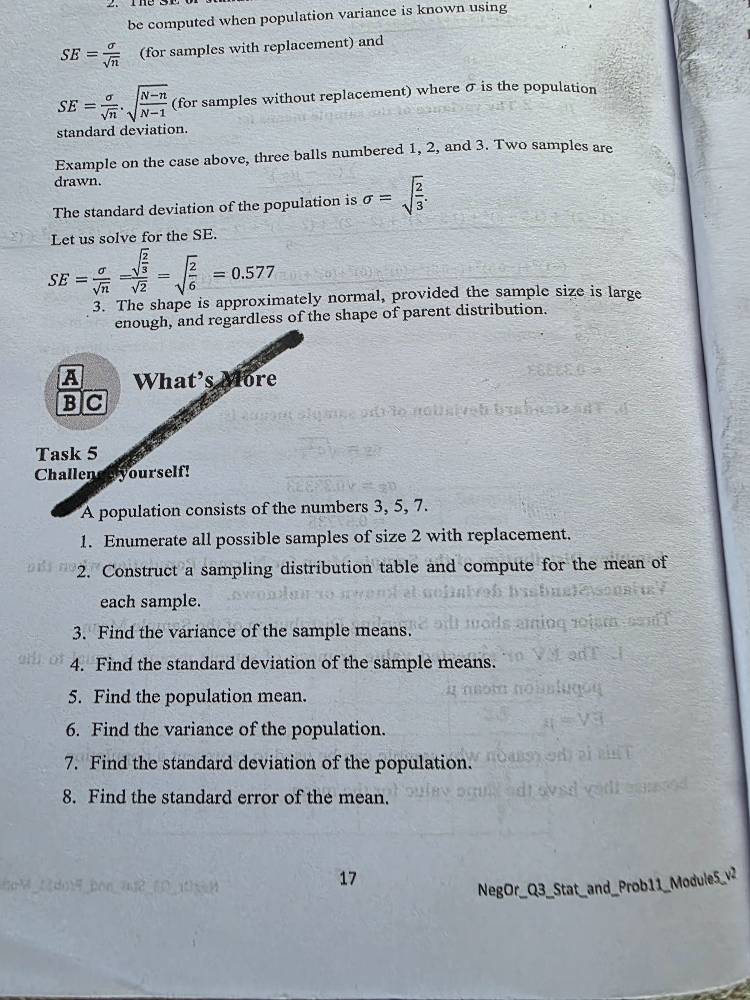
be computed when population variance is known using ( se = \frac{sigma}{sqrt{n}} ) (for samples with replacement) and ( se = \frac{sigma}{sqrt{n}} cdot sqrt{\frac{n - n}{n - 1}} ) (for samples without replacement) where ( sigma ) is the population standard deviation. example on the case above, three balls numbered 1, 2, and 3. two samples are drawn. the standard deviation of the population is ( sigma = sqrt{\frac{2}{3}} ). let us solve for the se. ( se = \frac{sigma}{sqrt{n}} = \frac{sqrt{\frac{2}{3}}}{sqrt{2}} = sqrt{\frac{2}{6}} = 0.577 ) 3. the shape is approximately normal, provided the sample size is large enough, and regardless of the shape of parent distribution. whats more task 5 challenge yourself! a population consists of the numbers 3, 5, 7. 1. enumerate all possible samples of size 2 with replacement. 2. construct a sampling distribution table and compute for the mean of each sample. 3. find the variance of the sample means. 4. find the standard deviation of the sample means. 5. find the population mean. 6. find the variance of the population. 7. find the standard deviation of the population. 8. find the standard error of the mean.
1. Enumerate all possible samples of size 2 with replacement.
Step1: Understand with replacement sampling
When sampling with replacement, after selecting a number, we put it back, so we can select the same number again. The population is {3, 5, 7}, and we need to draw samples of size 2.
The possible samples are: (3, 3), (3, 5), (3, 7), (5, 3), (5, 5), (5, 7), (7, 3), (7, 5), (7, 7)
Step1: Calculate the mean for each sample
- For (3, 3): $\bar{x}=\frac{3 + 3}{2}=3$
- For (3, 5): $\bar{x}=\frac{3 + 5}{2}=4$
- For (3, 7): $\bar{x}=\frac{3 + 7}{2}=5$
- For (5, 3): $\bar{x}=\frac{5 + 3}{2}=4$
- For (5, 5): $\bar{x}=\frac{5 + 5}{2}=5$
- For (5, 7): $\bar{x}=\frac{5 + 7}{2}=6$
- For (7, 3): $\bar{x}=\frac{7 + 3}{2}=5$
- For (7, 5): $\bar{x}=\frac{7 + 5}{2}=6$
- For (7, 7): $\bar{x}=\frac{7 + 7}{2}=7$
Step2: Construct the sampling distribution table
We list the sample means and their frequencies.
| Sample Mean ($\bar{x}$) | Frequency ($f$) |
|---|---|
| 4 | 2 |
| 5 | 3 |
| 6 | 2 |
| 7 | 1 |
Step1: Recall the formula for variance of a discrete distribution
The formula for the variance of a discrete random variable (here, the sample mean $\bar{x}$) is $s^2=\frac{\sum f(\bar{x}-\mu_{\bar{x}})^2}{N}$, where $\mu_{\bar{x}}$ is the mean of the sample means, $f$ is the frequency, and $N$ is the total number of samples. First, we find $\mu_{\bar{x}}$.
Step2: Calculate the mean of the sample means ($\mu_{\bar{x}}$)
$\mu_{\bar{x}}=\frac{\sum f\bar{x}}{\sum f}$
$\sum f\bar{x}=(3\times1)+(4\times2)+(5\times3)+(6\times2)+(7\times1)=3 + 8 + 15 + 12 + 7 = 45$
$\sum f=1 + 2 + 3 + 2 + 1 = 9$
So, $\mu_{\bar{x}}=\frac{45}{9}=5$
Step3: Calculate the sum of $f(\bar{x}-\mu_{\bar{x}})^2$
- For $\bar{x}=3$: $f(\bar{x}-\mu_{\bar{x}})^2=1\times(3 - 5)^2=1\times4 = 4$
- For $\bar{x}=4$: $f(\bar{x}-\mu_{\bar{x}})^2=2\times(4 - 5)^2=2\times1 = 2$
- For $\bar{x}=5$: $f(\bar{x}-\mu_{\bar{x}})^2=3\times(5 - 5)^2=3\times0 = 0$
- For $\bar{x}=6$: $f(\bar{x}-\mu_{\bar{x}})^2=2\times(6 - 5)^2=2\times1 = 2$
- For $\bar{x}=7$: $f(\bar{x}-\mu_{\bar{x}})^2=1\times(7 - 5)^2=1\times4 = 4$
$\sum f(\bar{x}-\mu_{\bar{x}})^2=4 + 2 + 0 + 2 + 4 = 12$
Step4: Calculate the variance
$s^2=\frac{12}{9}=\frac{4}{3}\approx1.333$

Snap & solve any problem in the app
Get step-by-step solutions on Sovi AI
Photo-based solutions with guided steps
Explore more problems and detailed explanations
(3, 3), (3, 5), (3, 7), (5, 3), (5, 5), (5, 7), (7, 3), (7, 5), (7, 7)