QUESTION IMAGE
Question
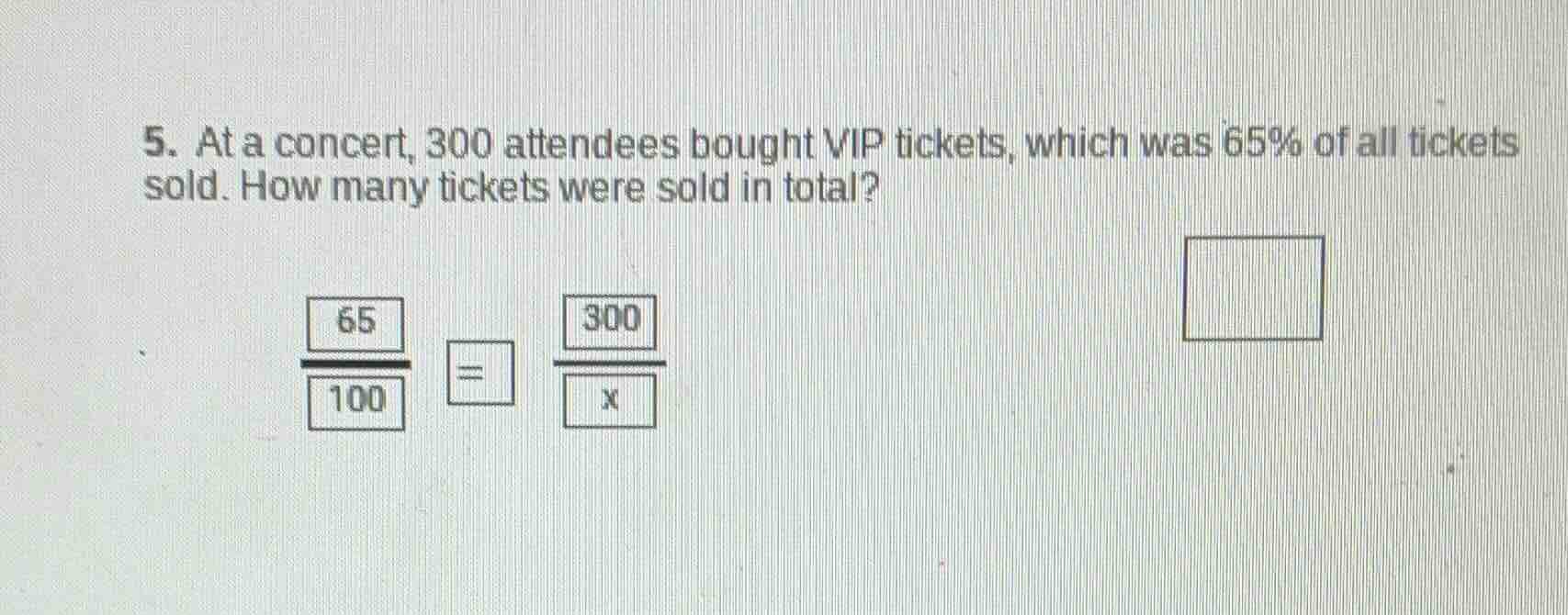
- at a concert, 300 attendees bought vip tickets, which was 65% of all tickets sold. how many tickets were sold in total?\
\\(\dfrac{65}{100}=\dfrac{300}{x}\\)
Step1: Set up the proportion
We know that 65% of the total tickets (let the total be \( x \)) is 300. So the proportion is \(\frac{65}{100}=\frac{300}{x}\).
Step2: Cross - multiply
Cross - multiplying gives us \( 65x = 300\times100 \).
Step3: Solve for \( x \)
First, calculate \( 300\times100 = 30000 \). Then, \( x=\frac{30000}{65}=\frac{6000}{13}\approx461.54 \). But since the number of tickets must be a whole number, and if we consider the exact value from the proportion (maybe there was a typo and it's 60%? But following the given numbers), if we do the calculation as is, \( x = \frac{30000}{65}=\frac{6000}{13}\approx462 \) (rounding up). However, if we assume that maybe the 65% is a mistake and it's 60% for a whole number, but based on the given problem:
From \(\frac{65}{100}=\frac{300}{x}\), cross - multiply: \( 65x=300\times100 \)
\( x = \frac{30000}{65}=\frac{6000}{13}\approx461.54 \). But in real - world terms, we can also write it as a fraction or a decimal. But if we need a whole number, we can say approximately 462. But let's do the exact calculation:
\( 65x = 30000 \)
\( x=\frac{30000}{65}=\frac{6000}{13}\approx461.54 \)

Snap & solve any problem in the app
Get step-by-step solutions on Sovi AI
Photo-based solutions with guided steps
Explore more problems and detailed explanations
\(\frac{6000}{13}\) (or approximately \( 461.54 \) or \( 462 \) if we round to the nearest whole number)