QUESTION IMAGE
Question
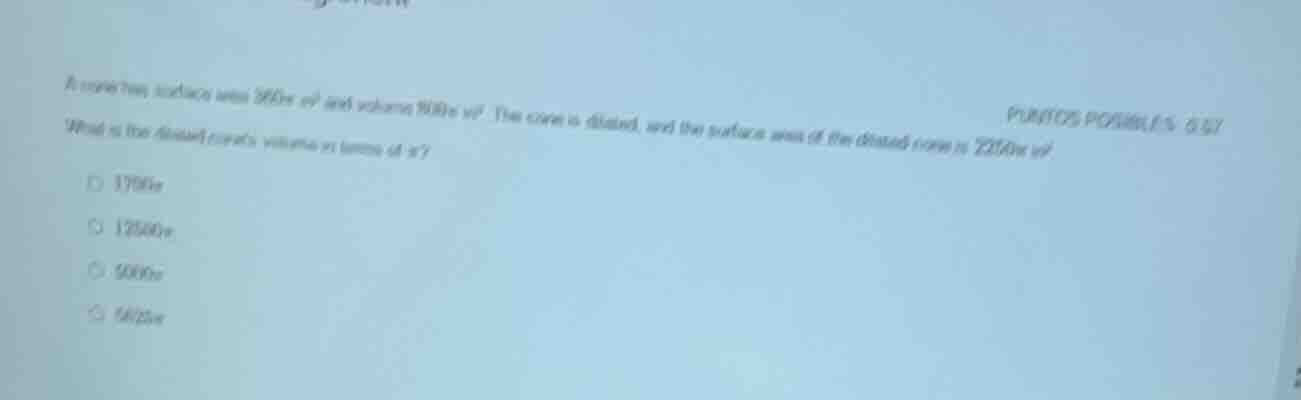
a cone has a radius of 30\pi in³ and a slant height of 100\pi in²? the cone is dilated, and the surface area of the dilated cone is 2250\pi in². what is the dilated cone’s volume in terms of \pi? \
\bigcirc 1390\pi \
\bigcirc 13500\pi \
\bigcirc 5000\pi \
\bigcirc 5625\pi
Step 1: Recall Similar Solids Ratio
For similar solids (the original cone and the dilated cone), the ratio of surface areas is the square of the ratio of corresponding linear dimensions (like radius, height), and the ratio of volumes is the cube of the ratio of linear dimensions. Let the scale factor (ratio of linear dimensions of dilated to original) be \( k \). The surface area of a cone is \( \pi r (r + l) \) (where \( l \) is slant height), but for similar cones, the ratio of surface areas \( \frac{SA_{dilated}}{SA_{original}}=k^{2} \), and ratio of volumes \( \frac{V_{dilated}}{V_{original}}=k^{3} \).
First, find the original surface area. Wait, the problem says "a cone has surface area 360π and volume 800π". Wait, maybe the original surface area is \( 360\pi \) and original volume \( 800\pi \), dilated surface area is \( 2250\pi \). Let's confirm:
Let \( SA_{1} = 360\pi \), \( V_{1}=800\pi \), \( SA_{2}=2250\pi \), \( V_{2}=? \)
Ratio of surface areas: \( \frac{SA_{2}}{SA_{1}}=\frac{2250\pi}{360\pi}=\frac{2250}{360}=\frac{125}{20}=\frac{25}{4} \)? Wait, no, \( 2250\div360 = \frac{2250}{360}=\frac{225}{36}=\frac{25}{4} \)? Wait, \( 25/4 = 6.25 \), but \( k^{2}=\frac{SA_{2}}{SA_{1}} \), so \( k^{2}=\frac{2250\pi}{360\pi}=\frac{2250}{360}=\frac{125}{20}=\frac{25}{4} \)? Wait, no, 2250 divided by 360: 360*6=2160, 2250-2160=90, so 6 + 90/360=6.25=25/4. So \( k^{2}=\frac{25}{4} \), so \( k=\frac{5}{2} \) (since scale factor is positive).
Now, ratio of volumes: \( \frac{V_{2}}{V_{1}}=k^{3} \). Since \( k = \frac{5}{2} \), \( k^{3}=(\frac{5}{2})^{3}=\frac{125}{8} \).
Original volume \( V_{1}=800\pi \), so \( V_{2}=800\pi\times\frac{125}{8} \).
Step 2: Calculate Dilated Volume
Calculate \( 800\times\frac{125}{8} \): 800 divided by 8 is 100, 100125=12500. So \( V_{2}=12500\pi \)? Wait, but the options include 12500π? Wait the options are 1792π, 12500π, 5000π, 5625π. Wait maybe I misread the original surface area. Wait maybe the original surface area is 360π, dilated is 2250π? Wait 360 and 2250: 360 = 1442.5? No, 360 = 490, 2250=2590. So \( \frac{2250}{360}=\frac{25}{4} \), so scale factor squared is 25/4, scale factor is 5/2. Then volume ratio is (5/2)^3=125/8. Original volume 800π, so 800*(125/8)=12500π. So the answer should be 12500π. Wait the option is "12500π" (the second option).
Wait let's check again:
Original surface area \( SA_1 = 360\pi \), dilated \( SA_2 = 2250\pi \)
\( \frac{SA_2}{SA_1} = \frac{2250}{360} = \frac{25}{4} = k^2 \) ⇒ \( k = \frac{5}{2} \)
Volume ratio \( \frac{V_2}{V_1} = k^3 = (\frac{5}{2})^3 = \frac{125}{8} \)
\( V_1 = 800\pi \), so \( V_2 = 800\pi \times \frac{125}{8} = (800 \div 8) \times 125 \pi = 100 \times 125 \pi = 12500\pi \)

Snap & solve any problem in the app
Get step-by-step solutions on Sovi AI
Photo-based solutions with guided steps
Explore more problems and detailed explanations
12500π (the second option, assuming the options are: 1792π, 12500π, 5000π, 5625π)