QUESTION IMAGE
Question
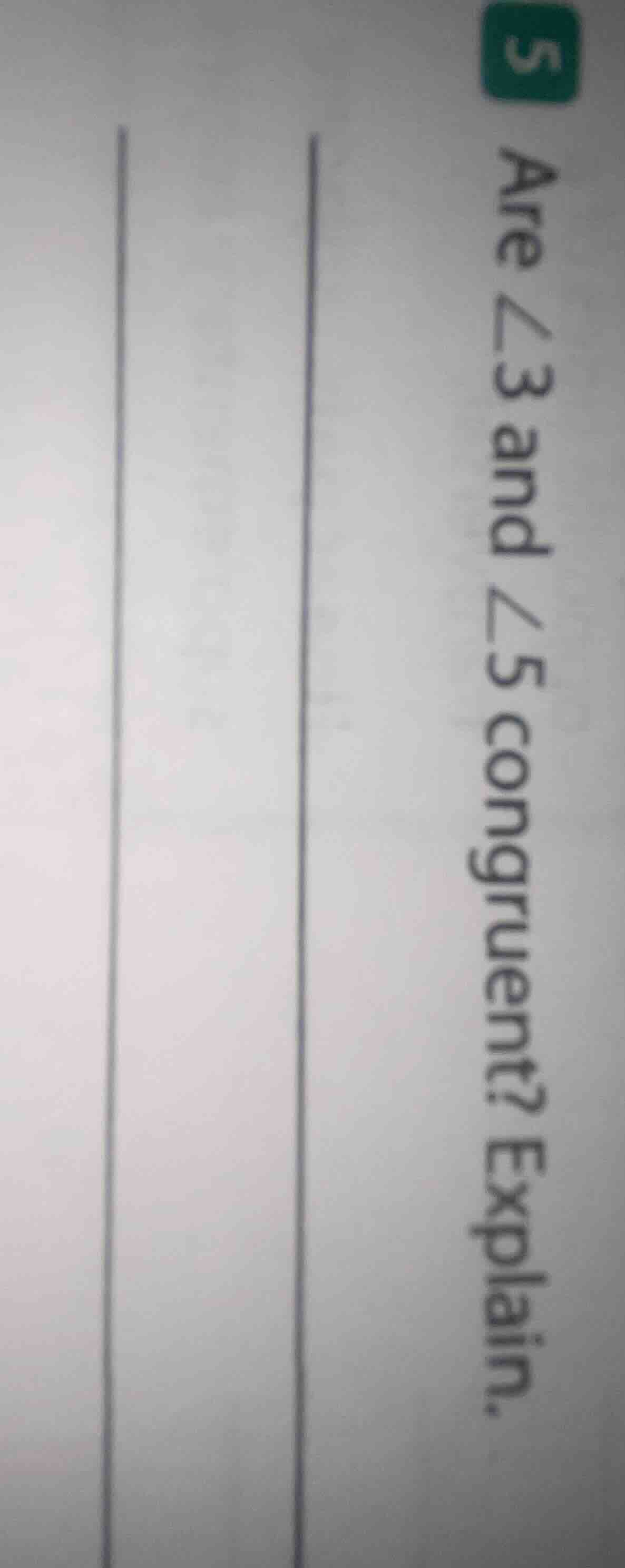
are ∠3 and ∠5 congruent? explain.
To determine if \(\angle3\) and \(\angle5\) are congruent, we need to analyze their relationship (e.g., vertical angles, alternate interior angles, corresponding angles, etc.). However, since the diagram is not fully visible, we'll assume a common scenario (e.g., parallel lines cut by a transversal or vertical angles).
Case 1: Vertical Angles
If \(\angle3\) and \(\angle5\) are vertical angles (formed by two intersecting lines), vertical angles are always congruent.
Case 2: Parallel Lines Cut by a Transversal
If there are parallel lines cut by a transversal:
- If \(\angle3\) and \(\angle5\) are alternate interior angles, they are congruent (Alternate Interior Angles Theorem).
- If they are same - side interior angles, they are supplementary (not congruent unless each is \(90^\circ\)).
Since the problem likely involves a standard diagram (e.g., vertical angles or alternate interior angles in a parallel - line - transversal setup), we can conclude:
If \(\angle3\) and \(\angle5\) are vertical angles (formed by intersecting lines) or alternate interior angles (formed by parallel lines cut by a transversal), they are congruent. Vertical angles are always congruent, and alternate interior angles between parallel lines are congruent.

Snap & solve any problem in the app
Get step-by-step solutions on Sovi AI
Photo-based solutions with guided steps
Explore more problems and detailed explanations
Assuming a typical diagram (e.g., vertical angles or parallel lines with a transversal), \(\angle3\) and \(\angle5\) are congruent. The reason is that vertical angles are congruent, or if they are alternate interior angles formed by parallel lines cut by a transversal, alternate interior angles are congruent.