QUESTION IMAGE
Question
conjectures about properties
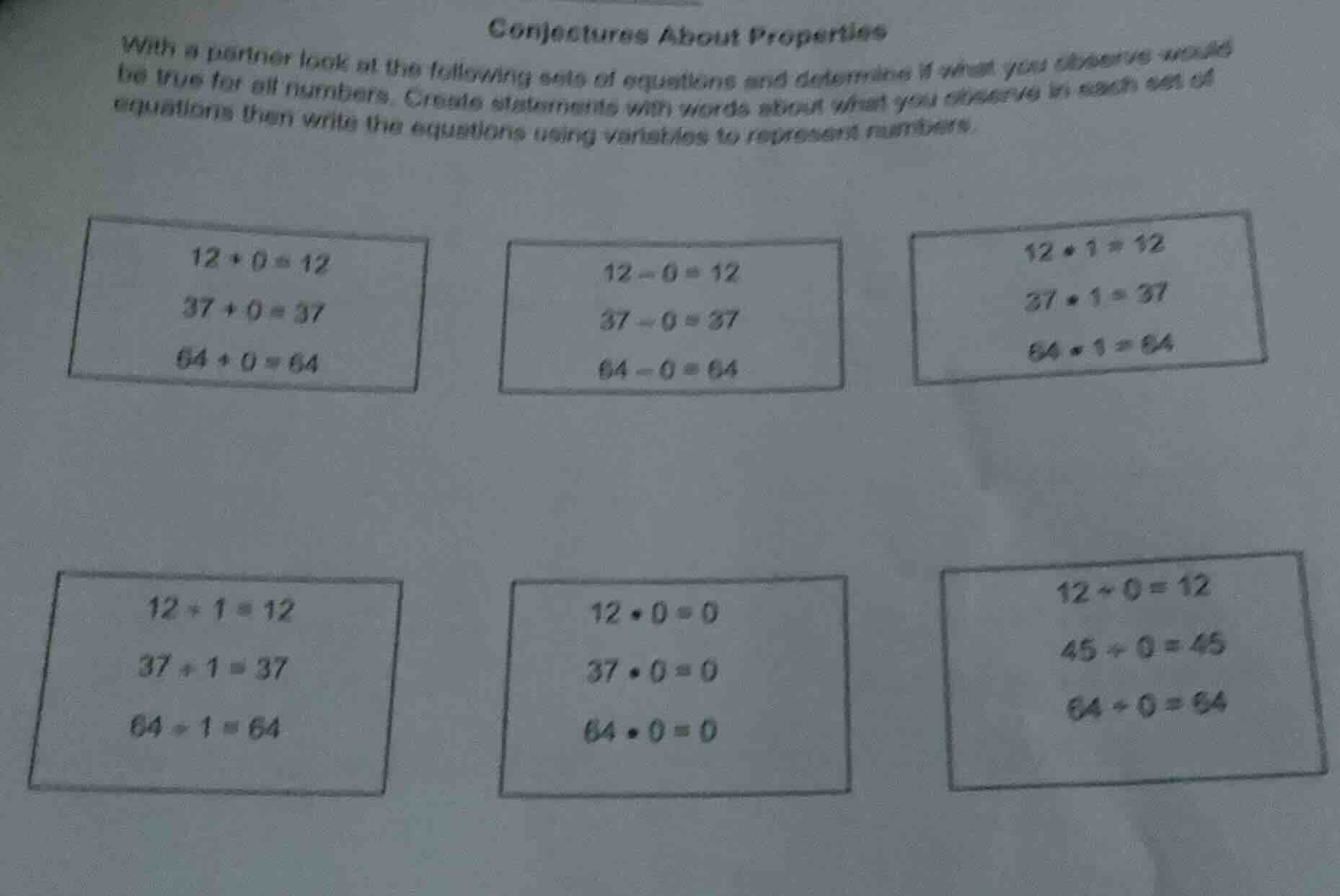
with a partner look at the following sets of equations and determine if what you observe would be true for all numbers. create statements with words about what you observe in each set of equations then write the equations using variables to represent numbers.
12 + 0 = 12
37 + 0 = 37
64 + 0 = 64
12 - 0 = 12
37 - 0 = 37
64 - 0 = 64
12 * 1 = 12
37 * 1 = 37
64 * 1 = 64
12 ÷ 1 = 12
37 ÷ 1 = 37
64 ÷ 1 = 64
12 * 0 = 0
37 * 0 = 0
64 * 0 = 0
12 + 0 = 12
45 + 0 = 45
64 + 0 = 64
Step1: Analyze addition with 0
When any number is added to 0, the result is the original number.
Let $n$ represent any number: $n + 0 = n$
Step2: Analyze subtraction with 0
When 0 is subtracted from any number, the result is the original number.
Let $n$ represent any number: $n - 0 = n$
Step3: Analyze multiplication by 1
When any number is multiplied by 1, the result is the original number.
Let $n$ represent any number: $n \times 1 = n$
Step4: Analyze division by 1
When any number is divided by 1, the result is the original number.
Let $n$ represent any number: $\frac{n}{1} = n$
Step5: Analyze multiplication by 0
When any number is multiplied by 0, the result is 0.
Let $n$ represent any number: $n \times 0 = 0$
Step6: Analyze division by non-zero number
When any non-zero number is divided by itself, the result is 1.
Let $n$ represent any non-zero number: $\frac{n}{n} = 1$

Snap & solve any problem in the app
Get step-by-step solutions on Sovi AI
Photo-based solutions with guided steps
Explore more problems and detailed explanations
- Addition with 0: Adding 0 to any number leaves the number unchanged. $n + 0 = n$
- Subtraction with 0: Subtracting 0 from any number leaves the number unchanged. $n - 0 = n$
- Multiplication by 1: Multiplying any number by 1 leaves the number unchanged. $n \times 1 = n$
- Division by 1: Dividing any number by 1 leaves the number unchanged. $\frac{n}{1} = n$
- Multiplication by 0: Multiplying any number by 0 gives 0. $n \times 0 = 0$
- Division of number by itself: Dividing any non-zero number by itself gives 1. $\frac{n}{n} = 1$ (where $n
eq 0$)