QUESTION IMAGE
Question
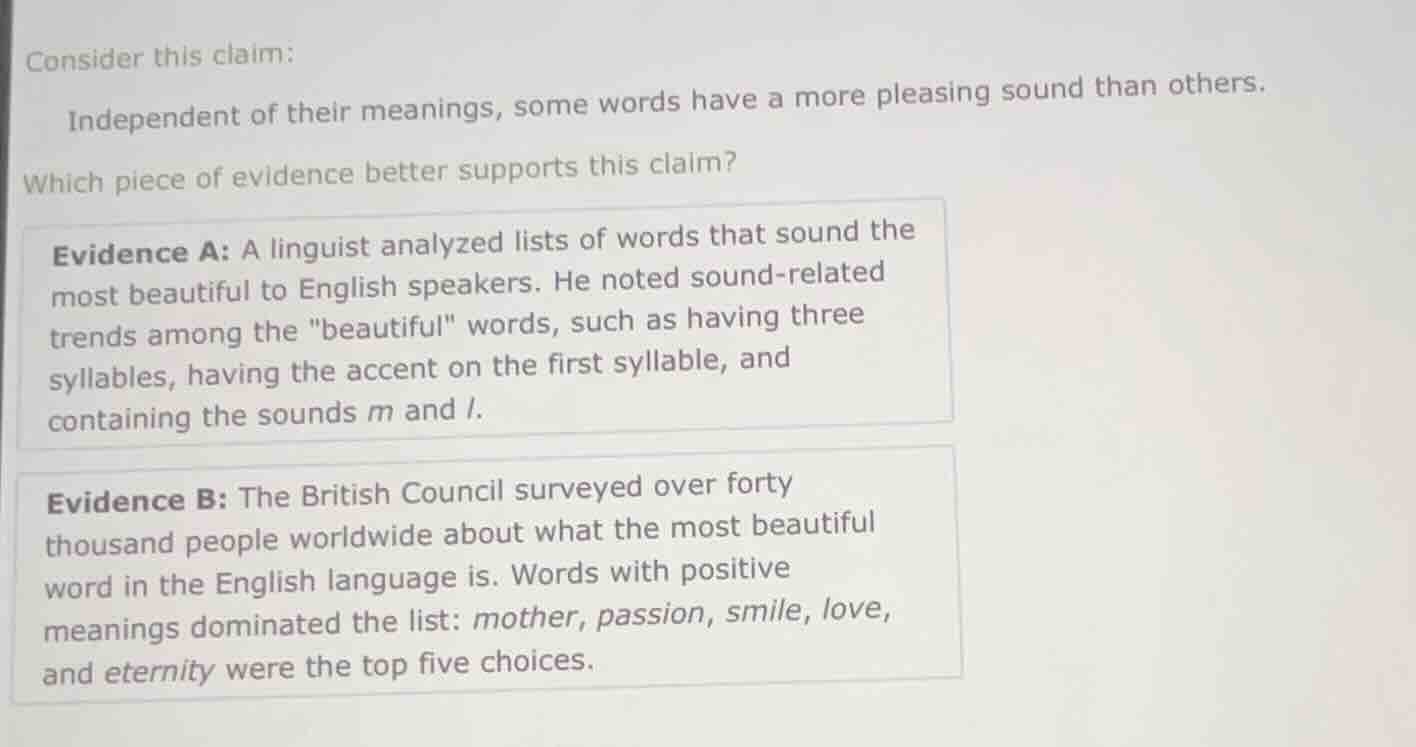
consider this claim: independent of their meanings, some words have a more pleasing sound than others. which piece of evidence better supports this claim? evidence a: a linguist analyzed lists of words that sound the most beautiful to english speakers. he noted sound - related trends among the \beautiful\ words, such as having three syllables, having the accent on the first syllable, and containing the sounds m and l. evidence b: the british council surveyed over forty thousand people worldwide about what the most beautiful word in the english language is. words with positive meanings dominated the list: mother, passion, smile, love, and eternity were the top five choices.
The claim is about words having a more pleasing sound independent of their meanings. Evidence A focuses on sound - related trends (syllables, accent, sounds) of words considered beautiful, without involving meaning. Evidence B shows words with positive meanings being seen as beautiful, which is about meaning, not sound independent of meaning. So Evidence A better supports the claim.

Snap & solve any problem in the app
Get step-by-step solutions on Sovi AI
Photo-based solutions with guided steps
Explore more problems and detailed explanations
Evidence A: A linguist analyzed lists of words that sound the most beautiful to English speakers. He noted sound - related trends among the "beautiful" words, such as having three syllables, having the accent on the first syllable, and containing the sounds m and l.