QUESTION IMAGE
Question
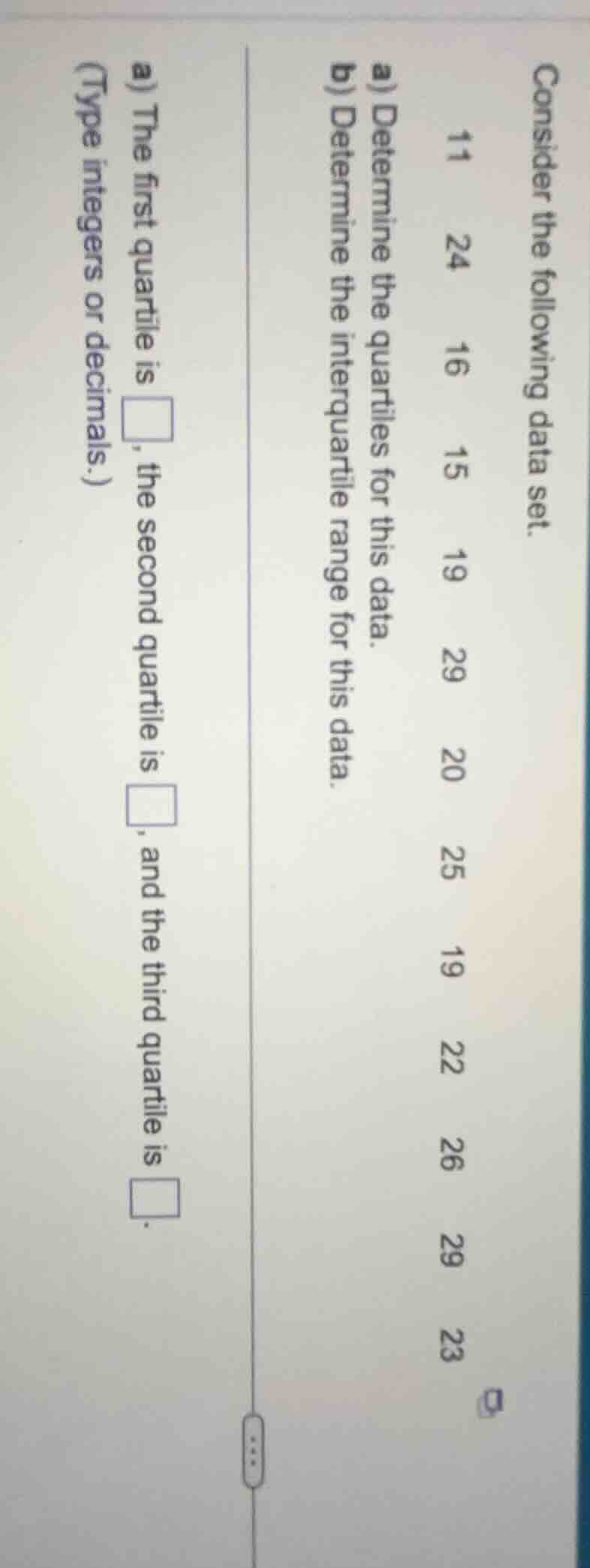
consider the following data set. 11 24 16 15 19 29 20 25 19 22 26 29 23
a) determine the quartiles for this data.
b) determine the interquartile range for this data.
a) the first quartile is \\(\square\\), the second quartile is \\(\square\\), and the third quartile is \\(\square\\).
(type integers or decimals.)
Part a)
Step 1: Order the data set
First, we need to arrange the data set in ascending order. The given data set is: 11, 24, 16, 15, 19, 29, 20, 25, 19, 22, 26, 29, 23.
After sorting in ascending order: 11, 15, 16, 19, 19, 20, 22, 23, 24, 25, 26, 29, 29.
Step 2: Find the position of the median (second quartile, \(Q_2\))
The number of data points \(n = 13\) (odd). The median (second quartile) is the middle value, which is at position \(\frac{n + 1}{2}=\frac{13 + 1}{2}=7\)th value.
Looking at the sorted data: 11, 15, 16, 19, 19, 20, \(\boldsymbol{22}\), 23, 24, 25, 26, 29, 29. So, \(Q_2 = 22\).
Step 3: Find the first quartile (\(Q_1\))
The first quartile is the median of the lower half of the data. The lower half consists of the first 6 values (since \(n = 13\), the lower half is from position 1 to 6): 11, 15, 16, 19, 19, 20.
The number of values in the lower half \(n_1 = 6\) (even). The median of the lower half is the average of the 3rd and 4th values.
3rd value: 16, 4th value: 19. So, \(Q_1=\frac{16 + 19}{2}=\frac{35}{2}=17.5\).
Step 4: Find the third quartile (\(Q_3\))
The third quartile is the median of the upper half of the data. The upper half consists of the last 6 values (from position 8 to 13): 23, 24, 25, 26, 29, 29.
The number of values in the upper half \(n_2 = 6\) (even). The median of the upper half is the average of the 3rd and 4th values.
3rd value: 25, 4th value: 26. So, \(Q_3=\frac{25 + 26}{2}=\frac{51}{2}=25.5\).
Step 1: Recall the formula for interquartile range (IQR)
The interquartile range is calculated as \(IQR = Q_3 - Q_1\).
Step 2: Substitute the values of \(Q_3\) and \(Q_1\)
We found \(Q_3 = 25.5\) and \(Q_1 = 17.5\) from part a.
So, \(IQR = 25.5 - 17.5 = 8\).

Snap & solve any problem in the app
Get step-by-step solutions on Sovi AI
Photo-based solutions with guided steps
Explore more problems and detailed explanations
(for part a):
The first quartile is \(17.5\), the second quartile is \(22\), and the third quartile is \(25.5\).