QUESTION IMAGE
Question
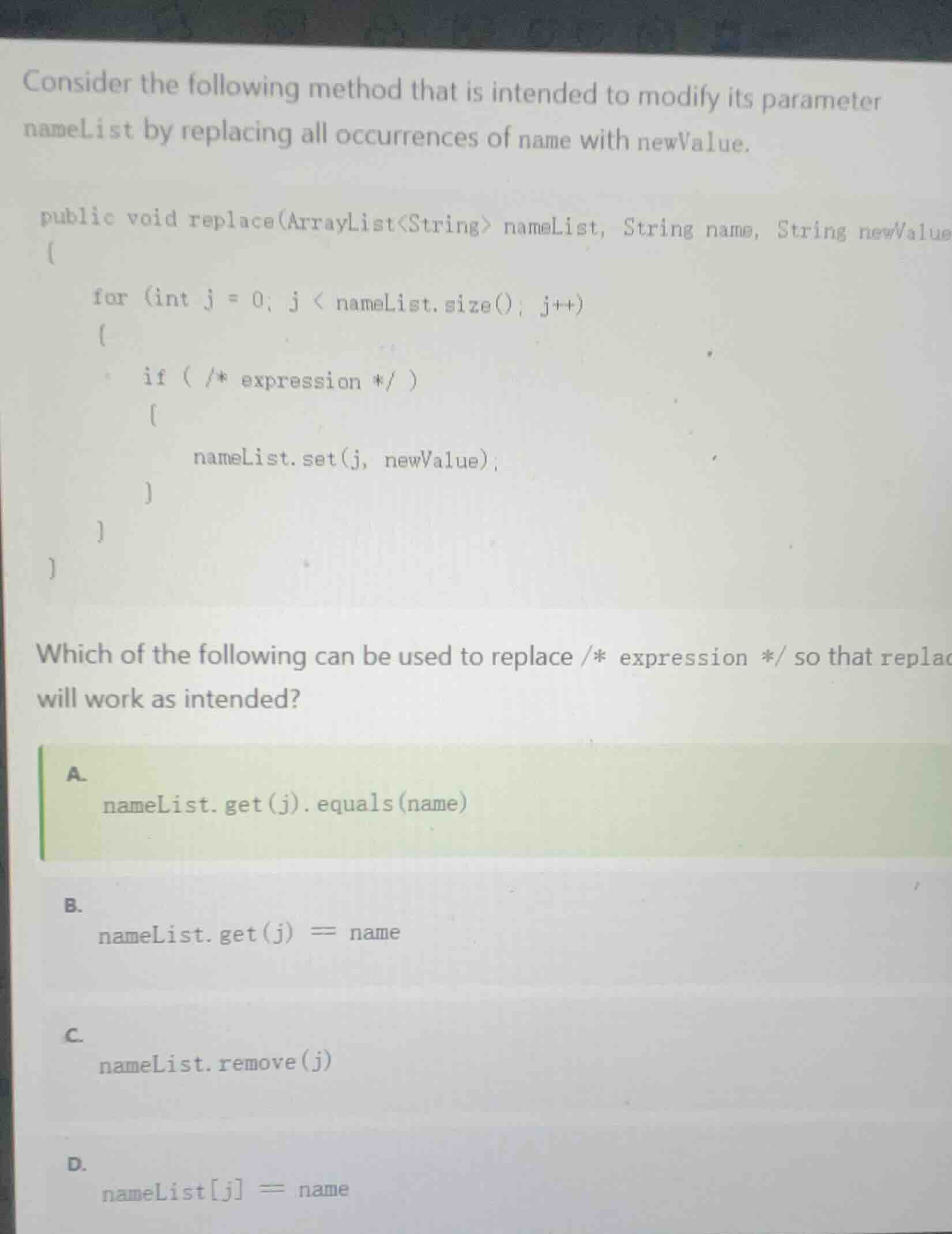
consider the following method that is intended to modify its parameter namelist by replacing all occurrences of name with newvalue.
public void replace(arraylist<string> namelist, string name, string newvalue
{
for (int j = 0; j < namelist.size(); j++)
{
if ( / expression / )
{
namelist.set(j, newvalue);
}
}
}
which of the following can be used to replace / expression / so that replace will work as intended?
a.
namelist.get(j).equals(name)
b.
namelist.get(j) == name
c.
namelist.remove(j)
d.
namelistj == name
To determine the correct expression for the if condition, we analyze each option:
- Option A: In Java, to compare the content of two
Stringobjects, we use theequals()method.nameList.get(j).equals(name)checks if the element at indexjinnameListhas the same content as thenamestring. This is the correct way to check for equality of string contents, which aligns with the goal of replacing all occurrences ofnamewithnewValue. - Option B: Using
==to compareStringobjects in Java checks for reference equality (whether they refer to the same object in memory), not content equality. So this will not work as intended to check if the string contents are the same. - Option C:
nameList.remove(j)is a method to remove an element from the list, not a boolean expression suitable for anifcondition. It also does not check for the occurrence ofnamein the list. - Option D:
nameList[j]is not valid syntax for accessing elements in anArrayListin Java.ArrayListelements are accessed using theget()method, not array - like indexing with square brackets. Also, as with Option B,==is used incorrectly here.

Snap & solve any problem in the app
Get step-by-step solutions on Sovi AI
Photo-based solutions with guided steps
Explore more problems and detailed explanations
A. nameList.get(j).equals(name)