QUESTION IMAGE
Question
consider parallelogram jklm below.
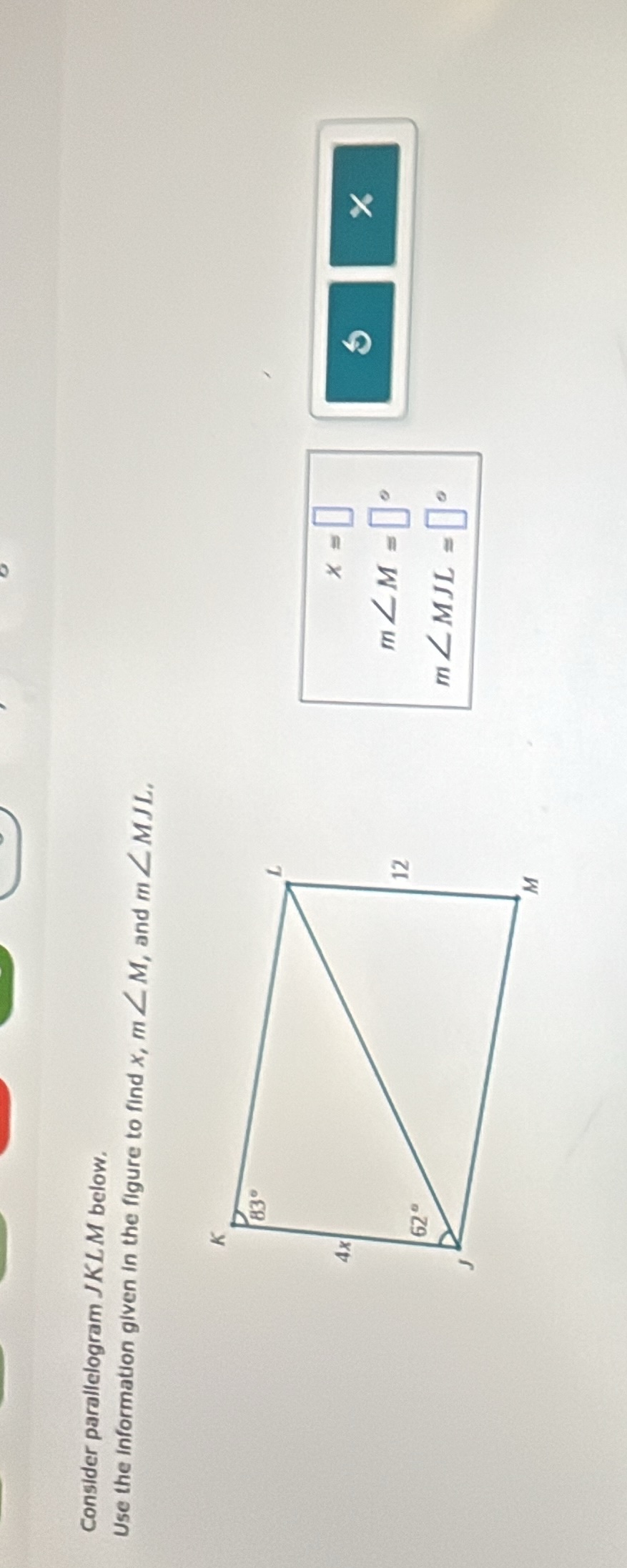
use the information given in the figure to find ( x ), ( mangle m ), and ( mangle mjl ).
Step1: Find x using opposite sides of parallelogram
In a parallelogram, opposite sides are equal. So \( JK = LM \) and \( JL = KM \)? Wait, no, looking at the diagram, \( JK = 4x \) and \( LM = 12 \) (since \( LM \) is labeled 12). So \( 4x = 12 \).
\( 4x = 12 \)
Divide both sides by 4: \( x = \frac{12}{4} = 3 \)
Step2: Find \( m\angle M \) using opposite angles of parallelogram
In a parallelogram, opposite angles are equal. \( \angle K \) and \( \angle M \) are opposite angles? Wait, \( \angle K = 83^\circ \), but wait, no, in a parallelogram, consecutive angles are supplementary. Wait, \( JKLM \) is a parallelogram, so \( JK \parallel LM \) and \( JL \parallel KM \)? Wait, maybe \( \angle K \) and \( \angle J \) are consecutive? Wait, no, let's check the angles. Wait, \( \angle K = 83^\circ \), and in a parallelogram, consecutive angles are supplementary. Wait, maybe \( \angle M \) is equal to \( \angle K \)? Wait, no, opposite angles are equal. Wait, \( \angle K \) and \( \angle M \): if \( JKLM \) is a parallelogram, then \( \angle K = \angle M \)? Wait, no, maybe I made a mistake. Wait, actually, in a parallelogram, opposite angles are equal, and consecutive angles are supplementary. So if \( \angle K = 83^\circ \), then \( \angle M = \angle K = 83^\circ \)? Wait, no, wait, let's look at the sides. \( JK \) and \( LM \) are opposite, \( JL \) and \( KM \) are opposite? Wait, the diagram shows \( JK = 4x \), \( LM = 12 \), \( LW = 12 \)? Wait, no, the diagram has \( L \) connected to \( W \)? Wait, no, the parallelogram is \( JKLM \), so vertices are \( J, K, L, M \) in order. So \( JK \parallel LM \) and \( JL \parallel KM \)? Wait, no, \( JK \) and \( LM \) are opposite sides, \( JL \) and \( KM \) are opposite sides? Wait, maybe \( \angle K \) and \( \angle J \) are consecutive angles. Wait, \( \angle K = 83^\circ \), \( \angle J \) has a part \( 62^\circ \). Wait, maybe I need to re-examine. Wait, the problem is to find \( x \), \( m\angle M \), and \( m\angle MJL \).
First, \( x \): since \( JK = 4x \) and \( LM = 12 \), and in a parallelogram, opposite sides are equal, so \( JK = LM \), so \( 4x = 12 \), so \( x = 3 \).
Then, \( m\angle M \): in a parallelogram, opposite angles are equal. \( \angle K = 83^\circ \), so \( \angle M = \angle K = 83^\circ \)? Wait, no, maybe \( \angle M \) is equal to \( \angle K \). Wait, yes, opposite angles in a parallelogram are equal, so \( \angle M = \angle K = 83^\circ \).
Then, \( m\angle MJL \): looking at the diagram, \( \angle J \) is split into \( 62^\circ \) and \( \angle MJL \). Wait, in a parallelogram, \( JK \parallel LM \), so the alternate interior angles: \( \angle MJL \) and \( \angle JLM \)? Wait, no, maybe \( \angle MJL \) is equal to \( \angle KJL \)? Wait, no, the triangle \( JKL \) or something. Wait, maybe \( \angle MJL \) is calculated as follows: in the parallelogram, \( \angle K = 83^\circ \), \( \angle KJL = 62^\circ \), wait, no, the angle at \( J \) is \( 62^\circ \) and \( \angle MJL \). Wait, maybe \( \angle MJL \) is equal to \( 180^\circ - 83^\circ - 62^\circ \)? No, that's for a triangle. Wait, no, in the parallelogram, \( JK \parallel LM \), so \( \angle MJL \) and \( \angle JLM \) are alternate interior angles. Wait, maybe I'm overcomplicating. Wait, the problem gives \( \angle K = 83^\circ \), and in the parallelogram, \( \angle MJL \) is equal to \( 180^\circ - 83^\circ - 62^\circ \)? No, wait, let's check the angles. Wait, the sum of angles in a triangle is \( 180^\circ \), but here it's a parallelogram. Wait, maybe \( \angle MJL = 180^\circ -…

Snap & solve any problem in the app
Get step-by-step solutions on Sovi AI
Photo-based solutions with guided steps
Explore more problems and detailed explanations
\( x = 3 \), \( m\angle M = 83^\circ \), \( m\angle MJL = 35^\circ \)