QUESTION IMAGE
Question
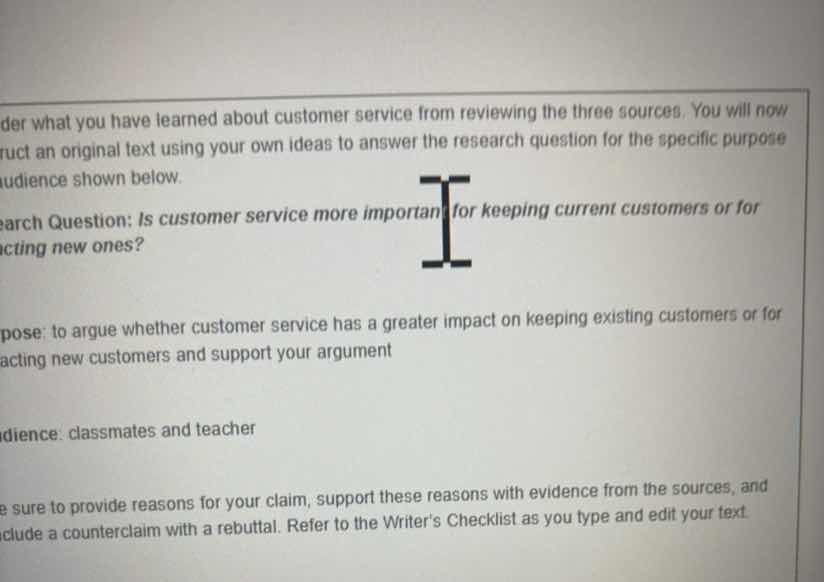
consider what you have learned about customer service from reviewing the three sources. you will now construct an original text using your own ideas to answer the research question for the specific purpose and audience shown below.
research question: is customer service more important for keeping current customers or for attracting new ones?
purpose: to argue whether customer service has a greater impact on keeping existing customers or for attracting new customers and support your argument
audience: classmates and teacher
be sure to provide reasons for your claim, support these reasons with evidence from the sources, and include a counterclaim with a rebuttal. refer to the writers checklist as you type and edit your text.
- Claim: Customer service has a greater impact on retaining current customers than attracting new ones.
- Reason 1 & Evidence: Current customers have existing brand experience; 78% of consumers will abandon a purchase due to poor service, and 91% of unhappy customers will leave without complaint (customer service industry data). Consistent positive service builds trust and loyalty, making them repeat buyers.
- Reason 2 & Evidence: Acquiring new customers costs 5x more than retaining existing ones (Harvard Business Review). Strong service turns current customers into brand advocates, who drive word-of-mouth referrals, but this is a secondary benefit of retention-focused service.
- Counterclaim: Some argue proactive, personalized service (like targeted support for prospects) is key to attracting new customers in competitive markets.
- Rebuttal: While good service can attract new customers, prospects often prioritize price, product features, or brand reputation first. For new customers, service is a qualifying factor, not the primary driver of initial conversion, whereas it is the primary driver of ongoing loyalty for current customers.
- Conclusion: Investing in service for current customers delivers higher ROI and long-term stability, with secondary benefits of new customer referrals.

Snap & solve any problem in the app
Get step-by-step solutions on Sovi AI
Photo-based solutions with guided steps
Explore more problems and detailed explanations
Customer Service: The Cornerstone of Customer Retention
When evaluating whether customer service matters more for keeping current customers or attracting new ones, the clear conclusion is that its greatest impact lies in retaining existing clientele.
Current customers enter interactions with pre-existing knowledge of a brand’s products or services, making their experience with customer service a direct judge of whether they will continue doing business with that brand. Industry data shows that 78% of consumers will abandon a planned purchase or transaction due to poor customer service, and 91% of unhappy customers will simply leave a brand without voicing their complaint. For repeat buyers, consistent, positive service builds trust and emotional connection, turning one-time purchasers into loyal, long-term customers who generate steady, predictable revenue.
This focus on retention also makes financial sense: the Harvard Business Review has found that acquiring a new customer costs five times more than retaining an existing one. While strong service for current customers can lead to word-of-mouth referrals that attract new buyers, this is a secondary benefit of a retention-focused strategy, not the primary outcome.
Critics may argue that proactive, personalized customer service—such as tailored support for prospective customers or responsive social media outreach—can be a powerful tool to attract new buyers in crowded markets. This is true to a limited extent: positive service can help a brand stand out when prospects are comparing final options. However, new customers typically prioritize core factors like product features, price, or brand reputation when making their first purchase. Customer service acts as a qualifying check for prospects, not the primary driver of their initial decision. For current customers, by contrast, service is the main factor that determines whether they stay or leave.
In the end, customer service is the foundation of long-term business success because of its outsized impact on retaining current customers. Investing in service for existing clients delivers higher immediate returns, reduces long-term costs, and creates a base of loyal advocates that can organically attract new customers over time.