QUESTION IMAGE
Question
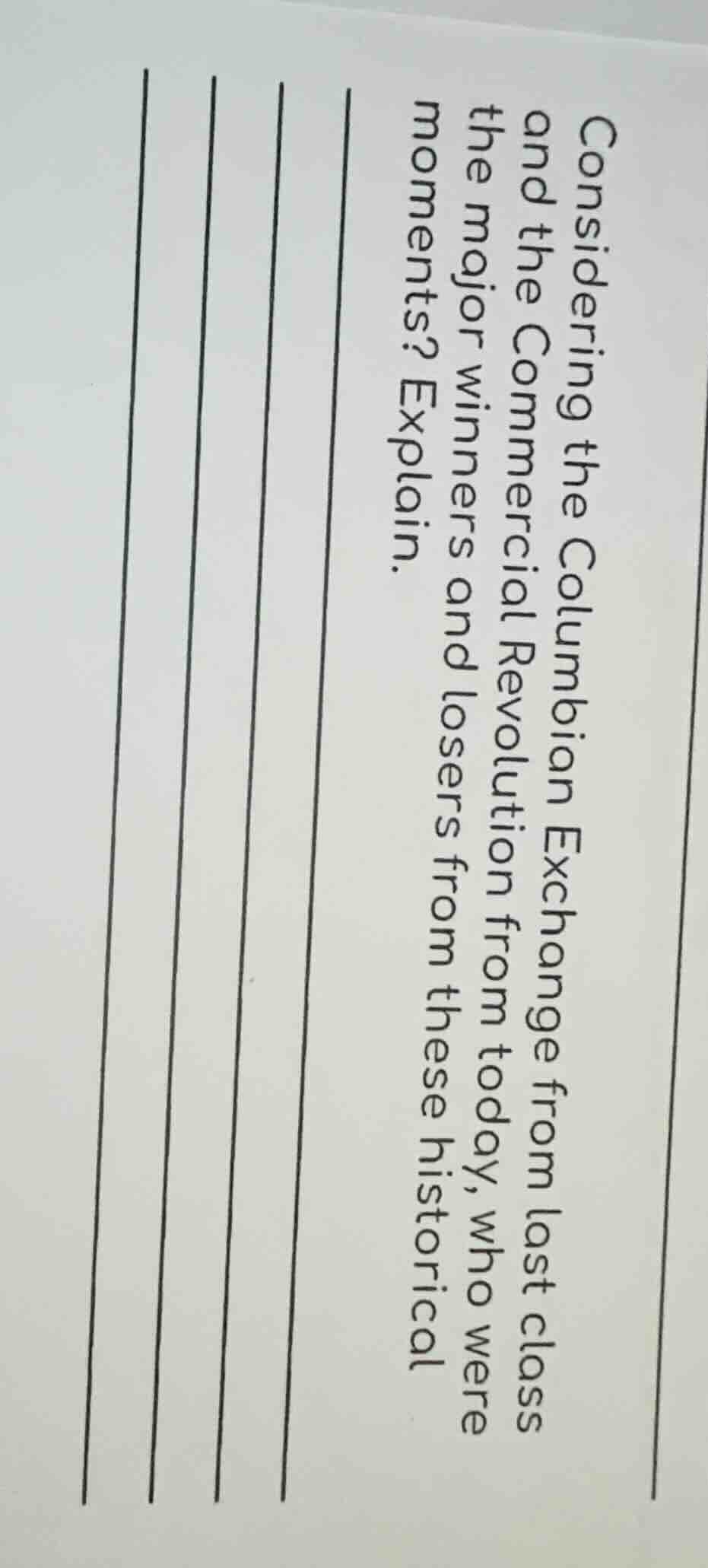
considering the columbian exchange from last class and the commercial revolution from today, who were the major winners and losers from these historical moments? explain.
Brief Explanations
The Columbian Exchange (15th - 16th century) and Commercial Revolution (late Middle Ages - early modern period) reshaped global power, economies, and societies. Winners:
- European Powers (Spain, Portugal, later England, France, Netherlands): Columbian Exchange brought new crops (e.g., maize, potatoes) to Europe, boosting population and agriculture. Commercial Revolution spurred banking (e.g., Medici banks), joint - stock companies (e.g., VOC), and colonial trade networks. They gained wealth, colonies, and global dominance.
- Merchants/Business Classes: Commercial Revolution created new trade routes (Atlantic, Indian Ocean), and institutions (stock exchanges, insurance). Merchants profited from intercontinental trade (spices, slaves, raw materials), forming capitalist foundations.
- Some New World Elites: In colonies, European - descended elites (creoles) controlled land, labor (e.g., encomienda, plantation systems), and trade, enriching themselves.
Losers:
- Indigenous Americans: Columbian Exchange introduced diseases (smallpox, measles) killing 90% of native populations. They were enslaved, displaced, and their cultures/lands were destroyed.
- African Societies: Trans - Atlantic slave trade (fueled by Commercial Revolution’s labor demand) kidnapped millions, disrupting societies, economies, and families.
- Traditional European Peasants/Artisans: Commercial Revolution’s market - driven economy and enclosures (for wool production) displaced peasants. Artisans faced competition from cheaper colonial goods or industrial - like production, leading to poverty and unrest.
- Asian Traditional Traders: European maritime powers (e.g., Portuguese in Indian Ocean) disrupted Asian trade networks (Arab, Indian, Chinese), imposing monopolies and reducing local traders’ profits.

Snap & solve any problem in the app
Get step-by-step solutions on Sovi AI
Photo-based solutions with guided steps
Explore more problems and detailed explanations
Winners:
- European Colonial Powers (e.g., Spain, England): Gained colonies, new crops (e.g., potatoes) for population growth, and wealth from trans - Atlantic trade (slaves, raw materials) during the Columbian Exchange. The Commercial Revolution’s new financial systems (banks, joint - stock companies) and trade routes (Atlantic) boosted their global dominance.
- Merchant Classes: Profited from intercontinental trade (spices, slaves) and new commercial institutions (stock exchanges) in the Commercial Revolution, and from Columbian Exchange - driven commodity flows.
- New World Elites (e.g., Creoles): Controlled land and labor (plantations, encomienda) in colonized Americas, enriching themselves via trade and resource extraction.
Losers:
- Indigenous Americans: Devastated by diseases (smallpox) from the Columbian Exchange (90% population loss), enslaved, and displaced from their lands.
- African Societies: Millions were enslaved in the trans - Atlantic slave trade (fueled by Commercial Revolution labor demand), disrupting social and economic structures.
- European Peasants/Artisans: Enclosures (for wool) displaced peasants, and artisans faced competition from colonial goods/industrial - style production, leading to poverty.
- Asian Traditional Traders: European maritime monopolies (e.g., Portuguese in Indian Ocean) disrupted Asian trade networks, reducing local traders’ profits.