QUESTION IMAGE
Question
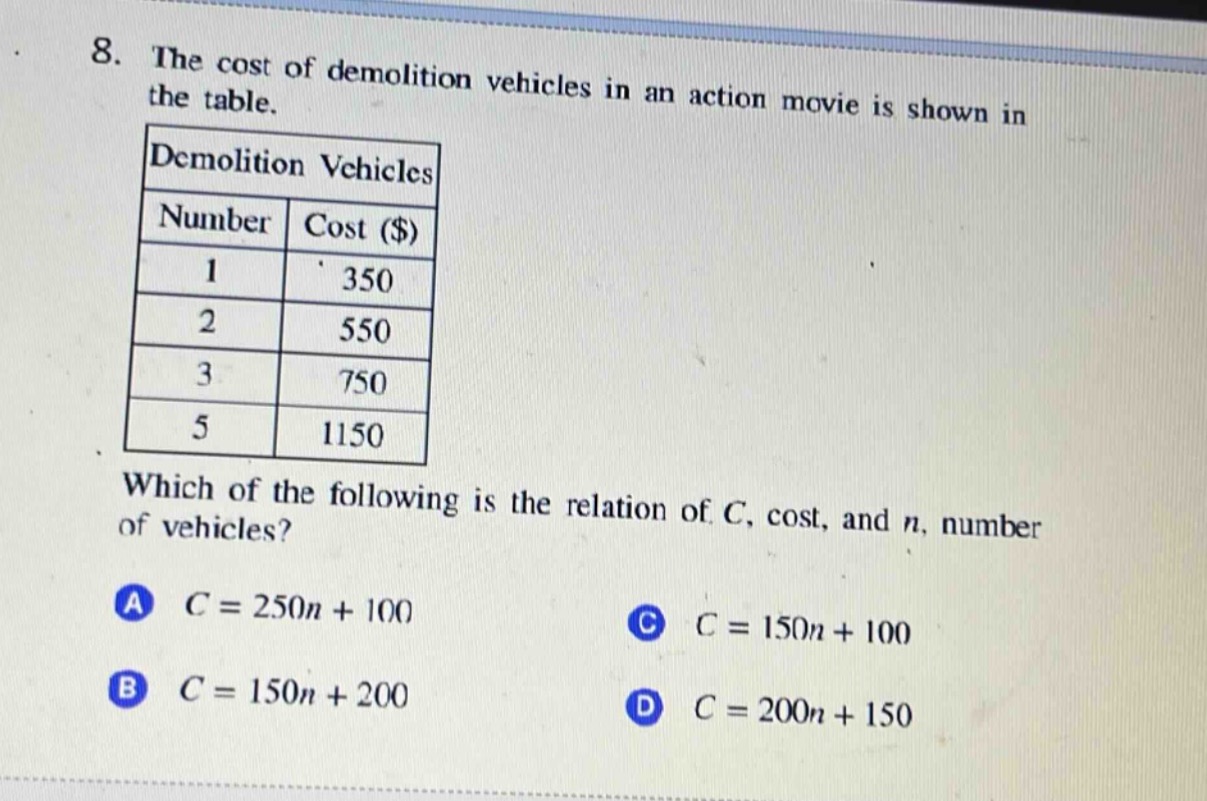
- the cost of demolition vehicles in an action movie is shown in the table.
demolition vehicles
number | cost ($)
1 | 350
2 | 550
3 | 750
5 | 1150
which of the following is the relation of c, cost, and n, number of vehicles?
a $c = 250n + 100$
b $c = 150n + 200$
c $c = 150n + 100$
d $c = 200n + 150$
Step1: Test Option A with n=1
Substitute \( n = 1 \) into \( C = 250n + 100 \).
\( C = 250(1) + 100 = 350 \). This matches the first data point. Let's test another.
Step2: Test Option A with n=2
Substitute \( n = 2 \) into \( C = 250n + 100 \).
\( C = 250(2) + 100 = 600 \). But the table says for \( n = 2 \), \( C = 550 \). So A is wrong.
Step3: Test Option B with n=1
Substitute \( n = 1 \) into \( C = 150n + 200 \).
\( C = 150(1) + 200 = 350 \). Matches n=1. Test n=2.
Step4: Test Option B with n=2
Substitute \( n = 2 \) into \( C = 150n + 200 \).
\( C = 150(2) + 200 = 500 \). But table says 550. So B is wrong.
Step5: Test Option C with n=1
Substitute \( n = 1 \) into \( C = 150n + 100 \).
\( C = 150(1) + 100 = 250 \). Wait, no, that's 250, but table says 350. Wait, no, wait, 1501 + 100 = 250? No, 150+100=250? Wait, no, I must have miscalculated. Wait, 1501 + 200? No, wait the option C is \( C = 150n + 100 \)? Wait no, wait the first data point is n=1, C=350. Let's recalculate. Wait, maybe I made a mistake. Wait, let's check the slope first. The slope between n=1 (350) and n=2 (550) is (550 - 350)/(2 - 1) = 200? No, 550-350=200, 2-1=1, so slope 200? Wait no, 550-350 is 200? Wait 350 to 550 is 200, 550 to 750 is 200, 750 to 1150: 1150 - 750 = 400, and 5 - 3 = 2, so 400/2=200. Wait, so the slope is 200? Wait but the options have 150, 200, 250. Wait, maybe I misread the table. Wait the table: n=1, C=350; n=2, C=550; n=3, C=750; n=5, C=1150. So the difference between n=1 and n=2: 550-350=200. n=2 to n=3: 750-550=200. n=3 to n=5: 1150-750=400, which is 2200, since 5-3=2. So the slope (rate of change) is 200? But the options have 150, 200, 250. Wait, but let's check the options again. Wait option D is \( C = 200n + 150 \). Let's test n=1: 200(1)+150=350. Perfect. n=2: 200(2)+150=550. Perfect. n=3: 200(3)+150=750. Perfect. n=5: 200(5)+150=1150. Perfect. Wait, but earlier I thought option C was 150n + 100, but that was a miscalculation. Wait, let's re-express. Wait the user's options: A: 250n +100, B:150n +200, C:150n +100, D:200n +150. Let's test D: n=1: 2001 +150=350. Correct. n=2: 2002 +150=550. Correct. n=3: 2003 +150=750. Correct. n=5: 2005 +150=1150. Correct. So the correct answer is D. Wait, but earlier when I tested option C, I must have miscalculated. Let's check option C: n=1: 1501 +100=250≠350. So C is wrong. Option D: n=1: 200+150=350. Correct. n=2: 400+150=550. Correct. n=3: 600+150=750. Correct. n=5: 1000+150=1150. Correct. So the correct answer is D.

Snap & solve any problem in the app
Get step-by-step solutions on Sovi AI
Photo-based solutions with guided steps
Explore more problems and detailed explanations
D. \( C = 200n + 150 \)